Wine Culture and Information since 2002 - Volume 22
Wine Culture and Information since 2002 - Volume 22 |
 |
× |
 DiWineTaste on Instagram
  DiWineTaste Mobile for Android
DiWineTaste Mobile for iOS
Become a Registered User
Subscribe to the Mailing List
Tell a Friend About DiWineTaste
Download DiWineTaste Card
DiWineTaste Mobile for Android
DiWineTaste Mobile for iOS
Become a Registered User
Subscribe to the Mailing List
Tell a Friend About DiWineTaste
Download DiWineTaste Card
|
Issue 22, September 2004 |
Contents |
|
|
EnoForum: Our Forum About Wine |
|
A nice surprise is waiting DiWineTaste's readers in our site. We thought about a gift for all the readers coming home from their vacation and that will finally share it with all the ones who stayed home and that already had the chance to enjoy this surprise in advance. During August we in fact released a new service in our site in the hope it will be useful to the community of DiWineTaste's readers and that will allow them to express their opinion about the wine subject. EnoForum is the new forum DiWineTaste has dedicated to our loved beverage of Bacchus, a meeting place for all wine lovers where it will be possible to share opinions and grow up together, sharing one's own experiences with the others while enriching his or her own culture with everyone else's opinions. After all - every wine lover knows this - wine is a pleasure that should be shared with friends and all the people one cares of: the pleasure of uncorking a bottle together is a moment of social communion and a tribute to the good company. EnoForum - this is the name we have chosen for our forum about wine - is available in our site at the address www.DiWineTaste.com/english/EnoForum.php and it is also accessible by the menu found in every page of the site. Browsing the forum is free to all visitors, whereas in order to actively take part - that is to create new topics and posting messages - it is required to be registered users. The registration to EnoForum is free and allows the creation of a personalized user profile as well as allowing the full access to every EnoForum function related to the management and posting of messages. The registration procedure is very simple and it only takes few minutes as well as entering specific information about your user profile. After having filled in the form, the system will send to your e-mail address the activation code that will allow the completion of the registration. It will be enough to click on the WEB address found in the e-mail message and the registration procedure will be completed: the new user will be activated and will have full access to EnoForum. Being registered user in EnoForum - as well as allowing the active participation to the many discussions - allows the personalization of the user profile, such as choosing an identifying image, a signature for messages, messages view mode and the time zone of your country. Choosing the correct time zone adopted in the user's country allows a consistent and adequate chronological view according to the user's habits. EnoForum uses GMT time (Greenwich Mean Time) as a reference for dates and times attributed to forum's messages in order to offer an universal reference to all visitors, in particular to all the visitors of the English version of our site. By choosing the correct time zone in the user profile, EnoForum will show dates and times according to this parameter, therefore providing the user a more consistent view of the forum activity. Moreover EnoForum makes use of user ranks which are regulated by the number of messages posted in all forums. This rank simply represents the assiduity of a user, therefore the more the message posted, the higher the rank. Registered users can also start new topics - discussion places related to the same subject - in which all EnoForum's registered users can express their opinions. We thought about EnoForum as an open place of discussion about wine where everyone - while respecting the opinion and dignity of others - can express his or her point of view about the subject of wine as well as sharing it with others. But also a place where we all can grow up together while improving our knowledge about the vast and charming world of wine. We wish EnoForum to become all that, a reference point for DiWineTaste's readers where they can meet and talk about wine in the aim of spreading and improving the worldwide wine culture. We certainly understand that talking about wine and tasting wine are two completely different things: thousand words or million of words will never be enough to explain something that only senses can make everyone understand in just a moment. However we are aware of the fact that remaining hidden in one's own shell without having the privilege of sharing what one is or has, is something silly that only a fool cannot understand. This is another reason which convinced us to release EnoForum in the aim of having people to share their experiences with everyone: what one has can be useful to everyone and what everyone has can be useful to someone. We invite you to visit EnoForum's pages and to become a registered user by filling in the registration form: you will then have full access to all forums about wine already available and to all the others available in future. We remind you the registration is free and it only takes few minutes of your time. EnoForum is available in two distinct versions: one in the Italian section of the site and the other in the English version. There are no functional differences between the two versions and both offer the very same functions. The only difference is about the language to be used in forum's topics and - in a more specific way - the English version is destined to all readers and visitors who live in every country of the world and that however speak English. It should be however observed the registration to EnoForum allows users to have full access to both linguistic versions, therefore a user who has registered in the Italian version can also take part to the English version of EnoForum and vice versa. The only recommendation is to make use of the appropriate language according to the EnoForum version. A final word should be said for the EnoForum software project: we would like to remember all of our readers and all visitors that the current version just represents a starting point and not a final destination. In “technical” terms, it is only the first release which will certainly be improved and developed in the next months, also thanks to your support. The current version already has many characteristics and functions in order to allow a full and functional usage for browsing and managing messages. Like always, your support, your suggestions and feedback will be extremely useful in order to improve this new service. After all, this is just another step of our journey and we hope it will take us ahead - we certainly wish together with you all - in order to fulfill one of our goals which was - and still is - the spreading of wine culture. We sincerely wish this new service will be useful and appreciated for you all and that will be for all of us a place where sharing and understanding wine better as well as sharing opinions and experiences. Enjoy EnoForum!
|
||||
MailBox |
|
In this column are published our reader's mail. If you have any comment or any question or just want to express your opinion about wine, send your letters to our editorial or fill in the form available at our site.
|
| I often hear saying fish goes with white wine and this seems to be a very common habit and practically indisputable. Why fish cannot be matched to red wines? |
| Kathleen Gordon -- Portland, Oregon (USA) |
| Probably the most famous saying concerning the world of wine is the one you mentioned, that is “fish goes with white wine”. Indeed this certainly is an approximate and too much common assertion which is well established in people's habits. Fish can be happily matched to red wine, provided the type of fish, the type of cooking and the wine are going to be carefully evaluated, in other words - of course - they should be followed the fundamental rules applied to any wine-food matching. It is more likely red wines are prejudicially excluded from the possibilities of the matching with fish because of the metallic taste that can be often perceived in this matching, therefore believing - erroneously - this is simply the norm. The metallic taste is probably caused by a chemical reaction between phosphates contained in fish and iron traces bound to the tannins of wine, in particular to pigments. This could explain the reason why red wine is frequently avoided with fish, however this inconvenience only happens with tannic red wines. In case a red wine is not tannic - such as many Pinot Noirs - it can be happily matched to fish, or better to say, with certain recipes made of fish. Non tannic red wines - or moderate tannic red wines - can be well matched to fish prepared with elaborated and succulent cooking techniques, such as roasted fish, stewed fish and elaborated fish soups. |
| Is the glass used for wine tasting really important or is it just a simple suggestion? |
| Helmut Schweinhardt -- Rüdesheim (Germany) |
| Dear reader, maybe the huge attention paid on wine glasses has made people believe it is just a fashionable accessory, without having other technical functions saved the utility of containing the wine to be tasted. Indeed the shape and size of a glass play a determinant and fundamental role in the correct perception and correct appreciation of wine's organoleptic qualities. The shape and size of a wine glass is not determined according to aesthetical or cultural tastes - even though we must admit these factors however play a role - indeed they are made according to specific technical, geometrical and mechanical considerations. In particular it is the ratio between the surface of contact of wine and the volume of air contained in the glass, as well as the quantity of wine in the glass and its volume. In case you wish to know more about the importance of wine glasses in the organoleptic tasting of wine, we suggest you reading the reports “ISO Tasting Glass”, “Wine Glasses” and “Wine Glasses” available at our WEB site and in DiWineTaste's back issues. |
ChampagneNot only a charming wine which enchants since centuries the lovers of the nice drinking and of well living with its joyous chains of bubbles, but above all a great wine which owes its quality to the area from which it is from: Champagne |
|
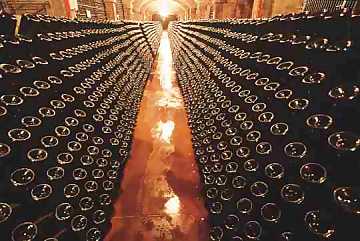
Whoever is into the wine world or is totally uninterested in the beverage of Bacchus - with no distinctions - has already heard talking about Champagne for at least one time, of the magic the uncorking of a bottle of this wine can make, of its fame and of its elegance. Since centuries it is identified as the indisputable emblem of special occasions and of “fashionable living and luxury”, Champagne practically belongs since ever to the narrow class of wine élite. Whether Champagne is a great wine is certainly undeniable, whether every Champagne is of high quality is disputable instead, whether Champagne owes its elegance and its great class to the area in which it is produced - the Champagne - is absolutely true. In almost every wine country of the world are being produced sparkling wines with the method of refermentation in bottle and with the very same grapes used in Champagne, however the class and elegance of these best wines is in most cases incomparable to the best Champagnes. Could it be that Champagne is therefore the best sparkling wine in the world? This is cannot be said - as already mentioned not all Champagnes are of good quality - even because other classic method sparkling wine producers are capable of making products of very high quality, however it is undeniable the great condition offered by the environmental and climate factors of Champagne play a determinant role of primary importance. Just like any other wine, even for Champagne it is necessary to make a selective evaluation based on the reliability and seriousness of producers: not all Champagnes are of high quality - and we remind this once again - quality is always and however a concept which is realized thanks to the principles and to the seriousness of a producers. The production area of Champagne is located 150 kilometers north-east from Paris (about 95 miles) and it is among the most northern quality wine areas of the world. In Champagne there are currently about 15,000 viticulturists who provide their grapes to about 110 maison which they use to make the famous and celebrated wine renowned all over the world. Wine history of Champagne does not begin - as it can be suggested by the famous legend of abbot Dom Pierre Pérignon to whom is recognized the invention of Champagne - indeed it was earlier, exactly during the times of the Roman Empire, when they were introduced the first techniques of wine making. Some archaeological evidences suggest the vine was already present in Champagne during the tertiary era - a species called vitis sezannensis and now extinct - of which - of course - it is not known whether it survived in later eras and the local people used this vine to make wine with its grape. The history of the enology in Champagne begins with the arrival of Romans and with the introduction of Christian culture and religion to the Gauls people.
The production of wine in Champagne therefore begins during the age of Roman Empire, however it will be necessary to wait until the seventeenth century in order to have that frothy wine rich in bubbles which we identify today with Champagne. Legend has it that it was Dom Pierre Pérignon to “invent” Champagne, however today we know the merit of this “discovery” is not recognizable to this important figure only. What it is certain is that Dom Pérignon has played a very important role in the development and the improvement of this great wine. Champagne probably is the result of a series of circumstances which took place thanks to the particular environmental and climate conditions of the area and that were used - and controlled - by the many producers until the half of 1800's when it was produced for the first time what we call today “Champagne”. Concerning the particular production method - of which the legend recognizes the paternity of this invention to Dom Pérignon - it should be remembered the Italian Francesco Scacchi - a doctor from Fabriano (Italy) who lived in the seventeenth century and now almost forgotten - who wrote in his work De salubri potu dissertatio (on the healthy beverages) some considerations about the production of sparkling wines and slightly sparkling wines. First of all it is necessary to remember the Champagne area - besides taking advantage of the exceptional environmental conditions for the production of bubbly wines - it is located to a latitude with a pretty cold climate and this greatly influences the production of wine. In fact the low temperatures in autumn and wintertime of Champagne cause the interruption of alcoholic fermentation as the cold has the effect of inhibiting the action of yeast. The interruption of alcoholic fermentation because of cold temperatures - besides blocking the activity of yeast - also keeps a high quantity of sugar in the wine, and sugar - as it is commonly known - is the precious element yeast transforms into alcohol and thanks to it they can stay alive therefore ensuring their biological functions. With the arrive of springtime - and hence with the increasing of temperature - yeast wake up from its “lethargy” and having some sugar available it resumes its job, in other words, the alcoholic fermentation restarts. This process - as it is known - produces a carbon dioxide as a byproduct which, being trapped in the bottle, gets solubilized to the wine, the internal pressure raises and this frequently causes the explosion of the bottle. In the beginning this was a serious problem for Champagne producers and they certainly were not happy of the fact their wines were “frothy”, so different and strange from the ones produced in the neighboring enological “rival”: Bourgogne. So, what was the role played by Dom Pierre Pérignon in Champagne? Dom Pérignon (1638-1715) was a Benedictine monk who not only played a fundamental role for the improvement of Champagne wines, he can also be considered the father of high quality enology whose teachings are still in use today, not only in the Champagne area. When he was 29 years old, Dom Pierre Pérignon was sent to the famous abbey of Hautvillers and in 1668 he was named procurator, that is administrator of the goods of the abbey, including wine. It seems Dom Pierre Pérignon did not drink wine, however he was a talented wine maker and merchant. To Dom Pérignon - and to the monks who worked with him - is to be recognized the improvement of white vinification of red grapes, considered today a fundamental practice for the production of Champagne. It is said Dom Pérignon was very exacting and strict about the cultivation of vines and the wine making procedures: he was aware of the fact the improvement of the wines of Champagne required very strict rules. He set strict rules about the cultivation of vines in order to aim to a drastic decrease of yields while increasing the concentration in wines and demanded grapes were to be pressed soon after harvesting, to be strictly done before ten o'clock in the morning. These concepts are still today associated to quality wine making. Dom Pérignon was the first one to vinify and keep separated the grapes from specific vineyards, he believed any single vineyard was capable of giving its unique and specific qualities: in other words he was the first one to apply the concept of cru. He was also the first one to support the idea it was better to bottle the wine soon after it was ready instead of leaving it in casks. These all are concepts and principles still in use today for high quality wine making. The result of all this “strictness” was a dramatic and huge improvement of Champagne wines, so high that they even rivaled with the neighboring Bourgogne. However it should be remembered Dom Pérignon did not want his wines to become sparkling, indeed he tried as hard as he could - without succeeding in this - in order to avoid this “deprecable” inconvenient: just like every other wine maker of that time, he knew that in case a wine became sparkling, something wrong surely happened during production. Whether it is true Dom Pérignon did not invent Champagne the way we know it today, he however has the merit of having greatly improved the development of enology as well as setting the basis for what is now considered modern enology. It certainly is a remarkable thing. The legend also has it was Dom Pierre Pérignon to invent the assembling of wines - it is absolutely proved this was a very common practice before he was named procurator of Hautvillers - however, thanks to the conviction of vinifying separately the grapes from different vineyards, the assembling of wine was improved as well as more consistent and reliable. Concerning sparkling wines - or at least slightly sparkling wines - there are historical evidences which confirm they existed before Dom Pérignon and that “slightly sparkling wines” from Champagne were already known - and very appreciated - to the court of Stuarts in 1660 and it seems they were introduced in England in the beginning of 1600's. By considering the success of these “wines with bubbles”, as well as considering the impossibility of avoiding the restart of fermentation, producers of Champagne - including Dom Pérignon and Dom Ruinart, another famous name of Champagne - worked in order to take advantage of effervescence therefore producing a wine that was different from any other else and that was already successful. From a side effect it could be obtained a conspicuous commercial advantage. However the long way that will lead to the Champagne as we know it today is still long and rich in intuitions and experiences: it is more likely the Champagne produced at Dom Pérignon's times was unrecognizable from the one that we would usually expect today. One of the problems that seemed to have a difficult solution was the turbidity of wine because of the refermentation in bottle. In other words the Champagne at those times was turbid and certainly not brilliant like we are used to see it today. Until the beginning of the 1800's the most common practice was to decant Champagne from one bottle to another until sediments were eliminated. This method had however the disadvantage of dissolving effervescence, therefore the wine became flat and with no bubbles. We need to wait 1818 when an employee of the famous Clicquot widow (veuve Clicquot) developed a system still known today with the name of rémuage, that is the system of rotating and shaking bottles in order to have the sediments to slip towards the neck so it can be easily eliminated. Moreover, the first Champagnes were sweeter than the ones known today. The adding of the dosage practically was a need in order to mask the strong acidity and harshness of wine. As the production techniques improved, likewise the quality of Champagne improved as well and the sweetness progressively diminished until having the so called brut, a goal that could be reached only around the half of 1800's. In the beginning brut Champagnes were not accepted - it probably was too early to introduce such a drastic change in taste from sweet to off-dry and brut - however this is the reference style of Champagne today and few producers now make demi-sec or sweet styles.
|
||||||||
|
The current region of Champagne - the one in which is legally allowed the production of Champagne - was defined and delimited in 1927 by INAO (Institut National des Appellations d'Origine, National Institute for Appellations of Origin). There are currently about 15,000 viticulturists in the Champagne area who sell their grapes to 110 Maison de Champagne which they use for the production of the renowned wines with bubbles. Some viticulturists - about 5,000 - besides selling their grapes to the maison, keep part of the grapes in order to make their own Champagnes and the result of these small producers can be frequently considered extraordinary. Champagne is classified according a system - called Echelle des Crus (scale of cru) - and known as vineyard classification. This classification was defined in 1911 according to the quality of every single cru as well as by its distance from the commercial heart of Champagne, Reims and Epernay. The system basically classifies the many communes of Champagne according to the commercial value of the grapes cultivated in its area which is expressed with a percentage value. Communes are classified in three categories: Grand Cru (100%), Premier Cru (90-99%) and Cru (80-89%). The percentage value defines the commercial value of grapes - and therefore their quality - based on the price set for Champagne grapes. This means that grapes coming from a Grand Cru commune - whose classification if 100% - will be exactly paid to the full price. Grapes coming from a commune that, for example, is classified as 85%, will be paid 85% of the reference price. In practical terms in case the reference price is set, for example, to € 10, grapes coming from a Grand Cru commune will be paid € 10, whereas the ones coming from 85% communes will be paid € 8,50. There are currently only 17 communes classified as Grand Cru, 41 as Premier Cru and the remaining 255 as Cru. The 17 Grand Cru of Champagne are: Louvois, Bouzy, Ambonnay, Verzy, Verzenay, Mailly-Champagne, Beaumont-sur-Vesle, Sillery and Puisieulx (Montagne de Reims); Aÿ and Tours-sur-Marne (Vallée de la Marne); Oiry, Chouilly, Cramant, Avize, Oger and Mesnil-sur-Oger (Côte des Blancs). Champagne is produced in many styles and each one of them is created with a base wine - called cuvée - made of different wines from different vintages, in case of the so called Sans Année or Non Vintage, or from many wines belonging to the same vintage for the so called Millésime or Vintage. The cuvée is generally made of a variable number of wines ranging from 30 to 60, or even more. Champagnes made from a single type of wine represent - as a matter of fact - an exception. According to the grapes and the technique used for the production, Champagnes can belong to different categories. The majority of them belong to the “generic” category of Champagne and are usually produced with all the three grapes allowed by the disciplinary: Chardonnay, Pinot Noir and Pinot Meunier. Champagnes exclusively produced with Chardonnay are defined as Blanc de Blancs (White from Whites); the ones exclusively produced with red berried grapes, that is Pinot Noir and Pinot Meunier, alone or together, are defined as Blanc de Noirs (White from Blacks). A special mention goes to Champagne Rosé, considered by connoisseurs as the most refined and elegant one. These Champagnes - usually more expensive - have their pink color because of the presence of a small quantity of red wine - and this is the most common and modern practice - or because of the traditional production technique called saignée (bleeding) which is used today only by very few Maison de Champagne. The process and the phases for the production of Champagne are not covered in this report. We however suggest readers to read other reports published in DiWineTaste about the production of sparkling wines. In every Champagne label is found a code which deserves proper attention in order to be understood. This code is usually found in the bottom of the label and it is made of two letters followed by a number. The meaning of the first part can be interpreted as follows:
|
||||
|
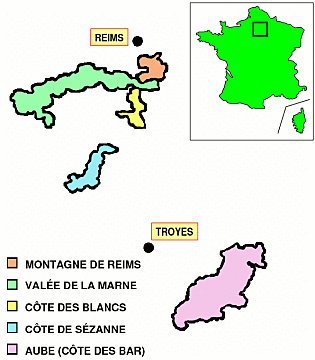
Champagne owes its fame and its quality mainly to the favorable climate and environmental conditions. The Champagne climate is often critical for the ripeness of grapes - rain, humidity, winter frosts and mold are frequent risks in this area - and for this reason vines are trained low in order to benefit from the heat reflected by the soil. The soil of Champagne is made of sediments of chalk and this forces the vine to dig very deep in the ground in order to search for water. Chalk is also very porous and therefore it is capable of keeping water therefore ensuring the vine a good condition for survival, however it does not offer the best fertile and vegetative conditions. As it is known, the vine is capable of giving the best results in difficult conditions. Grapes cultivated in Champagne and from which can be produced the renowned wine are Chardonnay - responsible for finesse and elegance - Pinot Noir - responsible for structure and aromas - and Pinot Meunier, to which is recognized the merit of increasing the aromatic complexity and richness of fruits as well as structure. Champagne is divided into five production areas: Montagne de Reims (Mountain of Reims), Côte des Blancs (Hillside of Whites), Vallée de la Marne (Valley of Marne), Côte de Sézanne (Hillside of Sézanne) and Aube (or Côte des Bar). Of these five areas the most important ones are those neighboring Reims and, as a matter of fact, represent the heart of Champagne: Montagne de Reims, Côte des Blancs and Vallée de la Marne, in which are found all the 17 Grand Cru (100%) communes. In the Montagne de Reims is mainly cultivated Pinot Noir and Pinot Meunier as well as a small part of Chardonnay; in the Côte des Blancs - as the name suggests - is almost exclusively cultivated Chardonnay, the only white berried grape; in the Vallée de la Marne it is Pinot Meunier to be the dominant grape; in the Côte de Sézanne - south from the main area - is mainly cultivated Chardonnay; in the Aube (or Côte des Bar) - the most southern area of Champagne - is almost exclusively cultivated Pinot Noir. Grapes used for the production of Champagne come from one or more of these areas, and base wines suited for the production with the Méthode Champenoise usually have not truly inviting organoleptic qualities - saved the aromas - in case are tasted before the beginning of the refermentation in bottle. In fact wines used for the cuvée generally are pretty acid with few alcohol: it will be the talent and experience of the persons who will choose them to imagine their elegant transformation that will enrich them with complex aromas and charming elegance - last but not the least - with enchanting bubbles.
|
RieslingCapable of giving its best in cool climates and with a good exposition to the sun, Riesling is among the most prestigious and elegant wines of the world whose wines are among the most longeval of the category |
|
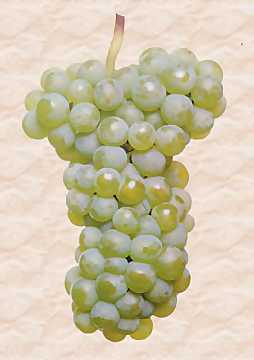
Welcome to the prestigious world of refined and elegant white wines! Talking about Riesling - or better to say, about good wines made of Riesling - this is a consideration which certainly seems to be adequate. Riesling - whose origins are from Germany - is now considered an “international” grape highly praised for its extraordinary elegance, its class and, in particular, for the surprising capacity of aging of its wines which can magnificently improve for many years. In fact the best Rieslings, thanks to the high acidity of this grape and the remarkable quantity in extracts, can even age for some tens of years, practically a record shared with other very few examples of the same category. Riesling is pretty looked for both by wine lovers and producers, and despite the fact this grape gives its best in areas with a cool but sunny climate, today it is virtually present in every country of the world. It is not clear what was the exact area of origin of Riesling and the current theories suggest it could have been originated from the Rhein, Mosel or Palatinate (Pfalz) areas, all located in Germany. Historical and reliable documents tell that Riesling was known and widely cultivated in the areas along the course of Rhein since the fifteenth century, however other reliable sources suggest it was already cultivated in the ninth century because of an order of Ludwig the Germanic. Moreover other sources support the theory Riesling was already cultivated in Germany 2,000 years ago: in case this hypothesis is to be confirmed, Riesling should be considered among the most ancient grapes of this country together with Elbling, Silvaner and Räuschling. The importance of Riesling has been obscured by many other varieties obtained by crossing Riesling with other vines. This is the case of Müller Thurgau, whose notoriety was such that viticulturists uprooted Riesling from their vineyards and replaced it with this vine. In 1980 Riesling represented only 19% of the total acreage of Germany and ten years later - in 1990 - it was just 21%.
The rigid winters of the 1990's have however exalted the resistance qualities of Riesling as opposed to the “new species” and the efforts made in order to improve the quality of wines by the wineries which were historically producing Riesling, have contributed on the long run to the superiority of this important white berried grape. Riesling is a vine which tends to produce abundant yields and - surprisingly - it keeps remarkable levels of acidity even when reach full ripeness. The notoriety of Riesling is also because of the excellent results obtained by producers in Mosel-Saar-Ruwer - or Mosel in short - where about one third of all German Riesling is being produced. Riesling has also been used for creating new crossings and, in particular, with Silvaner it gave origin to many species of which the most famous ones are Müller Thurgau, Ehrenfelser and Scheurebe. Moreover the Incrocio Manzoni 6.0.13 grape - particularly common in north-eastern Italy - is the result of the crossing between Riesling and Pinot Blanc. Riesling is a variety having an excellent resistance to cold temperatures, for this reason it is the most cultivated grape in cool climate areas. However Riesling needs proper care and conditions in order to give its best. The quality of Riesling seems not to suffer of its tendency to produce abundant yields, however the best Rieslings are the ones produced with low yields harvests. Riesling is very resistant to winter frosts and it is a variety defined as late ripening, in fact the harvesting of its grapes - in the northern hemisphere - is usually done after the half of October and the beginning of November. Riesling has a small and pretty compact bunch and for this reason it is very sensitive to the effects of molds which frequently result in serious problems for viticulturists. In warm climate areas Riesling seems not to produce good results. In these areas the ripening of grapes is faster and this frequently influence the quality of wines by producing coarser and less elegant aromas. In cool climate areas - where Riesling can ripe slowly - this grape develops elegant aromas and intense flavors while keeping a high level of acidity. For this reason the best Riesling of the world are believed to be the ones from Germany and in particular the ones produced in the coolest areas of Mosel-Saar-Ruwer (Mosel). It is believed Riesling can give its best in slopes having an ideal inclination of 30° in order to take advantage of the incidence of sun rays and the heat reflected by the surface of rivers. Vineyards in Mosel producing the best Riesling are however exposed towards south and shielded by the cold winds in order to ensure the best ripening conditions of grapes. Riesling is now present in many countries of the world and it is frequently called with different name while remaining the very same variety. In the United States of America it is usually called Johannisberg Riesling and occasionally White Riesling or Rhine Riesling. In Italy is frequently called Riesling Renano and it should be observed the grape called Riesling Italico - known somewhere else as Welschriesling - has no connection with Riesling. Wines produced with Riesling probably represents the magnification of enology based on inert containers. In fact the majority of Riesling wines is produced without making use of any casks or barriques and despite the fact there are producers outside Germany who allow their Riesling to age in cask, this method represents, as a matter of fact, the minority. The styles of wines produced with Riesling are many, from dry wines to sweet wines, of which the best representatives certainly are Trockenbeerenauslese (TBA) and Eiswein. Thanks to Riesling acidity, this excellent German sweet wines are always well balanced and never sickly. It should however be observed the overall tendency in the production of Riesling wines is to diminish the quantity of residual sugar therefore producing dry wines. The alcoholic percentage in Riesling wines is generally low and rarely can be found a Riesling with a high alcohol percentage. For example, German Riesling usually has an alcoholic percentage of about 7-9% and even in other areas they rarely goes beyond 12%. Thanks to its remarkable acidity and to the high content in extracts, wines produced with Riesling can stand to long aging times in bottle and in higher quality wines it can also reach some tens of years while improving their organoleptic qualities. Wines of lesser quality rarely goes beyond three years of aging in bottle.
|
||||||||
|
The analysis of colors in wines produced with Riesling will consider the specific style of the wine. In young dry wines not aged in wood containers - that is the majority of cases - the color of Riesling wines will always show greenish yellow hues and nuances of the same color. Rarely in young dry wines can be observed straw or golden yellow colors saved when the wines were aged in wood containers such as the barrique. Riesling - when it is being produced with quality criteria and kept in optimal conditions - can be aged in bottle even for many years. In this case the color tends to show the usual development of any other white wine with straw or golden yellow hues. Pretty different considerations are to be made - of course - for sweet wines produced with Riesling, typically from Germany and Austria and in particular for Auslese, Trockenbeerenauslese and Eiswein styles. In these wines the typical color is golden yellow and as the concentration and the ripeness of grapes increases - as well as the aging time - they can easily get amber yellow color of remarkable intensity.
|
|
Among the amazing characteristics of Riesling we certainly find its aromas. However it should be remembered the best way to appreciate Riesling is waiting. Contrary to the majority of dry white wines - like to say the totality of them - young wines produced with Riesling usually reveal the common and typical aromas of other white wines, in short, young Rieslings could be confused among many other wines. We are not saying young Rieslings are not interesting according to an olfactory point of view, however it should be remembered Riesling can give its best after a proper aging in bottle in which its aromas get more intense and more complex. Young Rieslings produced with not fully ripen grapes or cultivated in cool climate areas, denote pretty “sour” fruity aromas of green apple, lemon, lime, cedar and citrus fruits, as well as floral aromas of hawthorn, jasmine, wistaria and chamomile. Wines produced in certain areas - such as German Mosel - also have mineral hints because of the soil which are added to the aromatic hints mentioned above. Rieslings produced with ripe grapes, or cultivated in warm climate areas, reveal more round and less sour aromas in which can be perceived peach, pear, grapefruit, apricot, apple as well as tropical fruit. Like we already said, wines produced with Riesling, both dry and sweet, can excellently age while improving their organoleptic qualities. With the aging Riesling wines develop aromas of butter, honey, wax as well as an elegant and looked for aroma of petrol oil and, even this can sound pretty strange, in Riesling wines is very pleasing. In sweet wines, and in particular in those produced with grapes affected with Botrytis Cinerea - or noble rot - can also be found aromas of spices, such as cinnamon, ginger and anise, aromas of musk, dried fruit, in particular dried apricot, walnut and almond, as well as fruit jams such as apricot and peach. Sometimes it is also possible to find vegetal and herbaceous aromas such as sage, thyme, nettle, tobacco and tea. Despite the fact this style of Riesling are not very common, in wines aged in cask - certainly a minority - can also be found aromas of vanilla and toasted wood.
|
||||
|
By considering the rich variety of styles produced with Riesling, the gustatory qualities of these wines are equally rich. In dry wines the acidity will be the most dominant taste as well as any possible mineral flavors: for these two characteristics - as well as the typical aromatic qualities - wines from German Mosel are usually defined as “wines of steel”. Despite the high - and certainly agreeable - acidity, these wines are however balanced, with a truly pleasing crispness. Acidity is also the essential factor which contributes in a determinant way to the balance of German sweet wines - such as Trockenbeerenauslese and Eiswein - while avoiding the remarkable sweetness to taste sickly. Alcohol in wines produced with Riesling is never too high - rarely is beyond 12% - and in German wines the typical alcohol level is of about 7-9%, whereas for sweet wines - in particular the ones produced with grapes affected by Botrytis Cinerea - the alcoholic percentage is even lesser, most of the times 6-7%. The gustatory elegance and the balance of these sweet wines remains however a solid reference point for the wines of this category.
|
|
Despite the fact Riesling is now spread in many wine countries of the world, its homeland - Germany - still remains the reference point for all the other producers. In this country Riesling is used for the production of many styles of wines, from dry wines to sweet ones. The best German Rieslings are certainly from Mosel-Saar-Ruwer - Mosel in short - followed by Palatinate (Pfalz), Rheingau, Nahe and Rheinhessen. Despite the German tradition is based on the production of wines having an appreciable quantity of residual sugar, the current tendency is to make very dry wines. However they are the wines belonging to the Kabinett, Spätlese and Auslese categories to catch the interest of wine lovers. These wines have a pretty low alcoholic percentage (7.5-9.5%) and an extraordinary balance between acidity, freshness and aromatic richness and certainly among the best representatives are the ones produced in Mosel, where today is being produced about 30% of German Riesling. In favorable years, wines produced in the Saar area are to be considered the best examples of Riesling of all Germany. In the central part of Mosel - at Bernkastel - Riesling wines are rounder and probably more immediate, whereas in the Ruwer area can be found Rieslings with intermediate styles between the two areas. The best wines of Mosel are also excellent when young, however it will be the aging in bottle to reveal their very best. In the Palatinate - thanks to a warmer climate - Riesling wines are more robust and spicy, whereas to the north - in the Rheinhessen - the style is rounder and smoother. In Rheingau are being produced excellent Riesling wines, elegant and refined of which the best examples are the ones having an appreciable residual sugar. In the Nahe area are found Rieslings that can be considered an in between style of Mosel and Rheingau. In Austria the best area for Riesling wine is Wachau where are being produced dry wines in the Smaragd style with alcohol percentages as high as 15.5%. In France Riesling offers excellent wines in Alsace, here produced in many styles - both sweet and dry - as well as in the Sélection de Grains Nobles and Vendange Tardive versions. New Zealand produces excellent Rieslings, in particular late harvests and wines produced with grapes affected by Botrytis Cinerea. Even in Australia the production of Riesling is remarkable and of high quality. Here the style is mainly for dry wines and with a very long aging potential, in particular the ones produced in Southern Australia in the areas of Clare Valley, Eden Valley and Adelaide Hills. Among other countries in which are produced wines with Riesling grapes there is Italy - in particular the Alto Adige region - Canada (mainly used for the production of Icewines) and United States of America in Washington and California states.
|
Wines of the Month |
|
|
Score legend Fair Pretty Good Good Very Good Excellent Fair Pretty Good Good Very Good Excellent Wine that excels in its category Wine that excels in its category Good value wine Good value winePrices are to be considered as indicative. Prices may vary according to the country or the shop where wines are bought |
|
|
Prosecco di Valdobbiadene Superiore di Cartizze 2003 |
|
| Ruggeri (Italy) | |
| Grapes: Prosecco | |
| Price: € 12,40 | Score: |
| This sparkling wine shows a brilliant greenish yellow color and nuances of greenish yellow, very transparent, good effervescence, fine and persistent perlage. The nose denotes intense, clean, pleasing and refined aromas that start with hints of banana, pineapple and litchi followed by aromas of acacia, wistaria, broom, green apple, pear, peach and almond. In the mouth has good correspondence to the nose, a crisp and effervescent attack, however well balanced, delicate, intense flavors, agreeable. The finish is persistent with flavors of pear, banana and pineapple. A well made sparkling wine. This Prosecco ages on its lees for 2 months and ages in bottle for 3 months. | |
| Food Match: Pasta and risotto with vegetables, fish and crustaceans, Sauteed fish and crustaceans, Dairy products | |
|
|
Prosecco di Valdobbiadene Giustino B. 2003 |
|
| Ruggeri (Italy) | |
| Grapes: Prosecco | |
| Price: € 10,20 | Score: |
| This sparkling wine shows a brilliant greenish yellow color and nuances of greenish yellow, very transparent, good effervescence, fine and persistent perlage. The nose reveals delicate, clean and pleasing aromas which start with hints of pear, apple and peach followed by aromas of pineapple, hawthorn, broom and litchi. In the mouth has good correspondence to the nose, a crisp and effervescent attack with slightly sweetness, however balanced, delicate, intense flavors, agreeable. The finish is persistent with flavors of pear and peach. This Prosecco is produced with the Charmat method and ages in bottle for 3 months. | |
| Food Match: Aperitifs, Vegetables and crustacean appetizers, Pasta and risotto with vegetables and crustaceans | |
|
|
Barbaresco Cottà 2001 |
|
| Sottimano (Italy) | |
| Grapes: Nebbiolo | |
| Price: € 30,00 | Score: |
| This Barbaresco shows an intense ruby red color and nuances of garnet red, little transparency. The nose denotes intense, clean, pleasing, refined and elegant aromas which start with hints of black cherry and plum followed by aromas of blueberry, dried violet, licorice, tobacco, vanilla, mace, menthol and hints of coffee and cocoa. In the mouth has very good correspondence to the nose, a tannic attack and pleasing crispness, however balanced by alcohol, full body, intense flavors, good tannins. The finish is very persistent with long and good flavors of black cherry and plum. A well made wine. Barbaresco Cottà ages for 18-20 months in barrique. | |
| Food Match: Game, Stewed and braised meet, Roasted meat, Hard cheese | |
|
|
Barbaresco Pajorè 2001 |
|
| Sottimano (Italy) | |
| Grapes: Nebbiolo | |
| Price: € 30,00 | Score: |
| Barbaresco Pajorè shows an intense ruby red color and nuances of garnet red, little transparency. The nose reveals intense, clean, pleasing, refined and elegant aromas which start with hints of cherry and violet followed by aromas of blueberry, plum, dried rose, tobacco, licorice, vanilla, cinnamon, cocoa and hints of rubber. In the mouth has very good correspondence to the nose, a slightly tannic attack and however well balanced by alcohol, full body, intense flavors, good tannins, agreeable. The finish is very persistent with long flavors of cherry, plum and blueberry. A very well made wine. Barbaresco Pajorè ages for 18-20 months in barrique. | |
| Food Match: Stewed and braised meat, Game, Roasted meat, Hard cheese | |
|
|
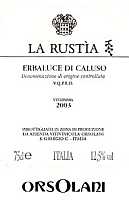
Erbaluce di Caluso La Rustia 2003 |
|
| Orsolani (Italy) | |
| Grapes: Erbaluce | |
| Price: € 8,90 | Score: |
| The wine shows a brilliant greenish yellow color and nuances of greenish yellow, very transparent. The nose reveals intense, clean, pleasing and refined aromas which start with hints of pear, litchi and honey followed by aromas of apple, peach, hawthorn, pineapple, broom, lemon and hints of mineral. In the mouth has good correspondence to the nose, a crisp attack and however balanced by alcohol, delicate, intense flavors, agreeable. The finish is persistent with flavors of peach, pear and lemon. A small part of this wine ferments in cask. | |
| Food Match: Fish appetizers, Dairy products, Eggs, Pasta and risotto with crustaceans and vegetables | |
|
|
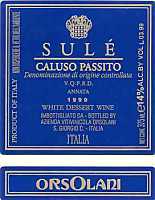
Caluso Passito Sulè 1999 |
|
| Orsolani (Italy) | |
| Grapes: Erbaluce | |
| Price: € 8,90 | Score: |
| This wine shows a brilliant amber yellow color and nuances of amber yellow, transparent. The nose reveals intense, clean, pleasing and elegant aromas which start with hints of dried fig and honey followed by aromas of dried apricot, candied fruit, quince jam, peach jam, date, orange marmalade, hazelnut, vanilla, saffron and hints of enamel. In the mouth has good correspondence to the nose, a sweet and round attack however well balanced, good body, intense flavors, agreeable. The finish is persistent with flavors of dried fig, honey and peach jam. A well made wine. Sulè ages for three years in barrique followed by one year of aging in bottle. | |
| Food Match: Confectionery, Hard and piquant cheese, Jam tarts | |
|
|
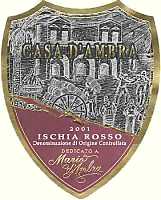
Ischia Rosso Riserva Mario D'Ambra 2000 |
|
| Casa D'Ambra (Italy) | |
| Grapes: Guarnaccia (50%), Piedirosso (Per' 'e Palummo) (50%) | |
| Price: € 14,50 | Score: |
| The wine shows an intense ruby red color and nuances of garnet red, little transparency. The nose reveals intense, clean, pleasing and refined aromas which start with hints of plum and black cherry followed by aromas of blackberry, licorice, violet, tobacco, vanilla and hints of cocoa and cinnamon. In the mouth has good correspondence to the nose, a slightly tannic attack and pleasing roundness, however balanced by alcohol, good body, intense flavors, good tannins. The finish is persistent with flavors of plum and black cherry. A well made wine. This reserve is aged in cask. | |
| Food Match: Broiled meat and barbecue, Stewed meat with mushrooms, Roasted meat | |
|
|
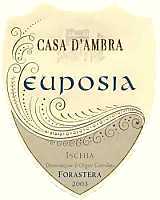
Ischia Forastera Euposia 2003 |
|
| Casa D'Ambra (Italy) | |
| Grapes: Forastera | |
| Price: € 7,80 | Score: |
| This wine shows an intense straw yellow color and nuances of greenish yellow, very transparent. The nose reveals intense, clean, pleasing and refined aromas which start with hints of pear and grapefruit followed by aromas of citrus fruit, hawthorn, broom, apple and plum. In the mouth has good correspondence to the nose, a crisp attack and pleasing sapidity, however balanced by alcohol, good body, intense flavors, agreeable. The finish is persistent with flavors of apple, pear and plum. | |
| Food Match: Broiled fish, Pasta and risotto with fish and vegetables, Sauteed fish | |
|
|
Collio Sauvignon Ronco dei Sassi 2003 |
|
| Ascevi Luwa (Italy) | |
| Grapes: Sauvignon Blanc | |
| Price: € 15,65 | Score: |
| This wine shows an intense straw yellow color and nuances of greenish yellow, very transparent. The nose denotes intense, clean, pleasing and refined aromas which start with hints of peach, elder and pineapple followed by good aromas of banana, passion fruit, broom, litchi, pear and hints of tomato leaf. In the mouth has good correspondence to the nose, a crisp attack and however well balanced by alcohol, good body, intense flavors, agreeable. The finish is persistent with flavors of peach, pineapple, litchi and passion fruit. A well made wine. This Sauvignon Blanc ages in steel tanks until the moment of bottling. | |
| Food Match: Fried fish, Pasta and risotto with crustaceans and fish, Vegetables soups, Eggs | |
|
|
Friuli Isonzo Tocai Friulano 2003 |
|
| Ascevi Luwa (Italy) | |
| Grapes: Tocai Friulano | |
| Price: € 9,00 | Score: |
| This wine shows a pale straw yellow color and nuances of greenish yellow, very transparent. The nose reveals intense, clean, pleasing and refined aromas that start with hints of plum, hawthorn and grapefruit followed by aromas of apple, pear, broom, peach and pineapple. In the mouth has good correspondence to the nose, a crisp attack and pleasing roundness, however balanced by alcohol, good body, intense flavors, agreeable. The finish is persistent with flavors of plum, pear and pineapple. This wine ages in steel tanks until the moment of bottling. | |
| Food Match: Sauteed and broiled fish, Pasta and risotto with fish, Sauteed meat | |
|
|
Franciacorta Pas Dosé 2000 |
|
| Cavalleri (Italy) | |
| Grapes: Chardonnay | |
| Price: € 18,50 | Score: |
| This Franciacorta shows an intense straw yellow color and nuances of golden yellow, very transparent, good effervescence, fine and persistent perlage. The nose reveals good personality with intense, clean, pleasing and elegant aromas which start with hints of yeast, grapefruit and citrus fruit peel followed by aromas of hawthorn, banana, bread crust, apple, hazelnut, praline and plum. In the mouth has good correspondence to the nose, a crisp and effervescent attack with pleasing roundness, however balanced, good body, intense flavors, agreeable. The finish is persistent with flavors of plum, grapefruit and banana. A small part of the cuvée ferments and ages in barrique. This Franciacorta ages for at least 36 months on lees. | |
| Food Match: Roasted fish and crustaceans, Pasta and risotto with fish and crustaceans, Roasted white meat | |
|
|
Franciacorta Satèn 2000 |
|
| Cavalleri (Italy) | |
| Grapes: Chardonnay | |
| Price: € 19,50 | Score: |
| This sparkling wine shows a brilliant straw yellow color and nuances of straw yellow, very transparent, good effervescence, fine and persistent perlage. The nose reveals intense, clean, pleasing, refined and elegant aromas which start with hints of yeast, bread crust and grapefruit followed by aromas of banana, brioche, apple, hazelnut, butter and plum. In the mouth has good correspondence to the nose, a crisp and effervescent attack, however well balanced, good body, intense flavors, agreeable. The finish is persistent with flavors of plum, grapefruit and hazelnut. A well made Franciacorta. Part of the cuvée ferments and ages in barrique. This Franciacorta ages for at least 36 months on lees. | |
| Food Match: Fried fish, Broiled fish and crustaceans, Pasta and risotto with fish and crustaceans, Sauteed white meat | |
|
|
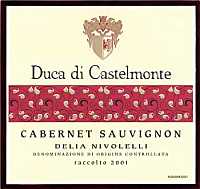
Delia Nivolelli Cabernet Sauvignon Duca di Castelmonte 2001 |
|
| Carlo Pellegrino (Italy) | |
| Grapes: Cabernet Sauvignon | |
| Price: € 9,30 | Score: |
| This wine shows an intense ruby red color and nuances of garnet red, little transparency. The nose reveals intense, clean, pleasing and refined aromas which start with hints of black cherry, violet and blackberry followed by aromas of black currant, blueberry, plum, licorice, vanilla and hints of menthol. In the mouth has good correspondence to the nose, a slightly tannic attack and however balanced by alcohol, good body, intense flavors, good tannins, agreeable. The finish is persistent with flavors of blackberry, black cherry and plum. This wine ages for 12 months in barrique. | |
| Food Match: Roasted meat, Stewed and braised meat, Hard cheese | |
|
|
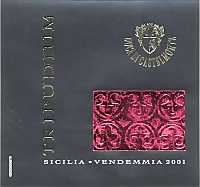
Tripudium Duca di Castelmonte 2001 |
|
| Carlo Pellegrino (Italy) | |
| Grapes: Nero d'Avola, Cabernet Sauvignon, Syrah | |
| Price: € 16,00 | Score: |
| This wine shows an intense ruby red color and nuances of garnet red, little transparency. The nose reveals intense, clean, pleasing and refined aromas which start with hints of black cherry and plum followed by aromas of blueberry, black currant, licorice, violet, vanilla and hints of mace and menthol. In the mouth has good correspondence to the nose, a slightly tannic attack and pleasing roundness, however balanced by alcohol, full body, intense flavors, good tannins. The finish is persistent with flavors of black cherry, plum and blueberry. A well made wine. Tripudium is aged for 12 months in barrique. | |
| Food Match: Roasted meat, Braised and stewed meat, Game, Hard cheese | |
|
|
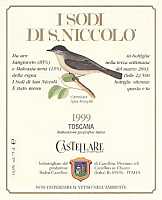
I Sodi di San Niccolò 1999 |
|
| Castellare di Castellina (Italy) | |
| Grapes: Sangiovese (85%), Malvasia Nera (15%) | |
| Price: € 42,00 | Score: |
| The wine shows a deep ruby red color and nuances of ruby red, little transparency. The nose reveals intense, clean, pleasing, refined and elegant aromas which start with hints of plum and black cherry followed by aromas of blueberry, blackberry, violet, licorice, tobacco, cocoa, cinnamon, vanilla and menthol. In the mouth has good correspondence to the nose, a slightly tannic attack and however well balanced by alcohol, full body, intense flavors, good tannins. The finish is persistent with flavors of plum, black cherry and blueberry. A well made wine. I Sodi di San Niccolò ages for 15-30 months in barrique followed by 12 months of aging in bottle. | |
| Food Match: Braised and stewed meat, Game, Roasted meat, Hard cheese | |
|
|
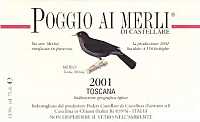
Poggio ai Merli 2001 |
|
| Castellare di Castellina (Italy) | |
| Grapes: Merlot | |
| Price: € 58,00 | Score: |
| Poggio ai Merli shows a deep ruby red color and nuances of ruby red, little transparency. The nose reveals personality with intense, clean, pleasing, refined and elegant aromas which start with good hints of plum, black cherry and rhubarb followed by good aromas of blackberry, black currant, dried violet, licorice, tobacco, vanilla, nutmeg and hints of cinchona and bell pepper. In the mouth has very good correspondence to the nose, a slightly tannic attack and pleasing smoothness, however well balanced by alcohol, full body, intense flavors, good tannins, very agreeable. The finish is very persistent with long and good flavors of black cherry, plum and black currant. A great and very well made wine. Poggio ai Merli ages for 15-30 months in barrique followed by 12 months of aging in bottle. | |
| Food Match: Braised and stewed meat, Game, Roasted meat, Hard cheese | |
|
|
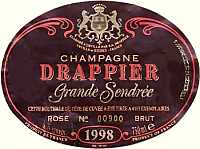
Champagne Grande Sendrée Rosé 1998 |
|
| Drappier (France) | |
| Grapes: Pinot Noir | |
| Price: € 51,80 | Score: |
| This Champagne shows a brilliant salmon pink color and nuances of salmon pink, very transparent, good effervescence, fine and persistent perlage. The nose reveals intense, clean, pleasing, refined and elegant aromas which start with hints of raspberry, cherry and yeast followed by aromas of tangerine, banana, brioche, butter, bread crust, hazelnut, dried rose, orange peel and hints of cinnamon. In the mouth has good correspondence to the nose, a crisp and effervescent attack, however well balanced, good body, intense flavors, agreeable. The finish is persistent with flavors of raspberry, cherry and tangerine. A well made Champagne. Grande Sendrée Rosé is produced with the bleeding technique (saignée). | |
| Food Match: Roasted fish, Stuffed pasta, Roasted meat, Broiled Fish and Crustaceans | |
|
|
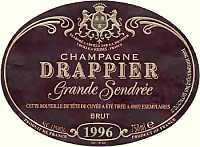
Champagne Grande Sendrée Brut 1996 |
|
| Drappier (France) | |
| Grapes: Pinot Noir (55%), Chardonnay (45%) | |
| Price: € 43,50 | Score: |
| This Champagne shows a brilliant golden yellow color and nuances of golden yellow, very transparent, good effervescence, fine and persistent perlage. The nose reveals good personality with intense, clean, pleasing, refined and elegant aromas which start with good hints of bread crust, honey and yeast followed by good aromas of banana, brioche, pineapple, butter, apple, litchi, grapefruit, orange peel, praline and hints of flint. In the mouth has very good correspondence to the nose, a crisp and effervescent attack with pleasing smoothness, however well balanced, good body, intense flavors, agreeable. The finish is very persistent with long flavors of honey, banana, grapefruit and brioche. A great Champagne. | |
| Food Match: Roasted fish, Stewed fish, Roasted meat, Stuffed pasta | |
I BorboniThe firm will of revaluating Asprinio, the renowned and ancient grape of the Aversa territory, is just one of the merits of this interesting winery to the contribution for the keeping of the ancient wine making tradition in Campania |
|
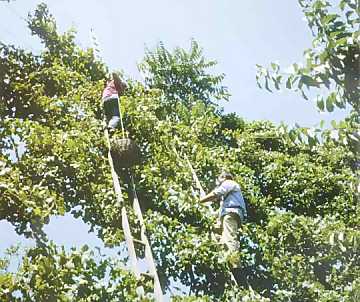
Among the ancient and historical autochthonous grapes of Italy, a relevant place certainly is occupied by Asprinio, whose qualities were already known in Roman times and many authors - including Pliny the Elder - praised its wines in their writings. The indisputable homeland of Asprinio grape is the territory of Aversa - in the province of Caserta, Italy - where it is still being cultivated today with the traditional method of vite maritata (married vine), a typically Etruscan viticultural system in which the vine is trained in trees having long trunks, usually poplar. Despite the system is now less and less used, it is still possible to see - by traveling in the countryside neighboring Aversa - the evocative view of the so called alberate Aversane (Aversan trees) which point high to the sky and even reaching a height of 15 meters (about 50 feet). In this land works since about one century the winery of Numeroso family which always paid a particular attention to Asprinio, the local and historical white berried grape.
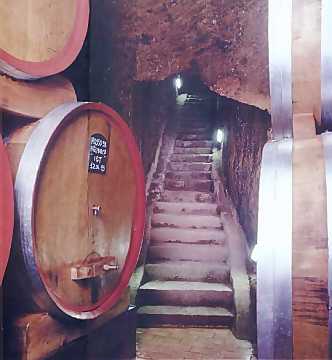
The winery of Numeroso family - owners of “I Borboni” branding - was established in the beginning of 1900's and since those times they were involved in the cultivation of Asprinio by using the traditional system of “alberata”. The trend for a massive bulk production - typical in the 1960's - converted the Numeroso winery in grapes providers for a very famous Italian spirit and liquor producer which used the grapes for the production of sparkling wines and brandies very renowned at those times. The first and fundamental change towards a quality production was thanks to the intuition of Mr. Gabriele Lovisetto - a former director of Buton - who at the beginning of 1970's convinced the Numeroso family to make drastic changes and innovations in the vineyards, by replacing the traditional “alberata” system with modern viticultural techniques. At the end of 1970's Numeroso winery begins the first experimentations about making sparkling wines with Asprinio and - encouraged by the first results - in 1982 decided to establish the “I Borboni” winery. It was during this important phase that Cavaliere Nicola Numeroso showed all of its tenacity and decided to concentrate his efforts on the revaluation of Asprinio, which at those times was seriously in danger of extinction from the countryside of Aversa. The results of his efforts were awarded with the recognition of IGT rank (Indicazione Geografica Tipica, Typical Geographic Indication) and later in 1993 with the recognition of Denominazione di Origine Controllata (DOC, Denomination of Controlled Origin) Asprinio di Aversa. In 1998 the Numeroso restored the family's palace in the historical center of Lusciano, built on a tufa cave, and therefore it could be used again as the cellar for the winery. In this way the Numeroso family restores the traditional wine making technique of Asprinio which was done in caves - dug 13 meters deep under houses (about 43 feet) - capable of offering unique and particular conditions suited for the keeping of wine, as well as ensuring the constant and adequate levels of temperature, humidity and light all year long. With the restoration of the ancient and traditional caves, Numeroso family intended to revaluate and keep their bonds with the most typical tradition of Asprinio wine making, even though, as a matter of fact, this a source for many difficulties in the many phases of processing, while, on the other hand, ensuring a better typicality and respect of the product.
Asprinio is a very ancient grape and many are the theories about its origin. What it is certain is that wines produced with this grape were mentioned by many authors in the course of history and its quality were praised and appreciated in the Campania region and elsewhere. It seems Asprinio was already present in the Aversa territory since Etruscan times where it was probably destined to the production of vinegar and in later times was particularly appreciated for its natural slightly sparkling wines, slightly sour and thirst quencher (Asprinio in Italian means slightly sour). The traditional viticultural system for Asprinio was the so called vite maritata - today defined as alberata Aversana - a tradition introduced in this area by Etruscans and that was usually common in all the other areas where this ancient people lived. The system consists in having the vine climbing a live support which usually is a poplar tree. The systemvite maritata system was so spread in the Aversa territory that attracted - of course - the astonishment and wonder of the visitors in past times. The most suggestive moment was represented by harvesting. Around the middle of September, skilled vintners gathered in the countryside with their very tall ladders - about 30 centimeters wide (about 11 inches) with steps about 40-50 centimeters apart (15-20 inches) - which they used to carry in perfect vertical balance on their shoulders. The ladders were leaned on the tall poplar trees, they climbed up to the top and began to harvest grapes from the top of vines. At the top of these ladders, they filled the traditional baskets and with a rope were lowered to the ground where women and children emptied the baskets in casks. The harvested grapes were then pressed by using the traditional press and the vinification was done in the underground cellars of the countryside of Aversa - caves dug on tufa rock and about 10 meters deep (about 32 feet) - in which the must was fermented and then transformed into wine. The commitment of Numeroso family to Asprinio grape is well represented by the wines they make. In the I Borboni winery are produced many styles of Asprinio including a sparkling wine and a sweet wine. The pomace of this grape is also used for the production of grappa, the most famous Italian brandy. Two are the wines produced with this grape: Asprinio di Aversa “Vite Maritata” and Asprinio di Aversa “Santa Patena”, the former being aged in steel tanks whereas the latter being aged in oak casks. Ebro is a sweet wine made from Asprinio and ages in cherry wood cask, interesting and particular for its aromas. With Asprinio is then produced a sparkling wine - I Borboni Brut - elaborated with a long Charmat process. The winery also produces wines with the traditional grapes from Campania, such as the white Coda di Volpe - used for the production of Lunajanca - and the red berried Aglianico, used for the production of Rivolta. The production of I Borboni is completed by Numeroso Rosso, a red wine produced with Aglianico, Cabernet Sauvignon and Merlot, aged for 6 months in oak cask and aged for 6 months in bottle.
|
||||||||||||||||||||
|
Score legend Fair Pretty Good Good Very Good Excellent Wine that excels in its category Good value wine Prices are to be considered as indicative. Prices may vary according to the country or the shop where wines are bought |
|
|
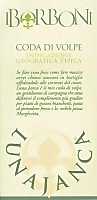
Lunajanca 2003 |
|
| I Borboni (Italy) | |
| Grapes: Coda di Volpe | |
| Price: € 5,50 | Score: |
| The wine shows a pale straw yellow color and nuances of greenish yellow, very transparent. The nose denoted intense, clean and pleasing aromas which start with hints of hawthorn, pear and apple followed by aromas of orange, pineapple, broom and peach. In the mouth has good correspondence to the nose, a crisp attack and however balanced, good body, intense flavors, agreeable. The finish is persistent with flavors of apple and pear. This wine ages for 6 months in steel tanks and 2 months in bottle. | |
| Food Match: Fish and crustaceans appetizers, Mushroom soups, Pasta and risotto with crustaceans and fish | |
|
|
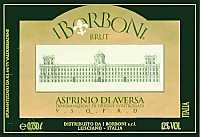
Asprinio di Aversa Spumante Brut |
|
| I Borboni (Italy) | |
| Grapes: Asprinio | |
| Price: € 6,50 | Score: |
| This wine shows a pale straw yellow color and nuances of greenish yellow, very transparent, good effervescence, fine and persistent perlage. The nose denotes delicate, clean and pleasing aromas which start with hints of hawthorn and apple followed by aromas of pineapple, broom, pear and lemon. In the mouth has good correspondence to the nose, a crisp and effervescent attack, however balanced, delicate, intense flavors. The finish is persistent with flavors of pear, apple and lemon. This sparkling wine is produced with grapes cultivated with the traditional "Alberata" method and elaborated with long Charmat method (6 months of aging on its lees) and ages for 4-6 months in bottle. | |
| Food Match: Aperitifs, Dairy products, Pasta and risotto with vegetables and crustaceans, Sauteed fish | |
|
|
Asprinio di Aversa Vite Maritata 2003 |
|
| I Borboni (Italy) | |
| Grapes: Asprinio | |
| Price: € 5,50 | Score: |
| This wine shows a pale golden yellow color and nuances of straw yellow, very transparent. The nose reveals intense, clean and pleasing aromas which start with hints of apple, plum and hawthorn followed by aromas of orange, pear, peach and broom. In the mouth has good correspondence to the nose, a crisp attack and pleasing roundness, however well balanced by alcohol, good body, intense flavors. The finish is persistent with flavors of apple and pear. This wine ages for 6 months in steel tanks and for 2 months in bottle. | |
| Food Match: Dairy products, Fried fish, Broiled fish, Sauteed fish, Pasta and risotto with fish | |
|
|
Ebro 2000 |
|
| I Borboni (Italy) | |
| Grapes: Asprinio | |
| Price: € 18,50 | Score: |
| The wine shows an intense amber yellow color and nuances of amber yellow, very transparent. The nose reveals good personality with intense, clean, pleasing and refined aromas which start with hints of dried fig, honey and orange peel followed by aromas of candied fruit, almond, dried apricot, litchi and hints of enamel and smoked. In the mouth has good correspondence to the nose, a sweet and smooth attack, however balanced, good body, intense flavors, good crispness, agreeable. The finish is persistent with flavors of dried fig, dried apricot and candied fruit. This wine is produced with overripe and dried grapes, ages for 12 months in cherry wood casks. | |
| Food Match: Almond desserts, Hard and piquant cheese | |
|
|
Rivolta 2000 |
|
| I Borboni (Italy) | |
| Grapes: Aglianico | |
| Price: € 6,50 | Score: |
| The wine shows an intense ruby red color and nuances of garnet red, little transparency. The nose reveals intense, clean, pleasing and refined aromas that start with hints of cherry, raspberry and plum followed by aromas of carob, blackberry, licorice, tobacco, violet, vanilla and hints of aniseed. In the mouth has good correspondence to the nose, a slightly tannic attack and however balanced by alcohol, good body, intense flavors, good tannins. The finish is persistent with flavors of cherry, raspberry and plum. A well made wine. Rivolta ages in cask for 6 months followed by 8 months of aging in bottle. | |
| Food Match: Roasted meat, Stewed meat, Broiled meat and barbecue, Hard cheese | |
|
|
Numeroso 2000 |
|
| I Borboni (Italy) | |
| Grapes: Cabernet Sauvignon, Merlot, Aglianico | |
| Price: € 9,50 | Score: |
| This wine shows a brilliant ruby red color and nuances of garnet red, moderate transparency. The nose reveals intense, clean, pleasing and refined aromas which start with hints of plum and black cherry followed by aromas of black currant, violet, tobacco, licorice, vanilla, cocoa and hints of black pepper and graphite. In the mouth has good correspondence to the nose, a slightly tannic attack and however balanced by alcohol, good body, intense flavors, good tannins. The finish is persistent with flavors of black cherry and plum. A well made wine. Numeroso ages for 6 months in cask followed by 6 months of aging in bottle. | |
| Food Match: Roasted meat, Stewed meat, Broiled meat and barbecue, Hard cheese | |
| I Borboni - Via Macedonia, 40 - 81030 Lusciano, Caserta (Italy) - Tel. +39 81 8141386 Fax. +39 81 8129507 - Winemaker: Maurizio De Simone e Roberto Cipresso - Established: 1982 - Production: 130.000 bottles - E-Mail: info@iborboni.it - WEB: www.iborboni.it |
Cellar Journal |
|
This section is reserved to wine producers who want to publish news and information about their business, to announce new products or just for communicating to its customers information and promotions about their products and activity. Send news to be published at our e-mail address.
|
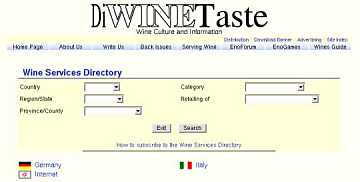
DiWineTaste's Wine Services DirectoryA new and practical tool is available at our site in order to let readers know the places of wine, a new interactive guide to discover new wine shops and restaurants in which it is possible to appreciate good wine |
For every lover of the beverage of Bacchus it is not only important to know the quality of his or her preferred wines, it is also useful to know where they can be bought at. We often receive letters from our readers asking us where they can find or buy the wines we review in the magazine or published in our Wines Guide. The only kind of help we can offer is to inform the producers so they can provide readers the proper information. The new DiWineTaste's Wine Services Directory is aimed to fulfill this kind of requests in order to actually have wine lovers and the ones who sell wines meet. The Wine Services Directory is integrated to the Wines Guide, therefore completing and improving, as a matter of fact, the quality of this truly and very appreciated tool. After having searched a wine in the guide, it will be possible to know the nearest shop or place where that wine can be bought or tasted. DiWineTaste's Wine Services Directory is more than that. One of the goals is to provide our readers - and therefore commercial activities related to the world of wine as well - a practical tool useful for searching and knowing the places of nice drinking. The Directory allows the searching of commercial activities related to wine and accessories retailing, such as wine shops, restaurants, wine bars, producers, wholesalers, distributors, WEB sites, E-Commerce sites, enotourism and other wine related businesses. The researches can be done by entering the commercial category as well as a specific area. To the ones running or owning commercial activities who are interested in being included in DiWineTaste's Wine Services Directory we are offering an interesting opportunity: one free month subscription, with no obligations. The free month subscription can be requested by filling in the form available at the page www.DiWineTaste.com/english/ServicesRequest.php. The link to this page can also be found in the home page of DiWineTaste's site. For more information we invite you to contact us at our E-Mail address.
|
||||||||
News |
|
In this section will be published news and information about events concerning the world of wine and food. Whoever is interested in publishing this kind of information can send us a mail at our address.
|
Production of Sparkling WinesCharming for their bubbles that from the bottom of the glass float to the top, a visual effect that can be made in many ways and which transforms, like a sort of magic, a wine |
|
Among all styles of wine, the ones who are capable of catching the attention for the charming effect they can create, certainly are sparkling wines. These wines, whose charm mainly derives from the joyous chain of bubbles which develops in the glass as well as from its social prestige, are the result of a complex wine making technique capable of trapping carbon dioxide in the wine - responsible for bubbles and froth - while enhancing its organoleptic complexity. Among the most famous representatives of the wines belonging to this category there is Champagne, certainly the one who was capable of giving this wine the prestige and charm which is repeated every time a bottle of “bubbles” is being uncorked. The production of sparkling wine can be made by using many techniques, each of them having proper qualities and peculiarities and with which can be obtained different results and suited for the many styles of grapes and wines.
|
|
All sparkling wines - no matter the technique used for their production - have a common characteristic: they all are the result of an elaboration made on a “normal” wine and produced according the usual and common wine making techniques. It is then a wine re-elaborated by using specific techniques and that produce as a result, or at least as the most evident result, an effervescent wine. For this reason sparkling wines belong to the category of the so called special wines. The most common sparkling wine types are however produced with a white or rose wine, very rarely with red wines. The reason for which are not produced sparkling wines with red wines - or at least the production is very low - it is to be found in the balance of the finished product. Carbon dioxide - responsible for effervescence - enhances the perception of astringency - which in red wines is practically always present - and therefore the result would be not balanced and scarcely agreeable. Just like any other type of wine, the production of sparkling wines begins in the vineyard and by choosing the best grapes suited for the production of this style of wines. Grapes - soon after harvesting - are being pressed and with the must is produced a “still” wine that will be later used for the assembling of a base wine. Base wines used for the production of sparkling wines - in particular non aromatic sparkling wines - are the result of an assemblage, that is of the union of many wines - even of different vintages - having proper characteristics and qualities and however suited to the type of sparkling wine to be produced. A fundamental difference between “regular” wines and sparkling wines is represented by this aspect. Whereas in still wines the finished product is obtained - saved the exception of particular cases - by the must produced with grapes coming from a single harvesting, the base wine for sparkling wines is generally made from tens of different wines - even belonging to different vintages - usually a number from 30 to 60.
One of the main goals of sparkling wine producers - and in particular for quality sparkling wines - is to ensure a constant recognizability and identifiability of their wines year after year, therefore the assembling of base wine is - as a matter of fact - a fundamental and determinant phase of the production. The base wine - that in French is defined with the famous term cuvée - is prepared by a group of expert and qualified technicians whose job is to analyze the organoleptic qualities of each wine, to choose it for its specific qualities and according to its contribution to the cuvée to be processed and transformed into a sparkling wine. The hard task of these experts is also to imagine the transformation of the organoleptic qualities of the cuvée at the end of the production of the sparkling wine in order to obtain a product which identifies the style of the producer. Wines used for assembling the base wine can also belong to different vintages in case the sparkling wine is not millesimée - also known as sans année or non vintage - whereas for vintage sparkling wines - that is the ones stating the year of vintage in the label - the cuvée can be made only with wines belonging to the same vintage written in the label. Wines used for the preparation of the base wine - no matter this could sound strange and paradoxical - do not have organoleptic qualities such to be defined as agreeable. Of course the quality of these wines - in a strictly enological sense - is absolutely equal to the quality of the sparkling wine to be produced, however their gustatory qualities cannot be considered truly agreeable when drunk before the beginning of the sparkling wine making process. The assembling of the cuvée used for the production of sparkling wines is made of pretty neutral wines, very acid and with low alcohol. These wines will be then transformed in a substantial way by the sparkling wine making process - in particular by classic method - not only by adding effervescence but also - and above all - by adding organoleptic complexity, structure and a small quantity of alcohol. Base wines used for the production of rose sparkling wines can be assembled by using a blend of white and red wines - this is the only case where blending these two types of wine is permitted - as well as blending many rose wines usually produced with the bleeding technique (saignée). According to the style and type of sparkling wine to be produced, base wines could also undergo a malolactic fermentation as well as an aging in cask, a practice which is usually used for wines destined to the production of classic method sparkling wines.
|
||||||||
|
The classic method is the most important system for the production of sparkling wines and with which can be usually obtained the best results in terms of elegance, organoleptic complexity and finesse. This system - also known as metodo tradizionale, metoto classico, méthode Champenoise, méthode traditionnelle or méthode classique, in South Africa méthode Cap Classique - is mainly used with wines produced with non aromatic grapes and in particular with Chardonnay, Pinot Noir, Pinot Meunier and Pinot Blanc. The classic method basically consists is favoring a second fermentation of the wine which is done inside a bottle, a process which is also called bottle refermentation. A particular aspect of this technique is represented by the bottle which accompanies the wine from the moment of the refermentation to the moment of consumption. In other words the bottle containing a classic method sparkling wine is exactly the very same used for the production of that sparkling wine. The charming journey of the wine towards the transformation in classic method sparkling wine begins by adding to the cuvée a mixture - made of the same base wine, cane sugar, selected yeast and other substances useful for making the rémuage easier, explained later. In most of the cases are being added 24 grams of sugar per liter (a little less than one ounce) in order to develop a pressure of 6 atmospheres (about 85 psi) to the inside of the bottle (4 grams of sugar develops, during the fermentation, a pressure of about one atmosphere) and for this reason the thickness of bottles to be used for sparkling wines is usually greater in order to prevent their explosion. The wine is then bottled and bottles are capped with special crown caps having a special container - called bidule - which will be useful for keeping the sediments at the end of the fermentation process. Alternatively the bottles can be capped - according to the tradition - with a cork tied to the neck of the bottle by means of a robust metallic clamp. In both cases the closure must ensure an excellent sealing capacity to the internal high pressure of the bottle. At this point bottles are laid horizontally in the cellar at a constant temperature of about 10°C (50°F) and in this phase begins the fermentation inside the bottle done by yeast. It is the beginning of the prise de mousse - a phase in which the effervescence begins to form - that is the real and proper refermentation of wine. In this phase carbon dioxide, having no possibility to exit the bottle, remains “trapped” inside therefore creating effervescence. The refermentation process usually lasts one or two months and at the end the alcohol level will be raised of about 1,2 - 1,3%. During the refermentation process bottles are periodically rotated in order to avoid the sediments to stick to the side of the bottle. When the refermentation is over - that is when the sugar has been transformed by yeast into alcohol and carbon dioxide - bottles are allowed to age in the cellar and it is during this slow phase the wine will increase its organoleptic complexity. At this point yeast cells begin to release their aromatic substances to the wine - aminoacids, proteins and volatile compounds - that will enrich the qualities of wine. This process is called autolysis of yeast which usually takes place after eight or ten months from the end of refermentation. The amount of time in which the wine is left in contact with the yeast inside the bottle is usually of 15 months for non vintage sparkling wines and of 30 months for vintages, however the best classic method sparkling wines are left in this condition even for ten years and sometimes more. When the producer decides to end the aging of the wine, it is necessary to eliminate the sediment of yeast from the bottle in order to obtain a limpid and presentable wine. Bottles are then placed in special racks called pupitre where qualified personnel shake and rotate the bottles by using a particular technique which favors the gathering of sediments to the neck of the bottle. This procedure is called rémuage and a skilled remueur can also shake 40,000 - 50,000 bottles a day. Despite how much this professional figure can be admired, this procedure is today done by using computer controlled machines called gyropallettes. The automatic procedure of rémuage does not affect the quality of the finished product. The complete procedure of manual rémuage can also lasts six weeks and at the end the bottle on the pupitre is on a vertical position and with the sediment gathered in the neck near the cap.
At this point it is necessary to eliminate the sediment in order to have the wine limpid and presentable, a phase which is called dégorgement, or disgorgement. The traditional way consists in uncorking the bottle with a very spectacular gesture - called à la volée - in order to have the internal pressure pushing the sediment out from the bottle. This technique - although spectacular - is scarcely used today because with the expulsion of the sediment is also spilled out a pretty large quantity of wine. The most used technique today is the so called à la glace consisting in plunging the neck of the bottle is a refrigerating brine at a temperature of about -25°C (-13°F) in order to freeze the sediment. The bottle is then turn upside and uncorked, the internal pressure pushes the sediment out and the loss of wine is very low while leaving the content of the bottle perfectly limpid. At this point it is added the so called liqueur d'expédition - liqueur de dosage or simply dosage - having both the function of refilling the bottle as well as defining the level of sweetness of the wine. This mixture is usually made of reserve wines, cane sugar and other “secret” ingredients, typically brandy or other distillates. The exact composition of the liqueur d'expédition is secretly kept by every producer and represents - as a matter of fact - the stylistic mark of every producer. The level of sweetness in sparkling wines is shown in table .
After the liqueur d'expédition has been added, the bottle is capped with a cylindrical cork whose diameter is about twice the one of a regular cork and that will get the usual “mushroom” shape. The cork is then fixed to the neck of the bottle with a wire cage in order to prevent its expulsion because of the internal pressure. The next phase is called poignetage and consists in shaking the bottle in order to perfectly blend the wine with the liqueur d'expédition. After the last check on the limpidity of the sparkling wine inside the bottle - a phase called mirage - bottles are being labeled and after a short period of time spent in the producer's cellars - usually few months - the sparkling wine is now ready to be released in the market.
|
||||||||||||||||||||||||||||||||||
|
This method - which was invented by the Italian Federico Martinotti and French Eugène Charmat - is also called bulk process or Cuvée Close in French. The method is particularly suited for wines produced with aromatic grapes - such as Muscat Blanc and Brachetto - because this method favors the keeping of fresh and fruity aromas of grapes. As opposed to the classic method, it allows the production of sparkling wines within two or three months, however the result is qualitatively lower. A mixture of yeast and sugar is added to the base wine and then it is transferred in a sealed container in which the wine begins the refermentation process. At the end of the refermentation the wine is filtered and then bottled. All these procedures are done in isobaric conditions, that is at the same pressure present in the container in order not to lose any carbon dioxide or effervescence. The Martinotti or Charmat method usually lasts two or three months and in case the wine is left in contact with the yeast for about six months, it is called long Charmat. The quality of these sparkling wines in term of perlage is lower than classic method sparkling wines - a characteristic which is easily recognizable by the greater size of bubbles - and the aromatic complexity of these wines is lower as well.
|
|
There are other methods for making effervescent a wine and of which the most simple one - and less noble - is carbonation, that is the same method used for sparkling water and soda pops. The quality of this method is rather low and it is destined for sparkling wines of very low quality. Another method - usually forbidden for the production of classic method sparkling wines regulated by specific disciplinary - is the so called transfer method. The initial phase is similar to classic method whereas at the moment of rémuage bottles instead of being shaken, are being uncorked and the content is transferred in a pressurized container where the wine is filtered - in order to eliminate sediments - and then bottled. Another method - which is occasionally used for the production of classic method sparkling wines - is called transversage. Soon after disgorgement (dégorgement), the content of bottles is being transferred in a pressurized container and then it is added the dosage. At this point the wine is bottled under pressure and then labeled. This system is generally used for classic method sparkling wines sold in small sized bottles (half bottle and split) or large sizes greater than magnum. For this reason classic method sparkling wines taste better and have a higher quality when sold in regular bottles or in magnums, that is the very same bottles in which they have been made.
|
HoneyConsidered as the food of gods, this golden and precious food is produced by one of the most beloved insects by human beings - bees - which have always been admired for their organization |
|
Honey is a food produced by bees after having eaten then nectar of flowers - as well as other secretions of plants - transformed and enriched with other substances which they produce, and therefore stored in the cells of honeycombs where it is allowed to age.
|
|
Honey was known since ancient Egypt times, around 300 B.C., where bees were bred for the production of honey and wax. At those times honey was a food destined for the consumption of pharaohs and the most important personalities, it was held in such a high esteem that it was offered to gods as a sacrifice. Its importance is confirmed by its presence in the tombs of pharaohs, just near the sarcophagus, near to all the other foods. At those times were organized specific expeditions in search of wild honey. They were ancient Egyptians to invent the so called “mobile apiculture”: honeycombs were transferred from a place to another by means of boats in order to have a honey made of different flowers; this type of apiculture is still used today even though in a different way. Romans, just like Greeks, have continued the consumption of honey, they appreciated it both as a medical remedy for many diseases and as a cosmetic product, as well as an ingredient for cooking. They also used beeswax as a cosmetic product as well as a support for writing. Every civilization has its beverage made of honey and its medical remedy and cosmetic products based on honey. In the mythology of Northern Europe is often mentioned a beverage called melikraton made of a mixture of honey and blood. Mead probably is the most ancient fermented product of the world - made of water, honey and yeast - produced in many styles and called with many names each one of them being characteristic of a specific people or geographical area (Mead in English, idromele in Italian, Braggot, Melomel, Metheglin). Virgil defined honey as “the heavenly gift of dew”. In the Bible, Isaiah wrote: “…the virgin will conceive and give birth to a child, who will be called Immanuel. He will eat cream and honey…”. In Greek tradition, the legend of Pythagoras has it that he fed himself with honey only. Honey has been for many centuries the only source of sugar. It was Alexander the Great to import in Europe from Eastern Asia - and more precisely from the Gulf of Bengal - sugar cane, a rare and expensive food and therefore destined to the few that could afford it. In the eighteenth century sugar beet, already cultivated in Europe, was used for the production of sugar. Both cane sugar and beet sugar contain glucide, whereas honey is the only one to contain simple sugar which are easily digested. Moreover honey contains other important substances as well as its many aromas and flavors.
|
||||
|
Honey is a substance produced by bees, which eat the nectar of flowers and then transformed inside a special organ contained in their digestive system. Honey is stored in honeycombs and used as a food for larvae and as a food reserve for wintertime. Indeed honey is a very complex product and in many aspects it can be considered as unknown. Experts who study honey continuously discover new substances, new molecules that, although present in modest quantities, they are however important according to a dietetic and pharmacological point of view. Honey is a substance mainly produced by bees and few other insects and used by them as a food reserve. Bees are indispensable not only for the production of honey: they do an incredible work in collecting nectar - the sweet substance produced by plants - and they also transport the pollen from a flower to another therefore allowing the reproduction.
Of course every plant produces a nectar having different characteristics, therefore the honey produced by bees have different characteristics according to the nectar they eat. Just like for wine - in which climate and soil give the wine different qualities - flower, climate and different soils greatly affect the characteristics of honey. Pollen is used by bees as a food for the youngest subjects, therefore is accidentally found in small quantities in honey. Another “base” substance for the composition of honey is honeydew that is the lymph produced by plants. The main components of honey are: water, sugar (in the form of fructose, glucose and maltose), acids (malic, acetic, gluconic, formic, lactic), proteins, mineral salts (magnesium, calcium, sodium), pigments (carotene, chlorophyll and its derivatives), enzymes, tannins, vitamins and phosphates. Honey is a completely natural product and does not need any additive or preservatives. 100 grams of honey gives about 300 kilo calories readily available. It is almost impossible to tell the exact yearly production for a single bee, however a honeycomb - in which live about 30,000 bees - can produce about 20-30 kilograms of honey per year (44-60 pounds). Honey easily absorbs the humidity of air, for this reason is used as a humidifier for tobacco, and at a room temperature glucose tends to crystallize by separating from fructose. Before being commercialized honey is being heated at a temperature of 66°C (150°F) in order to melt any possible crystal, therefore it is poured in sealed jars which prevents crystallization. The natural evolution of honey consists in the precipitation of crystals: this process is faster in honeys particularly rich in glucose, such as sunflower or colza honey. In honeys poor in glucose and rich in fructose, such as acacia or chestnut honey, the formation of crystals is absent or may develop very slowly and however incomplete. The crystallization process in sugars is a natural and spontaneous phenomenon which does not alter the quality of the product. A honey showing crystals can be converted to the liquid state by heating it in bain-marie at a temperature not higher than 40°C (104°C). In case it is wanted to avoid the formation of crystals, the jar can be kept in the refrigerator until the moment of consumption, as the formation of crystals is particularly quick at a temperature of 14°C (57°F). Crystallization is inhibited at temperatures lower than 5°C (41°F) or higher than 25°C (77°F). These indication on how keeping or converting honey in its liquid state, that is without crystals, can erroneously make someone believe honey must be liquid and this is its normal state, however this is not the case. It is better to take the habit of eating honey in its crystallized form: besides being more easy to handle, its taste will also be perceived less sweet and fresher.
|
||||||||
|
Despite honey does not need preservatives, there are however some useful advice in order to keep honey properly. The first advice is to avoid fermentation. This type of alteration usually affects the variety of honeys having an excessive quantity of water. These usually are honeys which did not reached a proper aging level in honeycomb and for which it is forbidden commercialization. Varieties containing high quantities of water - very rare honeys, produced in springtime or in autumn (such as arbutus honey) - should be kept in the refrigerator in order to prevent fermentation. Fermented honey is not dangerous for the health - however it is preferred not to consume it - and it can be easily recognized for its foamy aspect, with gas bubbles as well as the separation of the solid part from the liquid part. The sour smell of fermentation is characteristic and easily recognizable. The maximum quantity of humidity allowed in order to prevent fermentation is about 19%. Every type of honey is subjected to the alteration of time: aging. Aging, even though keeps the physical-chemical properties of honey unaltered, attenuates its organoleptic qualities. Aging is inexorable and its velocity depends on how it was kept; it is almost negligible in honeys kept at a temperature lower than 10°C (5'°F), whereas at 20°C or 30°C (68° or 86°F) the keeping times is drastically reduced. The fresher the honey the better it can keep its qualities, however an one year old honey, in case it is properly kept, can also be considered fresh, in fact producers suggest a period of two years as the preferred time before consumption. Aging does not alter the edibility of honey but only some of its organoleptic qualities. A good habit is to keep honey at a temperature lower than 20°C (68°F), shielded from direct light and in sealed jars. Honey is hygroscopic therefore it can easily absorb humidity and odors. Another defect in keeping honey is the “change of color”, consisting in the change of the hue towards darker colors because of the degradation of fructose. This fault occurs when honey was exposed to excessive heat, or in products kept for a long time in bad conditions.
|
|
Honey is a completely natural product of vegetal origin. With its high content in simple sugars (70% is made of fructose and glucose) it is an excellent energetic source and readily available. It is recommended in kids diet because it can be easily digested, favors the fixation of mineral salts, reliefs throat irritations and favors the cicatrization of wounds. Moreover it is a good tonic and avoid fermentations. Honey is also a substance rich in enzymes playing a role in the metabolism while accelerating some functions.
In the nutrition of athletes, or in those subjects who are usually involved in physical works, it is recommended before, during and after the work in order to favor a complete recover. Not only muscles need sugar: even the functions of the brain are efficient only in case there is a proper quantity of glucose in the blood. A lowering of glycaemia can be cause of loss of lucidity, efficiency and attention. A teaspoon of honey can restore the functionality of brain as well as a correct vitality. In elder people, affected by diseases or inappetence, or anyone who cannot have a balanced and complete nutrition, a small quantity of honey melted in water can be of great help. The consumption of honey is not recommended to anyone. It should be avoided by anyone suffering from problems related to the metabolism of sugar (diabetes), saved the case it was prescribed by a specialist. It is not recommended to those who need to reduce the quantities of calories (obese people and those who are on diet), as the energetic contribution of honey is of 320 Kcal for 100 grams. Honey is a product which is rarely responsible for allergies, however, as a form of prevention, it should not be consumed by any kid in their first year of life. Moreover it is a good habit avoiding the consumption of honey in kids because this will make them accustomed to the sweet taste as well as affecting their growth and nutritional habits. In kids with less than one year of life honey can be responsible for infantile botulism - a disease however rare - which can give origin to an infection caused by some toxins produced by some bacteria found in honey.
|
||||||||
|
There are many varieties of honey - depending on the nutrition of bees - and each having its characteristics and properties. Honeys are classified in two categories according to their origin: “honeydew honey” and “nectar honey”. Honeydew honey is produced by bees whose nutrition was based on substances produced by plants, whereas nectar honey is produced by bees whose nutrition was based on flowers' nectar. According to the floral origin it can be classified in other varieties: monofloral honey and all flowers honey. Monofloral honey is produced by bees whose nutrition was based on a single type of flower or tree only, such as acacia or orange, whereas all flowers honey is produced by bees whose nutrition was based on different varieties of flowers and trees. Another factor used for the classification of honey is represented by the area of origin. The following list shows the quality of the main types of honey.
|
AquavitaeReview of Grappa, Distillates and Brandy |
|
|
| Distillates are rated according to DiWineTaste's evaluation method. Please see score legend in the "Wines of the Month" section. |
|
|
Grappa di Moscato Luigi Francoli “Le Fragranze” |
|
| Distillerie Francoli (Italy) | |
| Raw matter: Pomace of Muscat Blanc | |
| Price: € 22,00 - 500ml | Score: |
| The aspect of this grappa is colorless, limpid and crystalline. The nose reveals intense, clean, pleasing and refined aromas that start with a pleasing aroma of the grape as well as aromas of peach, pear, banana and a pleasing hint of sage, almost imperceptible alcohol pungency. The taste is agreeable with intense flavors, good roundness and very balanced sweetness, the alcohol is perceptible although not excessively pungent, balanced. The finish is persistent with a pleasing sweet and aromatic hint and good flavors of pear and peach. A well made grappa produced with the traditional steam distillation and passed in column plates, refined for 8 months in inert containers. Alcohol 42%. | |
|
|
Consenso Acquavite di Uva Aglianico |
|
| Distillerie Bonollo (Italy) | |
| Raw matter: Aglianico and other grapes from south Italy | |
| Price: € 31,00 - 500ml | Score: |
| The aspect is colorless, limpid and crystalline. The nose reveals intense, clean, pleasing and elegant aromas of violet, plum, raspberry, licorice and white rose with almost imperceptible alcohol pungency. The taste is very pleasing, with intense flavors, good roundness and very balanced sweetness, the alcohol is perceptible, not excessively pungent which rapidly get dissolved, elegant. The finish is intense and persistent with pleasing sweet hint and good flavors of plum, licorice and rose. Very elegant and very well made. Alcohol 42%. | |
|
|
Consenso Grappa di Chianti Classico |
|
| Distillerie Bonollo (Italy) | |
| Raw matter: Pomace of Chianti Classico (Sangiovese, Cabernet, Merlot) | |
| Price: € 31,00 - 500ml | Score: |
| The aspect of this grappa is colorless, limpid and crystalline. The nose reveals intense, clean and pleasing aromas of violet, raspberry, hazelnut and dried plums with almost imperceptible alcohol pungency. The taste is intense, good roundness and balanced sweet hint, the alcohol is perceptible without being excessively pungent, harmonic. The finish is persistent with pleasing sweet hint and good flavors of dried plum and hazelnut. This grappa is distilled with discontinuous steam alembic still in copper boilers. Alcohol 45%. | |
Wine Parade |
|
|
| The best 15 wines according to DiWineTaste's readers. To express your best three wines send us an E-mail or fill in the form available at our WEB site. |
| Rank | Wine, Producer | |
|---|---|---|
| 1 |

| Amarone della Valpolicella Classico Capitel Monte Olmi 1999, Tedeschi (Italy) |
| 2 |

| Turriga 1998, Argiolas (Italy) |
| 3 |
| Rioja Reserva Era Costana 1999, Bodegas Ondarre (Spain) |
| 4 |
| Anjou 2001, Domaine de Montgilet (France) |
| 5 |
| Barolo Cicala 1999, Poderi Aldo Conterno (Italy) |
| 6 |
| Brunello di Montalcino Prime Donne 1998, Donatella Cinelli Colombini (Italy) |
| 7 |
| Alto Adige Gewürztraminer Kolbenhof 2002, Hofstätter (Italy) |
| 8 |
| Montepulciano d'Abruzzo Villa Gemma 1999, Masciarelli (Italy) |
| 9 |
| Franciacorta Cuvée Annamaria Clementi 1996, Ca' del Bosco (Italy) |
| 10 |
| Aglianico del Vulture La Firma 2000, Cantine del Notaio (Italy) |
| 11 |
| Riesling Cuvée Frédéric Emile 1999, Maison Trimbach (France) |
| 12 |
| Margaux 2000, Ségla (France) |
| 13 |

| Harmonium 2001, Firriato (Italy) |
| 14 |

| Pinot Noir Napa 2002, Clos du Val (USA) |
| 15 |
| Chablis Grand Cru Les Clos 2002, Domaine Billaud-Simon (France) |
up down stable new entry
| |||||||
Privacy Policy | |||||||

| Copyright © 2002-2024 Antonello Biancalana, DiWineTaste - All rights reserved |
| All rights reserved under international copyright conventions. No part of this publication and of this WEB site may be
reproduced or utilized in any form or by any means, electronic or mechanical, without permission in writing from DiWineTaste. |


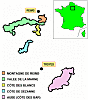
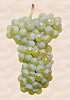
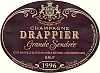
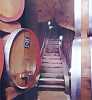
 Share this article