Wine Culture and Information since 2002 - Volume 22
Wine Culture and Information since 2002 - Volume 22 |
 |
× |
 DiWineTaste on Instagram
  DiWineTaste Mobile for Android
DiWineTaste Mobile for iOS
Become a Registered User
Subscribe to the Mailing List
Tell a Friend About DiWineTaste
Download DiWineTaste Card
DiWineTaste Mobile for Android
DiWineTaste Mobile for iOS
Become a Registered User
Subscribe to the Mailing List
Tell a Friend About DiWineTaste
Download DiWineTaste Card
|
Issue 43, Summer 2006 |
Contents |
|
|
The Season of White and Bubbles |
|
Springtime is now over and winter is a cold memory, June has been a little crazy and unpredictable - as to make us remember in its beginning January, the month having its same initial - and we are finally arrived to summertime. The hot season of the year makes us putting aside the large and showy glasses, in order to leave the scene to smaller and slimmer ones, to ice buckets and to bottles having evidently lighter colors, at least when observed in transparency. The cyclic fashion of wine continuously repeats itself: in this period of the year the full bodied and thick reds leave the scene to the protagonists of summertime, white and rose wines, sparkling and lightly sparkling wines. Not only a custom associated to the fact these wines are usually served at low temperatures - therefore more appropriate to the summer heat - but also because they are considered “lighter” and therefore more suitable for summertime. If it is true for most of the year the red wines are the ones to be mainly preferred by consumers, in summertime white, rose and sparkling wines take their revenge. In fact, in summertime, these wines are the ones to be mainly preferred by consumers, not only consumed during meals, but also used for making wine beverages - the so called “wine drinks” - and as aperitifs. In particular sparkling wines, which are getting a renewed interest going beyond their typical role, that is of “special” wine to be uncorked in occasion of holidays or particular moments only. There are more and more consumers who realize the pleasure of matching their meals with a good bottle of sparkling wine, in particular during hot seasons when the heat is mainly suffered. It is also true this renewed interest has begun some years ago, when in banquets and in formal receptions, sparkling wines appeared again also served as aperitifs. This has certainly been an important step forward which allowed sparkling wines to begin again to come out from cellars also before Christmas time or New Year's eve. A similar trend is also happening for rose wines which, with lot of efforts, are slowly trying to get more attention from consumers. This is also because of appropriate initiatives which were capable of catching the attention of consumers towards this pleasing wine style, also thanks to the efforts of producers in order to increase the quality of their rose wines. Those dark and not very dignified times are now a distant memory - although recent - when rose wines were mainly produced with pretty disputable quality methods and consumers preferred to have something else, as they did not find in rose wines neither quality or agreeability. However rose wines are truly pleasing products and they can be served at low temperatures, as low as white wines, therefore suited for warm seasons. Moreover, according to an enogastronomical point of view, whenever a white is “too little” and a red is “too much”, in most of the cases the solution is represented by a rose wine. On the other hand, white wines have always had their followers - although with significative oscillations both in consumption as well as in the preference for certain grapes - and in particular women who generally prefer whites to reds, possibly produced with aromatic grapes, such as Gewürztraminer, Müller Thurgau and Muscat Blanc. Women are not the only ones to show their preference for aromatic grapes: men frequently show an interest for the aromas of these grapes coming out from their glasses. White wine has represented a pretty significative fashion of the past, as to make consumer lose their interest for red wines, by creating an alternation which made some grapes famous in specific periods. If it is true Chardonnay represents today the most appreciated grape by consumers, as well as the most used one in cellar, in past times it was Pinot Gris to be mainly successful. As everyone knows, fashions come and go like seasons - and sometimes they also return - and therefore also Pinot Gris had its moment of glory therefore leaving the scene to other grapes, including the vehement return of red wines. During the warm season, the nectars of Bacchus are left in the cellar by many and in the glasses are preferred white wines instead. These wines - as we said - are certainly in good company because they are more and more joined by rose and sparkling wines, both Charmat method and classic method. Among white wines, the ones to be mainly consumed in summertime, the ones to be generally preferred are the ones having good crispness and aromas, possibly low in alcohol - such as certain wines made with Sauvignon Blanc or Riesling - that is a wine to be drunk at a low temperature and appropriate for the heat of summer days. In this renewed seasonal interest for white wines, also autochthonous grapes are successful, in particular in those places where tourists go, who, with the occasion of a vacation, can also satisfy the curiosity of appreciating the local white grapes transformed into wine. In a country like Italy, where every region of the boot has its traditional grapes, the choice of the so called “autochthonous” wines is rich in surprises and, last but not the least, in good products. The preference for white, sparkling and rose wines during hot seasons is also justified by the foods which usually characterize summertime meals. Lighter foods, frequently raw and slightly seasoned, fish, crustaceans, rice and pasta with delicate and light sauces: the rich and opulent preparations of wintertime, which can be well matched to red wines, are not preferred by people in this period. Therefore a fresh and pleasing white wine, as well as a rose or a sparkling wine, besides refreshing the palate, allows a better enogastronomical matching with summertime foods. And if for a short time of the year red wines are almost forgotten and are allowed to rest for the future cold seasons, the ones who prefer and mainly consume this type of wine should not take offense. After all, also the diversity and the curiosity of changing, to discover - or to rediscover - new things, is part of the pleasing organoleptic and sensorial aspect of wine and, last but not the least, its conscious and moderate consumption, represent one of the many surprising aspects of the beverage of Bacchus. And in case a good glass of fresh wine appreciated during a summer night makes you feel like having another one and then one more, remember it is not quantity making the pleasure of wine. Enjoy your vacations and see you in September!
|
||||
MailBox |
|
In this column are published our reader's mail. If you have any comment or any
question or just want to express your opinion about wine, send your letters to
our editorial or fill in
the form available at
our site.
|
| What is the difference between Asti Spumante and Moscato d'Asti? |
| Antonio Ricciardelli -- Florence (Italy) |
| According to the Italian quality system, Asti Spumante and Moscato d'Asti both belong to the classification of Denomination of Controlled and Guaranteed Origin (Denominazione d'Origine Controllata e Garantita) DOCG. Both wines are made with 100% Muscat Blanc and the difference consists in production. Moscato d'Asti is produced with the partial fermentation of must. This procedure allows the keeping of some sugar which will give wine sweetness, as well as an appreciable quantity of carbon dioxide responsible for effervescence. The interruption of fermentation has also an effect on effective alcohol volume, which must be from 4.5% and 6.5%. Asti Spumante is a sparkling wine produced in a tank (Charmat or Martinotti method) or with the refermentation in bottle. Also in this case the process is done in order to keep part of the sugar which will give the sparkling wine its typical sweetness, therefore avoiding the complete fermentation, with a lesser production of effective alcohol, however from 7% to 9,5%. |
| In your magazine I read a wine should be decanted only in case it has sediments. Why is then such a common practice in restaurants, where it is used for young wines as well? |
| Françoise Courtois -- Paris (France) |
| Decanting is a process consisting in separating a liquid from any possible solid part or sediments. Sedimentation is a phenomenon which is mainly observed red wines aged for a long time and produced with grapes rich of polyphenols. In order to make both the aspect and the tasting of these wines pleasing, it is required the separation of the liquid part from sediments. During the process of decanting, wine - because of the broad surface of contact which is created during this operation - gets an excessive quantity of oxygen, a condition which can be very negative for very old wines which spent many years in a bottle. In these cases, the complex aromas which have patiently developed in the course of time, are lost in few seconds. For this reason decanting is required only in case the wine has sediments which should be removed. In case decanting is used for “oxygenating” a wine, it is always preferable to avoid this operation and to use and more practical and functional glass of large size: it will be enough to swirl the glass for few seconds in order to obtain, among the other things, a better result. |
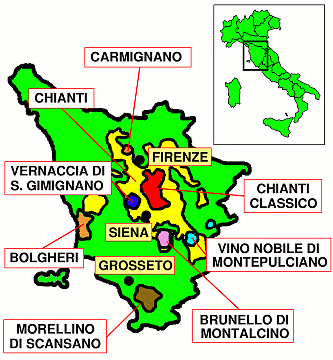
TuscanyChianti, Brunello di Montalcino and Vino Nobile di Montepulciano: three magnificent red wines which made Tuscany famous all over the world, one of the most celebrated wine region of Italy |
|
Among the first regions which come to mind when talking about Italian wine, Tuscany certainly is one of the first. Mainly famous for red wines produced with Sangiovese grape - including Chianti, Brunello di Montalcino and Vino Nobile di Montepulciano - Tuscany is also appreciated for red wines produced with the main “international” grapes, such as Cabernet Sauvignon, Merlot and Pinot Noir. Despite they are less famous, in Tuscany are also produced some interesting white wines, and just like for red wines, the production is made both with autochthonous grapes - such as Vernaccia di San Gimignano - and international grapes, in particular Chardonnay. Tuscany is also famous for the production of Vin Santo, certainly not the only region of Italy in which this particular sweet wine is produced with dried grapes, but certainly one of the most representative regions. The origin of wine making in Tuscany is dated back to Etruscan times, the ancient and amazing people who settled in central Italy, whose origin are still today not very clear. Despite some ancient authors have mentioned wines produced by Etruscans, none of them was considered of high quality as to compete with other renowned wines of those times, such as Falerno. This confirms the marginal role of wine in the culture of Etruscans, a role which however become important in commercial aspects. The finding of Etruscan amphoras dated back to the seventeenth century B.C., even in territories far away from the ancient lands of Etruscans, including south France, prove Etruscans considered wine as a good to be commercialized with other people, although they were not great consumers nor excellent wine makers. Maybe it is also because of the scarce importance Etruscans recognized to wine in their culture - and therefore to wine making as well - it will not be found mention of quality Tuscan wines for many centuries to come.
Tuscan wines are mentioned from medieval times, not because they were considered to be of quality, indeed for the prestige the region - in particular the cities of Florence and Siena - acquired politically and commercially. Wine was become a strategic commercial item, and it is thanks to this if today we have information about Tuscan wine because of the work of merchants. Information about the trading of wine in Tuscany are dated back to 1079, when the wine of the region was sold and commercialized at Mercato Vecchio (Old Market) in Florence. The trading of wine soon acquired a strategical importance, and in 1282 was founded the corporation of Arte dei Vinattieri (Art of Wine Merchants and Makers). It was a period in which viticulture and the production of wine flourished, although not showing important development in quality. In 1385 Giovanni di Piero Antinori joins Arte dei Vinattieri, therefore starting one of the most ancient dynasties still in activity and committed to wine making, a continuous and important history 26 generations long, which plays, still today, a primary role in Tuscan and Italian enology. In 1398 Chianti wine is mentioned for the first time, however it is interesting to see the citation was referred to white wine and not to the red one, that is the type of wine which today distinguishes the renowned and historical Tuscan area. The Chianti area is defined for the first time in a document dated back to the second half of twelfth century, where the hills between Baliaccia and Monte Luco are being identified as Monti del Chianti (Mountains of Chianti). The term Chianti - which probably comes from the Etruscan name Clante - was subsequently added to the names of the villages Castellina, Radda and Gaiole, which founded the “Lega del Chianti” (Chianti League), controlled by the jurisdiction of Florence. In occasion of the definition of its statute, the Lega del Chianti chose as its emblem the famous “black rooster in golden background”, which is still today used for distinguishing the wines of Chianti Classico. In the Chianti area wine has always played a strategic and important commercial role. Many are in fact the edicts and laws expressly emanated for the safeguarding of vineyards, cultivation techniques of vines and wine production in order to guarantee quality and therefore their commercialization. Chianti has also another important historical and worldwide record, the one of having being the first wine making area to be delimited and defined by law. In 1716 Grand duke Cosimo III, with a specific edict, delimited the borders of Chianti wine area «from Spedaluzzo to Greve; then to Panzano, with the territory of Radda, which includes the three villages of Radda, Gaiole and Castellina, up to the borders of the state of Siena». At those times the color of Chianti wine was already changed since many years, and the ancient citation of white wines written in the document of 1398 is now replaced by a red wine called “Vermihlio” (vermilion). To talk about the grapes used at those times for the production of Chianti is Cosimo Villifranchi, who in 1773 wrote this wine was mainly produced with Canaiolo Nero to which was added a small quantity of Sangiovese, Mammolo and Marzemino. It is singular to notice Cosimo Villifranchi mentioned the use of white grapes Trebbiano and San Colombano as well. In 1872 the famous Baron Bettino Ricasoli, after having experimented for decades on the production of Chianti, formulated his renowned recipe which is still today used by many producers. Baron Bettino Ricasoli suggested the use of Sangiovese for most of the part, in order to give Chianti vigor and aromas, as well as Canaiolo Nero, in order to smooth both the acidity and astringency of Sangiovese. He also suggested the use of Malvasia Bianca only for wines to be consumed young and he discouraged its use for wines destined for aging. Baron Bettino Ricasoli did not mention Trebbiano Toscano, mistakenly considered part of his “recipe”. The introduction of Trebbiano - which together with Malvasia Bianca can make 30% of the wine - was probably because of the custom the producers of those times had in order to make higher quantity of wines which could quickly aged and therefore commercialized earlier. At the end of 1960s, in order to stop the decaying image of Chianti wines, some producers - the first one being Marquis Mario Incisa della Rocchetta - decided to give a new boost to Tuscan enology by creating full bodied wines based on the “international” model, produced with French grapes and aged in barrique. These wines, which in the beginning were classified as table wines, were soon called Supertuscans and also other producers began their production, adding to the famous Cabernet Sauvignon and Merlot, the local Sangiovese: a combination which is still frequent in many Tuscan wines.
|
||||||||||||
|
Just like the other regions of Italy, Tuscany is classified according to the quality system in force in the country which provides for, from the lowest to the highest rank, Vini da Tavola (Table Wines), Indicazione Geografica Tipica (Typical Geographical Indication, IGT), Denominazione d'Origine Controllata (Denomination of Controlled Origin, DOC) and Denominazione d'Origine Controllata e Garantita (Denomination of Controlled and Guaranteed Origin, DOCG). Despite in Tuscany are defined many DOC and DOCG areas, particularly interesting are the wines classified as IGT, the category to which belong most of the so called Supertuscans, full bodied wines produced according to the “international” model. In Tuscany are defined 6 DOCG areas and precisely: Brunello di Montalcino, Carmignano, Chianti, Chianti Classico, Vernaccia di San Gimignano and Vino Nobile di Montepulciano. The DOC areas defined in Tuscany are 35: Ansonica Costa dell'Argentario, Barco Reale di Carmignano, Bianco della Valdinievole, Bianco dell'Empolese, Bianco di Pitigliano, Bianco Pisano di San Torpé, Bolgheri, Candia dei Colli Apuani, Capalbio, Colli dell'Etruria Centrale, Colli di Luni, Colline Lucchesi, Cortona, Elba, Montecarlo, Montecucco, Monteregio di Massa Marittima, Montescudaio, Morellino di Scansano, Moscadello di Montalcino, Orcia, Parrina, Pietraviva, Pomino, Rosso di Montalcino, Rosso di Montepulciano, San Gimignano, Sant'Antimo, Sovana, Val d'Arbia, Valdichiana, Val di Cornia, Vin Santo del Chianti, Vin Santo del Chianti Classico and Vin Santo di Montepulciano.
|
|
The production of wine in Tuscany is made in the whole territory, from north to south, the succession of hills has the vineyard as a common factor. In this region are mainly produced red wines with Sangiovese grape, which is found everywhere in Tuscany and used alone of together with other grapes, including the international ones. The most common white berried grape in Tuscany is Trebbiano Toscano, followed by Malvasia Bianca, present in many white wines of the region and, as it is suggested by tradition, in many Chianti wines as well. Another common white berried grapes in Tuscany is Chardonnay, with which are being produced white wines according to the international model to which it is frequently added the barrique. The spreading and notoriety of the so called Supertuscans has introduced in Tuscany many “international” red grapes - of which the main ones are Cabernet Sauvignon, Merlot, Pinot Noir and Syrah - to which is being added Sangiovese, in order to keep a “touch” of Tuscan tradition. The spreading of these grapes in Tuscany is such that today most of them are included in many production disciplinary of DOC wines, including the traditional Chianti, to which are being frequently used, besides Sangiovese, Cabernet Sauvignon and Merlot as well.
|
|
One of the most famous wines of Tuscany, practically known by every wine lover and also the ones who are not interested in wine have heard of it at least once, certainly is Brunello di Montalcino. The wine takes its name from the grape with which it is produced - Brunello - the name with which it is called in Montalcino the Sangiovese Grosso grape. The wines of Montalcino - which is located south from Siena - owe their notoriety to a figure who is part of the history of Tuscan wine making: Ferruccio Biondi Santi. The grape Brunello, traditionally present in Montalcino, thanks to the intuitions of Ferruccio Biondi Santi, as well as the experience of his grandfather Clemente Santi, was transformed into a wine which soon became famous all over the world. It was 1888: the history of Brunello di Montalcino was just begun. This famous wine, recognized by the Italian quality system as DOCG, is produced with 100% Sangiovese Grosso - locally known as Brunello - and can be released for consumption only after 5 years from harvesting (6 for the reserve), with a minimum of two years of aging in cask.
|
|
Chianti is just another of those names - and of wines - which made Tuscany famous in the world. According to the quality system in force in Italy - who recognizes to every Chianti wine the DOCG category - the famous wines of these areas are divided in many denominations, all being different one from each other in every aspect. Chianti Classico - that is the most ancient and traditional production area - is produced in the classic territory going from south of Florence to north of Siena, and it is from this area which come the most famous Chianti wines. The production area of Chianti - which provides for the generic denomination “Chianti” - includes seven areas and precisely: Colli Aretini, Colli Senesi, Colli Fiorentini, Colline Pisane, Rufina, Montalbano and Montespertoli. According to the disciplinary, Chianti is mainly produced with Sangiovese and Canaiolo Nero grapes, a small part of Malvasia Bianca and Trebbiano Toscano, as well as other grapes permitted by the disciplinary, usually Cabernet Sauvignon and Merlot. Despite the invasion of “international” grapes in Chianti is getting a more and more determinant role, it should be observed there are still many producers who prefer using traditional Chianti's grapes only.
|
|
Of the six DOCG areas of Tuscany in the province of Siena, the area of Vino Nobile di Montepulciano certainly is among the most famous ones. This wine is mainly produced with the Prugnolo Gentile grape - name with which in Montepulciano is called Sangiovese Grosso - to which is added Canaiolo Nero and, in lesser percentage, Mammolo and Colorino, as well as other grapes permitted by the production disciplinary. Vino Nobile di Montepulciano can be commercialized only after a minimum of two years of aging in cask. Robust and complex wine, Nobile di Montepulciano can be aged for many years, developing with time very complex and pleasing qualities. Wine having long traditions, Nobile di Montepulciano was known since 1500s for its quality, a wine appreciated and celebrated by the nobles of those times, it was also widely praised by Sante Lancerio. After a long time of decay, the first attempts of reprise were recorded after the year 1900 and in particular in 1960s, when producers began to become interested again to Nobile instead to Chianti, a process which will give origin to the new awakening in 1980s, when Vino Nobile di Montepulciano was recognized the DOCG rank.
|
|
Talking about the wine areas of Tuscany recognized by the Italian quality system, would certainly require a longer report. However it is appropriate mentioning those areas and those wines which in recent times are getting more and more popular among wine lovers. In this sense are interesting the other two Tuscan DOCG wines: Carmignano and Vernaccia di San Gimignano. Carmignano, another famous wine area having long history and tradition and which is located in the province of Prato, exclusively produces red wines with Sangiovese, Canaiolo Nero, Cabernet Sauvignon and Cabernet Franc. Vernaccia di San Gimignano - which is produced in the territory of the famous city of towers in the province of Siena - is a remarkable white wine produced with the homonymous grape. Among the other interesting DOC areas, is mentioned Morellino di Scansano, mainly produced with Sangiovese grape, locally called Morellino. Morellino di Scansano is a wine which is now part of the great ones of Tuscany, thanks to the efforts of producers who have been successful is proving the enormous potentialities of their territory and wine. Among the many wines, Vin Santo is one which should certainly be mentioned, despite it is a wine whose tradition is shared with other regions in Italy, in Tuscany is recognized in some areas as DOC, as in case of Vin Santo del Chianti, Vin Santo del Chianti Classico and Vin Santo di Montepulciano. In Tuscany, Vin Santo is generally produced with the grapes Trebbiano Toscano and Malvasia Bianca, however there is also a style produced with Sangiovese and which is called Occhio di Pernice (partridge eye). As for other interesting DOC areas in Tuscany are mentioned: Bolgheri, Cortona, Orcia, Parrina, Pomino, Rosso di Montalcino, Rosso di Montepulciano, San Gimignano and Sant'Antimo. A special mention goes to the family of the so called Supertuscans, robust and complex wines mainly produced with “international” grapes - in particular Cabernet Sauvignon, Merlot and Pinot Noir - to which is frequently added the local grape Sangiovese. Supertuscans wines generally belong to the IGT category (Indicazione Geografica Tipica, Typical Geographic Indication), a classification in which it is possible to find truly interesting wines, not only in Tuscany.
|
Comparing Alto Adige's GewürztraminerImportant representative of the aromatic grapes family, Gewürztraminer is an explosion of aromas and flavors, capable of making very elegant and refined wines |
|
Gewürztraminer is a special grape according to many point of views. Its presence in wines is easily recognizable by anyone and it is Gewürztraminer the first aromatic grape which is usually met by any neophyte wine lover. Capable of making white wines with remarkable body, with the characteristic golden yellow color, its aromatic vehemence - which reminds not only grape, but also spices, flowers and tropical fruits - is something which hardly goes unnoticed. The remarkable personality of Gewürztraminer is in fact so strong that it is sometimes exaggerated, in particular when it is being used with other grapes, but however it always gives any wine a touch of elegance and finesse like few other grapes. Introduced this way, it would seem that making a good Gewürztraminer wine takes little and it is enough to completely trust its magic. Of course, it is not like that. Making an excellent Gewürztraminer wine is an art not for many, transforming it into an ordinary wine is something which frequently happens instead. Despite Gewürztraminer is considered an “international” grape, as opposed to its other famous colleagues, it does not have French origins, nevertheless it has a strong connection with France and in particular with Alsace, region from which come excellent wines produced with this grape. It is believed Gewürztraminer - sometimes also written as Gewurztraminer or Traminer Aromatico in Italy - derives from Traminer, a grape originating from Termeno, in Alto Adige, and of which exists written documents as old as 1000 AD. Gewürztraminer's berries, as opposed to its progenitor Traminer, have a basically pink color and stronger aromatic qualities: it is not by chance the German word gewürz means spicy and, in this specific case, its more appropriate meaning is aromatic. It should be noticed the existence of a certain confusion between the use of the names Traminer and Gewürztraminer: despite they are two different grapes, Gewürztraminer is frequently defined as Traminer.
|
|
Wines produced with Gewürztraminer generally have a fuller structure when compared to other white wines, a strong and typical aromaticity as well as a pretty high alcohol by volume, sometimes greater than 13%. Thanks to its qualities, Gewürztraminer is a grape used for the production of many styles of wine, from dry to sweet, including ice wines. The most common vinification technique makes use of inert containers, such as steel and cement, whereas fermentation and aging in cask or barrique is a pretty limited practice, because when used in an exaggerated way it can compromise the appreciation of aromas, the main characteristic of Gewürztraminer. The remarkable quantity of alcohol can sometimes make acidity insufficient therefore making the wine unbalanced, a problem which keeps producers pretty busy. Gewürztraminer is not an easy grape for the ones who decide to cultivate it and to use it for wine making, however, given the appropriate conditions and quality criteria, it is capable of making wines which can always and however surprise.
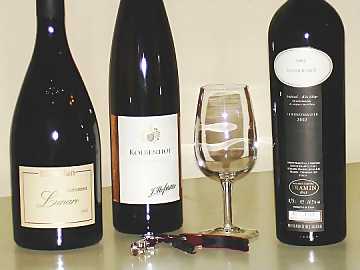
We will focus our comparative tasting on one of the most interesting and celebrated area of Italy for Gewürztraminer: Alto Adige. Not only the region from which this grape is from, but also an extremely interesting area for the production of white wines, of which Gewürztraminer is an excellent representative. The first wine selected for our comparative tasting is Cantina Terlano's Alto Adige Gewürztraminer Lunare, the second one is Hofstätter's Alto Adige Gewürztraminer Kolbenhof, whereas the third wine is Produttori Termeno's Alto Adige Gewürztraminer Nussbaumer. Three excellent examples of Alto Adige's Gewürztraminer, of which only Cantina Terlano's Lunare has been aged for about 12 months in cask, whereas the other two have been vinified in steel tanks, where they are allowed to age for some months followed by a short aging in bottle. The three wines will be served at a temperature of 10° C (50° F), enough for the development of the exuberant aromas of the grape and for the appreciation of the other organoleptic qualities. The comparative tasting will be done by using three ISO tasting glasses.
|
||||||||
|
As opposed to most of white wines - in which can be generally observed colors ranging from greenish yellow to straw yellow - in Gewürztraminer hues will show deeper and fuller colors, intense straw yellow color, as well as golden yellow color, a characteristic which can be found in young wines as well. The reason of this deeper intensity in colors is mainly because of Gewürztraminer's skin, which with its pink color, gives deeper colors to wines. As wines produced with this grape generally have a pretty high alcohol by volume - also greater than 13% - Gewürztraminer wines can age for some years in bottle. With aging the color will get deeper golden yellow colors, as well as evident amber yellow color nuances, a characteristic which is always present, for example, in sweet wines produced with Gewürztraminer. The first wine of which we will examine appearance is Cantina Terlano's Alto Adige Gewürztraminer Lunare, the only one of three wines fermented and aged in cask. By keeping the glass in vertical position, it will be observed the base of the liquid mass, where it will be possible to see a brilliant golden yellow color. By tilting the glass over a white surface and by observing the border of the liquid mass, it will be observed nuances of the same color. The second wine we will examine is Hofstätter's Alto Adige Gewürztraminer Kolbenhof. The color of this wine is paler than the previous one: here it will noticed an intense straw yellow color, almost golden, with straw yellow nuances. The last wine of which we will evaluate appearance is Produttori Termeno's Alto Adige Gewürztraminer Nussbaumer, aged in steel tanks. The color of this wine is intense golden yellow and - by tilting the glass over a white surface - it will be observed nuances of the same color. As it was predictable, the effect of aging in cask gave Cantina Terlano's Gewürztraminer Lunare deeper hues than the other two wines.
|
|
The evaluation of Gewürztraminer's aromas - of quality Gewürztraminer wines, of course - always represents an amazing experience for every taster. Not only a world made of the exuberant and exaggerated grape aroma, but in particular of a universe made of tens of aromas, in which are found, among the many, flowers, fruits - also tropical - spices and aromatic herbs. In Gewürztraminer produced with dried grapes, the scene is completed by aromas of dried fruits and jams, in other words, the olfactory analysis of this grape should be considered a highly educative experience for every taste: it is not by chance the wines produced with Gewürztraminer are frequently used for educational purposes in sensorial wine tasting classes. Thanks to alcohol - which in Gewürztraminer is frequently higher than 13% - wines produced with this grape can stand to some years of aging in bottle, a process allowing its exuberant aromas to evolve and by giving back - in particular in sweet wines - genuine nectars characterized by complex and intense aromas. We will begin the olfactory evaluation of our wines from Hofstätter's Alto Adige Gewürztraminer Kolbenhof. By keeping the glass in vertical position, we will evaluate opening aromas. It will be immediately perceived a strong grape aroma - a quality which classifies Gewürztraminer in the family of aromatic grapes - and an overall elegant and refined profile. After having swirled the glass, it will be done a second smell which will allow the perception of the aromas of peach, litchi, banana, pineapple, passion fruit, apricot, broom, pear, kiwi and honey. It will finally be noticed an aroma of sage, one of the many aromatic herbs which can be found in the olfactory evaluation of Gewürztraminer. It will also be noticed, despite the aromaticity of the wine is pretty strong, how the other aromas are expressed in a very balanced and harmonic way. We will now pass to the evaluation of the second wine, Produttori Termeno's Alto Adige Gewürztraminer Nussbaumer. By keeping the glass in vertical position and without swirling, we will proceed with the evaluation of opening aromas. From the glass will be perceived the typical aroma of grape as well as peach, litchi and honey. The second smell - done after having swirled the glass - will reveal aromas of banana, passion fruit, pineapple, apricot, pear and orange, as well as pleasing and balanced aromas of flowers such as acacia, lily and white rose, the latter being typical in Gewürztraminer. It will also be noticed the presence of sage aroma, just like in the previous wines. We will now pass to the olfactory evaluation of the last wine, Cantina Terlano's Alto Adige Gewürztraminer Lunare, the only one of the three fermented and aged in cask. The first smell will reveal opening aromas of grape, litchi, yellow rose and honey, whereas the second smell - after having swirled the glass - will allow the perception of the aromas of banana, peach, gooseberry, apricot and broom as well as sage. It should also be noticed the presence of vanilla and toasted wood aromas, sign of the passage in cask, which however do not disturb the balance and the perception of other aromas.
|
||||
|
The gustatory evaluation of dry Gewürztraminer wines can be sometimes deceiving for the neophyte taster. Because of the high content in alcohol and a limited acidity, dry wines produced with this grape usually appear smooth, a surely pleasing roundness. This characteristic, despite it is very pleasing, can be sometimes confused with the organoleptic sensation of sweetness. This “false” perception will be also evident in the three Gewürztraminers of our comparative tasting, three wines which have to be considered absolutely dry. Gewürztraminer wines are also characterized by a pretty full structure, probably among the whites having the highest structure. As we would certainly expect from any aromatic grape, in Gewürztraminer the olfactory correspondence to the taste is always very good, persistence in the mouth of the best wines can be measured for more than 15 seconds, while leaving in the mouth a pleasing and clear flavor of grape. The first wine we will examine is Hofstätter's Alto Adige Gewürztraminer Kolbenhof. After the very first sip it will be possible to perceive the high content in alcohol and the structure, a sensation which is hardly met in other white wines. It will also be noticed the correspondence to the nose - something we will notice in other wines as well - and the strong flavor of grape. Also acidity will be well balanced with the other organoleptic qualities of the wine. Let's now examine the second wine, Produttori Termeno's Alto Adige Gewürztraminer Nussbaumer. Also in this case the attack will evidence both alcohol and body, a good acidity, very well balanced, and the usual flavor of grape, very elegant and refined. The last wine we will examine is Cantina Terlano's Alto Adige Gewürztraminer Lunare, fermented and aged in cask. The attack is not different from the previous wines, also in this case it will be noticed the alcohol and body, higher than the previous wines, however balanced by a good acidity. It will finally be noticed how the organoleptic qualities of wood do not negatively influence Gewürztraminer's personality and typicality.
|
|
In the final phase of our comparative tasting, we will discover another fine characteristic of Gewürztraminer: long persistence. In quality wines produced with this grape - as in the case of our three wines - the taste-olfactory persistence is always very long, most of the times longer than 15 seconds. The long finish of Hofstätter's Alto Adige Gewürztraminer Kolbenhof will be characterized by flavors of grape, peach, banana, pear, kiwi, honey and litchi, whereas in Produttori Termeno's Alto Adige Gewürztraminer Nussbaumer the flavor of grape will be joined by peach, honey, litchi and banana. Also the last wine, Cantina Terlano's Alto Adige Gewürztraminer Lunare has a very long persistence in which it is possible to perceive flavors of grape, peach, apricot, litchi, honey and pear. As we can see, three pretty similar finishes which confirm the typicality of Gewürztraminer, a grape which hardly goes unnoticed, from its golden look to the long flavors left in the mouth at the end of tasting.
|
Wines of the Month |
|
|
Score legend Fair Pretty Good Good Very Good Excellent Fair Pretty Good Good Very Good Excellent Wine that excels in its category Wine that excels in its category Good value wine Good value winePrices are to be considered as indicative. Prices may vary according to the country or the shop where wines are bought |
|
|
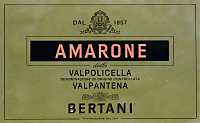
Amarone della Valpolicella Valpantena Villa Arvedi 2002 |
|
| Bertani (Veneto, Italy) | |
| Grapes: Corvina (70%), Rondinella (25%), Molinara (5%) | |
| Price: € 25.20 | Score: |
| This Amarone shows a brilliant ruby red color and nuances of brick red, moderate transparency. The nose reveals intense, clean, pleasing and refined aromas which start with hints of blackberry, plum and black cherry followed by aromas of dried violet, tobacco, vanilla, licorice, chocolate, cinnamon, mace and menthol. The mouth has good correspondence to the nose, a tannic attack and however balanced by alcohol, full body, intense flavors, pleasing roundness. The finish is persistent with flavors of plum, black cherry and blackberry. This Amarone ages in cask. | |
| Food Match: Game, Roasted meat, Stewed and braised meat, Hard cheese | |
|
|
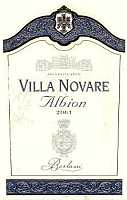
Villa Novare Albion 2001 |
|
| Bertani (Veneto, Italy) | |
| Grapes: Cabernet Sauvignon | |
| Price: € 18.90 | Score: |
| The wine shows an intense ruby red color and nuances of garnet red, little transparency. The nose denotes intense, clean, pleasing, refined and elegant aromas that start with hints of black cherry, plum and black currant followed by aromas of blueberry, dried violet, vanilla, licorice, cocoa, tobacco, pink pepper, mace and eucalyptus. The mouth has good correspondence to the nose, a tannic attack and however balanced by alcohol, full body, intense flavors, agreeable. The finish is persistent with flavors of black cherry, plum and black currant. A well made wine. Villa Novare Albion ages for 14 months in barrique followed by 6 months of aging in bottle. | |
| Food Match: Roasted meat, Stewed and braised meat, Hard cheese | |
|
|
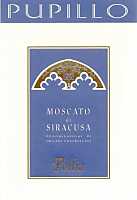
Moscato di Siracusa Pollio 2002 |
|
| Pupillo (Sicily, Italy) | |
| Grapes: Muscat Blanc | |
| Price: € 24.00 | Score: |
| Moscato di Siracusa Pollio shows a pale straw yellow color and nuances of straw yellow, very transparent. The nose denotes intense, clean, pleasing and refined aromas which start with hints of grape, peach and candied sugar followed by aromas of candied fruits, apple, litchi, citrus fruits, hawthorn, pear, honey, sage and rosemary. The mouth has good correspondence to the nose, a sweet attack and pleasing smoothness, however balanced, good body, intense flavors, agreeable. The finish is persistent with flavors of grape, peach, litchi and honey. This wine ages in steel tanks. | |
| Food Match: Desserts, Fruit and cream tarts | |
|
|
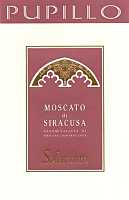
Moscato di Siracusa Solacium 2002 |
|
| Pupillo (Sicily, Italy) | |
| Grapes: Muscat Blanc | |
| Price: € 24.00 | Score: |
| This wine shows a brilliant straw yellow color and nuances of straw yellow, very transparent. The nose reveals intense, clean, pleasing, refined and elegant aromas which start with hints of grape, peach and candied fruit followed by aromas of litchi, almond, anise, citrus fruits, honey, pear, apple, white rose and sage. The mouth has good correspondence to the nose, a sweet attack and pleasing roundness, however balanced, good body, intense flavors, agreeable. The finish is persistent with flavors of grape, peach, honey and candied fruit. A well made wine. Moscato di Siracusa Solacium ages in steel tanks. | |
| Food Match: Dessert, Dried fruits tarts, Hard cheese | |

|
|
Alto Adige Gewürztraminer Castel Turmhof 2005 |
|
| Tiefenbrunner (Alto Adige, Italy) | |
| Grapes: Gewürztraminer | |
| Price: € 12.90 | Score: |
| The wine shows a brilliant golden yellow color and nuances of golden yellow, very transparent. The nose denotes intense, clean, pleasing and refined aromas that start with hints of grape, peach and litchi followed by aromas of yellow rose, pineapple, passion fruit, mango, apple, honey and pear. The mouth has good correspondence to the nose, a crisp attack and pleasing smoothness, however balanced by alcohol, full body, intense flavors, agreeable. The finish is persistent with flavors of grape, peach and litchi. Gewürztraminer Castel Turmhof ages for 6 months in steel tanks. | |
| Food Match: Roasted fish, Broiled crustaceans, Stewed fish | |

|
|
Alto Adige Cabernet Merlot Cuvée Linticlarus 2002 |
|
| Tiefenbrunner (Alto Adige, Italy) | |
| Grapes: Cabernet Sauvignon (55%), Merlot (45%) | |
| Price: € 15.00 | Score: |
| This wine shows an intense ruby red color and nuances of garnet red, moderate transparency. The nose reveals intense, clean, pleasing, refined and elegant aromas that start with hints of black cherry, plum and black currant followed by aromas of blueberry, dried violet, vanilla, cinnamon, licorice, tobacco, mace, bell pepper and menthol. The mouth has good correspondence to the nose, a tannic attack and however balanced by alcohol, full body, intense flavors, agreeable. The finish is persistent with flavors of black cherry, plum and black currant. A well made wine. Cuvée Linticlarus ages for 18 months in barrique. | |
| Food Match: Game, Roasted meat, Braised and stewed meat, Hard cheese | |

|
|
Brunello di Montalcino 2001 |
|
| Tenute Silvio Nardi (Tuscany, Italy) | |
| Grapes: Sangiovese | |
| Price: € 30.00 | Score: |
| This Brunello di Montalcino shows a brilliant ruby red color and nuances of garnet red, moderate transparency. The nose reveals intense, clean, pleasing and refined aromas which start with hints of black cherry, blueberry and plum followed by aromas of violet, carob, licorice, vanilla, cinnamon, tobacco, mace and hints of menthol. The mouth has good correspondence to the nose, a tannic attack and however balanced by alcohol, full body, intense flavors, agreeable. The finish is persistent with flavors of black cherry and plum. This Brunello di Montalcino ages for 12 months in barrique, 12 months in cask and at least 6 months of aging in bottle. | |
| Food Match: Game, Braised and stewed meat, Roasted meat, Hard cheese | |
|
|
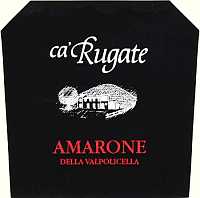
Amarone della Valpolicella 2003 |
|
| Ca' Rugate (Veneto, Italy) | |
| Grapes: Corvina (40%), Rondinella (30%), Corvinone (30%) | |
| Price: € 38.00 | Score: |
| This Amarone shows an intense ruby red color and nuances of garnet red, little transparency. The nose reveals intense, clean, pleasing, refined and elegant aromas which start with hints of blackberry, black cherry and plum followed by aromas of violet, vanilla, tobacco, licorice, cinnamon, chocolate, mace, pink pepper and menthol. The mouth has good correspondence to the nose, a tannic attack and however balanced by alcohol, full body, intense flavors, agreeable. The finish is persistent with flavors of blackberry, black cherry and plum. A well made wine. This Amarone della Valpolicella is produced with grapes dried for 4-5 months and ages in cask for 25-30 months. | |
| Food Match: Game, Roasted meat, Braised and stewed meat, Hard cheese | |
|
|
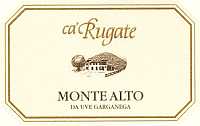
Soave Classico Monte Alto 2004 |
|
| Ca' Rugate (Veneto, Italy) | |
| Grapes: Garganega | |
| Price: € 19.00 | Score: |
| Soave Classico Monte Alto shows an intense golden yellow color and nuances of golden yellow, very transparent. The nose reveals intense, clean, pleasing, refined and elegant aromas which start with hints of apple, honey and vanilla followed by aromas of almond, broom, pear, peach, plum, grapefruit, medlar, hawthorn and yeast. The mouth has good correspondence to the nose, a crisp attack and pleasing roundness, however balanced by alcohol, good body, intense flavors, agreeable. The finish is very persistent with long flavors of plum, apple and almond. A very well made wine. Monte Alto ferments and ages in barrique for 6-8 months. | |
| Food Match: Pasta with mushrooms, Mushrooms soup, Roasted and stewed meat, Roasted white meat | |
|
|
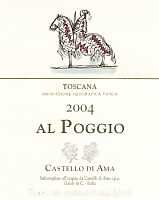
Al Poggio 2004 |
|
| Castello di Ama (Tuscany, Italy) | |
| Grapes: Chardonnay (80%), Malvasia Bianca (15%), Pinot Gris (5%) | |
| Price: € 16.00 | Score: |
| The wine shows a brilliant golden yellow color and nuances of straw yellow, very transparent. The nose reveals intense, clean, pleasing and refined aromas that start with hints of apple, pear and pineapple followed by aromas of hawthorn, yeast, plum and vanilla. The mouth has good correspondence to the nose, a crisp attack and pleasing roundness, however balanced by alcohol, good body, intense flavors. The finish is persistent with flavors of apple, plum and pear. Al Poggio ages for 8 months in barrique. | |
| Food Match: Stuffed pasta, Roasted white meat, Roasted fish | |
|
|
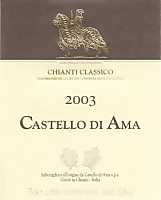
Chianti Classico Castello di Ama 2003 |
|
| Castello di Ama (Tuscany, Italy) | |
| Grapes: Sangiovese (80%), Canaiolo Nero (8%), Malvasia Nera, Merlot (12%) | |
| Price: € 25.00 | Score: |
| This Chianti Classico shows an intense ruby red color and nuances of garnet red, moderate transparency. The nose denotes intense, clean, pleasing and refined aromas which start with hints of plum and black cherry followed by aromas of violet, blueberry, blackberry, vanilla, chocolate, licorice, pink pepper and menthol. The mouth has good correspondence to the nose, a tannic attack and however balanced by alcohol, good body, intense flavors. The finish is persistent with flavors of plum and black cherry. This Chianti Classico ages in barrique. | |
| Food Match: Broiled meat and barbecue, Roasted meat, Stewed meat, Hard cheese | |
|
|
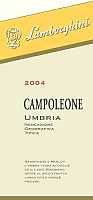
Campoleone 2004 |
|
| Lamborghini (Umbria, Italy) | |
| Grapes: Sangiovese (50%), Merlot (50%) | |
| Price: € 30.00 | Score: |
| Campoleone shows a brilliant ruby red color and nuances of ruby red, little transparency. The nose reveals intense, clean, pleasing, refined and elegant aromas which start with hints of black cherry and plum followed by aromas of black currant, blackberry, blueberry, violet, cinnamon, chocolate, vanilla, tobacco, mace, menthol and hints of lavender. The mouth has good correspondence to the nose, a tannic attack and however balanced by alcohol, full body, intense flavors, agreeable. The finish is persistent with flavors of black cherry and plum. A well made wine. Campoleone ages for 12 months in barrique followed by 6 months of aging in bottle. | |
| Food Match: Game, Roasted meat, Stewed and braised meat, Hard cheese | |
|
|
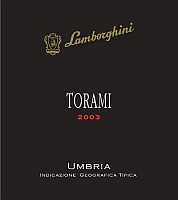
Torami 2003 |
|
| Lamborghini (Umbria, Italy) | |
| Grapes: Montepulciano | |
| Price: € 20.00 | Score: |
| Torami shows an intense ruby red color and nuances of ruby red, little transparency. The nose reveals intense, clean, pleasing, refined and elegant aromas which start with hints of black cherry, plum and black currant followed by aromas of blueberry, blackberry, violet, vanilla, tobacco, licorice, cinnamon, cocoa, eucalyptus and mace. The mouth has good correspondence to the nose, a tannic attack and however balanced by alcohol, full body, intense flavors, agreeable roundness. The finish is persistent with flavors of black cherry, plum and black currant. A well made wine. Torami ages for 10 months in barrique followed by 6 months of aging in bottle. | |
| Food Match: Game, Roasted meat, Stewed and braised meat, Hard cheese | |
|
|
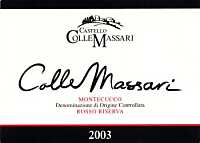
Montecucco Rosso Riserva Colle Massari 2003 |
|
| Collemassari (Tuscany, Italy) | |
| Grapes: Sangiovese (80%), Ciliegiolo (10%), Cabernet Sauvignon (10%) | |
| Price: € 14.00 | Score: |
| The wine shows an intense ruby red color and nuances of ruby red, little transparency. The nose denotes intense, clean, pleasing and refined aromas that start with hints of black cherry, plum and blueberry followed by aromas of vanilla, black currant, chocolate, cinnamon, anise, eucalyptus, tobacco, mace and pink pepper. The mouth has good correspondence to the nose, a tannic attack and however balanced by alcohol, full body, intense flavors, agreeable. The finish is persistent with flavors of black cherry, plum and blueberry. This wine ages for 18 months in barrique followed by at least 12 months of aging in bottle. | |
| Food Match: Game, Roasted meat, Stewed and braised meat, Hard cheese | |
|
|
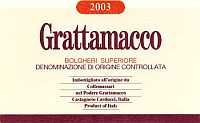
Bolgheri Rosso Superiore Grattamacco 2003 |
|
| Collemassari (Tuscany, Italy) | |
| Grapes: Cabernet Sauvignon (65%), Merlot (20%), Sangiovese (15%) | |
| Price: € 45.00 | Score: |
| Grattamacco shows a brilliant ruby red color and nuances of garnet red, little transparency. The nose reveals intense, clean, pleasing, refined and elegant aromas which start with hints of black cherry, plum and black currant followed by aromas of blueberry, violet, vanilla, undergrowth, cyclamen, carob, tobacco, pink pepper, eucalyptus and hints of bell pepper. The mouth has good correspondence to the nose, a tannic attack and however balanced by alcohol, full body, intense flavors, agreeable. The finish is persistent with flavors of plum, black cherry and black currant. A well made wine. Grattamacco ages for 18 months in barrique followed by at least 12 months of aging in bottle. | |
| Food Match: Game, Roasted meat, Stewed and braised meat, Hard cheese | |
Il MosnelAmong the oldest wineries in Franciacorta, Il Mosnel, a property of Barboglio family since 1836, is today one of the most successful wineries for the production of the precious Franciacorta's bubbles |
|
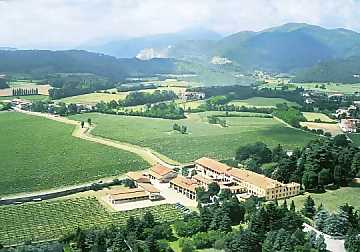
Among the many wineries in Franciacorta which were successful in proving the quality of the bubbles from this territory, there is the historical winery Il Mosnel, located at Camignone di Passirano. The name of this prestigious Franciacorta's winery derives from an ancient place whose name has Celtic origins and meaning “pietraia” - that is a drift of stones - which is enough to give the idea about the condition of these lands in ancient times. The territory was cleared up by Cistercians monks from the abbey of Cluny, in Burgundy, who in the village of Ridengo - near the Il Mosnel - built their magnificent abbey and introduced the cultivation of vine. Thanks to this, the place of Camignone quickly become famous for the quality of its wines, something which is proven by a document of the land registry of Brescia dated 1609, during the times of Venetian Republic, in which it is written that at Camignone «…lands are good and from which are produced excellent wines…In this context of long history and tradition, Il Mosnel winery takes its origins - still keeping in the oldest part of its structure the cellars of the 1500s - which was property of the powerful Cacciamatta family and in 1836 was acquired by the Barboglio family.
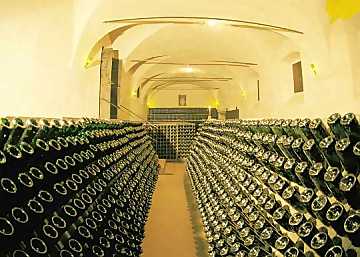
When Rosina Rosa Cacciamatta entered the management, she was the last descendant of the Cacciamatta di Castiglione family and who got married to Pietro Barboglio, the history of Il Mosnel has always been characterized by the key role the family's women played. The tradition of women's management continued up to the 1950s, when Emanuela Barboglio, after her father passed away and at the age of eighteen she was in charge for the management of the firm. Emanuela Barboglio, who was taught and advised by her grandmother Nina, faced the hard years of those times, when people moved from the countryside to the city and preferred a more comfortable lifestyle. Emanuela Barboglio decided to do the opposite, and from the city moved to Camignone, therefore contributing to the formation of the viticultural future of Il Mosnel. Vineyards were planted and in 1968 the winery adopted for its wines the newborn Franciacorta DOC. In recent times, Emanuela Barboglio has been joined in the management of Il Mosnel by her son Giulio Barzanò - which is in charge for technical, commercial and productive issues - and her daughter Lucia Barzanò, who is in charge for management, commercialization of wines, public and press relations. The complex where Il Mosnel winery is located is still made of the ancient structures of the 1500s, properly restored and adapted for the production of wine, offering an absolutely particular environment in which tradition meets the modern production technologies. The name “Il Mosnel” was used for the first time in the labels of wines produced by the winery in 1976, replacing the previous mention “azienda agricola Barzanò Barboglio”, and the winery was one of the first in this area to make use of steel tanks for the vinification of its wines, cooling systems and automatic presses. The presses used by the Il Mosnel allow the transferring of the must produced in each stage to specific steel tanks, classified according to variety and vineyard of origin. In the rooms of Il Mosnel winery, besides steel tanks, there are also casks used for the aging of wines, placed in proper rooms in which temperature and humidity are constantly controlled.
Casks are made with Hungarian and French wood, coming from the Central Massive, and are mainly used for fermentation and aging, in contact with yeast, of base wines which will then become valuable Franciacorta, by giving more complexity and color stability. The Il Mosnel's philosophy production believes in the intelligent and conscious use of wood for wine making, by using casks which can also be more than ten years old, exclusively destined to wines of particular concentration and quality. On this regard, the winery scrupulously choose the best tonnellerie, with the right aging and toasting of woods, by varying aging times according to the wine to be made. Not all the wines produced by Il Mosnel are completely made in wood, in fact only three of them are completely aged in new barriques: Sulif, Passito and Pinot Noir. As for the other wines, such as Rosso Fontecolo and Franciacortas, only a part is being aged in barrique, usually of second or third passage. In respect to the environment, the 40 hectares of the Il Mosnel's vineyards are cultivated with productive criteria characterized by high density of vines per hectare and low grapes yields. The eight vineyards of the winery are found in lands near the winery's complex, therefore allowing a better and quick care in cultural practices as well as a scrupulous control on harvesting times. The harvesting is done by hand and grapes are put in small boxes which are quickly transferred to the cellar, therefore, after a scrupulous selection, they are pressed. The must is being fermented at a controlled temperature in oak casks or in steel tanks, according to the type of wine to be made. In springtime, after a rigorous tasting, the wines produced with Chardonnay, Pinot Blanc and Pinot Noir and coming from different vineyards, are assembled in different percentages according to the style of Franciacorta to be made, therefore the process of the refermentation in bottle begins. In the ancient rooms of the winery, bottles age for at least two years in contact with yeast, and giving back, at the end of the process, precious Franciacorta bubbles. Wines produced by Il Mosnel are distributed all over the Italian territory as well as in many foreign countries, including United States of America, Japan, Korea, Germany, Luxembourg and Switzerland. The activity of Il Mosnel - led by Emanuela Barboglio and her son Giulio and daughter Lucia Barzanò - besides the production of wine, has also a receptive activity capable of hosting wine lovers and guiding them to the discovery of their wines. Recently, Il Mosnel has expanded its structure by creating a specific room - built over the cellar's rooms - reserved, since 2003, to the “Quelli che il Vino…”, an activity dedicated to every wine tourist. A place where people meet one each other and can discuss about wine, a place where wine is tasted and celebrated, “Quelli che il Vino…” offers to any wine lover events of enology, sensorial tasting and enogastronomy. Among the interesting bubbles production of Il Mosnel, are particularly mentioned, for their good qualities and characteristics, Franciacorta Pas Dosé, with complex aromas and good body, and the exclusive Franciacorta Rosé Pas Dosé Millesimato Parosé.
|
||||||||||||||||||||
|
Score legend Fair Pretty Good Good Very Good Excellent Wine that excels in its category Good value wine Prices are to be considered as indicative. Prices may vary according to the country or the shop where wines are bought |
|
|
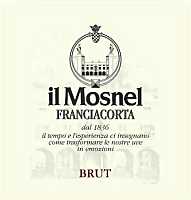
Franciacorta Brut |
|
| Il Mosnel (Lombardy, Italy) | |
| Grapes: Chardonnay (60%), Pinot Blanc (30%), Pinot Noir (10%) | |
| Price: € 15.00 | Score: |
| The wine shows a brilliant golden yellow color and nuances of straw yellow, very transparent, good effervescence, fine and persistent perlage. The nose denotes intense, clean, pleasing and refined aromas which start with hints of banana and acacia followed by aromas of pineapple, bread crust, hawthorn, yeast, pear and hazelnut. The mouth has good correspondence to the nose an effervescent and crisp attack, however balanced by alcohol, good body, intense flavors. The finish is persistent with flavors of pineapple and pear. Part of the Chardonnay used for the cuvée ferments in barrique. This Franciacorta ages in bottle on its lees for at least 25 months. | |
| Food Match: Fish and crustaceans appetizers, Pasta and risotto with crustaceans, Sauteed fish | |
|
|
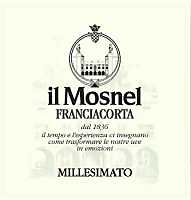
Franciacorta Brut Millesimato 2000 |
|
| Il Mosnel (Lombardy, Italy) | |
| Grapes: Chardonnay (60%), Pinot Blanc (30%), Pinot Noir (10%) | |
| Price: € 22.50 | Score: |
| This Franciacorta shows a brilliant golden yellow color and nuances of golden yellow, very transparent, good effervescence, fine and persistent perlage. The nose reveals intense, clean, pleasing and refined aromas that start with hints of banana and bread crust followed by aromas of acacia, hawthorn, yeast, apple, hazelnut, praline, pear, grapefruit and hints of vanilla. The mouth has good correspondence to the nose, an effervescent and crisp attack, however balanced by alcohol, good body, intense flavors, pleasing roundness. The finish is persistent with flavors of apple, banana and hazelnut. Part of the Chardonnay used for the cuvée ferments in barrique. This Franciacorta ages in bottle on its lees for at least 4 years. | |
| Food Match: Stuffed pasta with mushrooms, Roasted fish, Roasted white meat, Stewed meat | |
|
|
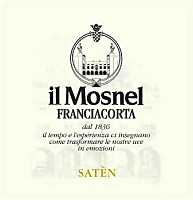
Franciacorta Brut Satèn 2001 |
|
| Il Mosnel (Lombardy, Italy) | |
| Grapes: Chardonnay | |
| Price: € 21.00 | Score: |
| This Franciacorta shows an intense golden yellow color and nuances of straw yellow, very transparent, good effervescence, fine and persistent perlage. The nose denotes intense, clean, pleasing and refined aromas which start with hints of bread crust, praline and banana followed by aromas of yeast, plum, cocoa butter, hawthorn, apple, grapefruit, hazelnut and vanilla. The mouth has good correspondence to the nose, an effervescent and crisp attack, however balanced by alcohol, good body, intense flavors. The finish is persistent with flavors of apple, banana and plum. Part of the Chardonnay used for the cuvée ferments in barrique. This Franciacorta ages in bottle on its lees for at least 36 months. | |
| Food Match: Fish and crustaceans appetizers, Pasta and risotto with crustaceans and vegetables, Sauteed fish | |
|
|
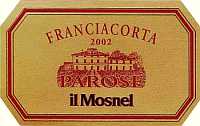
Franciacorta Pas Dosé Millesimato Parosé 2002 |
|
| Il Mosnel (Lombardy, Italy) | |
| Grapes: Pinot Noir (70%), Chardonnay (30%) | |
| Price: € 27.00 | Score: |
| The wine shows a brilliant onion skin pink color and nuances of onion skin pink, very transparent, good effervescence, fine and persistent perlage. The nose reveals intense, clean, pleasing and refined aromas which start with hints of cherry, raspberry and tangerine followed by aromas of bread crust, hawthorn, yeast, apple, pink grapefruit, plum and vanilla. The mouth has good correspondence to the nose, an effervescent and crisp attack, however balanced by alcohol, good body, intense flavors, agreeable. The finish is persistent with flavors of raspberry, cherry and apple. The cuvée ferments in barrique. This Franciacorta ages in bottle on its lees for at least 3 years. | |
| Food Match: Roasted white meat, Roasted fish, Fish soups, Broiled fish | |
|
|
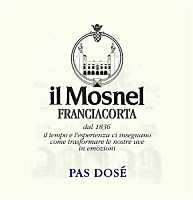
Franciacorta Pas Dosé |
|
| Il Mosnel (Lombardy, Italy) | |
| Grapes: Chardonnay (60%), Pinot Blanc (30%), Pinot Noir (10%) | |
| Price: € 15.50 | Score: |
| This Franciacorta shows a brilliant golden yellow color and nuances of straw yellow, very transparent, good effervescence, fine and persistent perlage. The nose reveals intense, clean, pleasing, refined and elegant aromas which start with hints of bread crust, yeast and banana followed by aromas of acacia, hawthorn, pear, hazelnut, grapefruit, praline, gooseberry, apple, plum and vanilla. The mouth has good correspondence to the nose, an effervescent and crisp attack, however balanced by alcohol, good body, intense flavors. The finish is persistent with flavors of banana, grapefruit and hazelnut. Part of the Chardonnay used for the cuvée ferments in barrique. This Franciacorta ages in bottle on its lees for at least 36 months. | |
| Food Match: Pasta and risotto with fish and crustaceans, Roasted fish, Broiled crustaceans | |
| Il Mosnel - Via Barboglio, 14 - 25040, Camignone di Passirano, Brescia (Italy) - Tel. +39 30 653117 Fax. +39 30 654236 - Winemaker: Alberto Musatti, Luigi Biemmi, Flavio Poleghi - Established: 1836 - Production: 250.000 bottles - E-Mail: info@ilmosnel.com - WEB: www.ilmosnel.com |
Cellar Journal |
|
This section is reserved to wine producers who want to publish news and information about their business, to announce new products or just for communicating to customers information and promotions about their products and activity. Send news to be published to our e-mail address.
|
News |
|
In this section are published news and information about events concerning the world of wine and food. Whoever is interested in publishing this kind of information can send us a mail to our address.
|
Japanese Cooking and WineSushi, Sashimi and Sake: to many westerners Japanese cooking is just that, indeed, it is a refined art capable of joining flavors to aesthetics united by simplicity |
|
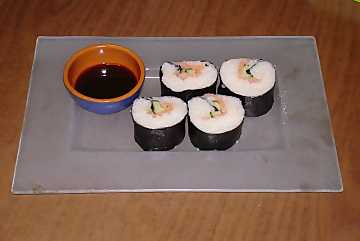
Whenever Japanese cooking comes to mind, the association with sushi and sashimi it is almost unavoidable, as if this refined as well as simple eastern cuisine is exclusively made from these two famous dishes only. If we think about the beverages of Japanese cooking, also in this case the association with sake and tea is the most frequent idea. Of course Japanese cooking is also sushi, sashimi, sake and tea, however these famous foods and beverages represent just a minimal part, if not exiguous. It is right from one of these renowned Japanese foods - sushi - the false belief it is raw fish and rice took origin. Despite this is partially true, in Japan raw fish dishes are called sashimi and can also be served with sushi. Indeed, sushi is a recipe made of cooked rice to which it is added rice vinegar, sugar and salt, and with which are being prepared “small balls” stuffed with fish, eggs, vegetables and seaweeds, or simply garnished with the same ingredients.
|
|
Japanese cooking is more than a simple method of preparing ingredients and transforming them in dishes. Japanese cooking is, essentially, all that to which it is added the charming ingredient capable of amazing all the times and which is represented by aesthetics. The way dishes are in fact presented to commensals represents the first and essential gratification of Japanese cooking, the anticipation of the pleasure that will delight the palate. Mainly made of quick and essential cooking techniques, Japanese cooking is widely based on the preparation of dishes by using raw ingredients, trying to respect, as much as possible, both the nature of ingredients as well as their original organoleptic qualities. Dishes of Japanese cooking are generally light and easily digestible, the cooking of ingredients - in case this is required - is simple and quick. What cannot be defined as simple are the countless techniques of cutting ingredients, strictly coded and requiring a scrupulous skill and mastery, because in Japanese gastronomic culture food must look aesthetically pleasing even before its preparation.
In this sense, Japanese cooking can be in fact defined as a set of preparation techniques instead of the transformation of ingredients. Because of its geographical position - Japan is an archipelago made of four main islands and about one thousand lesser islands - the cooking of this country is mainly based on fish and sea products, as well as seaweeds, available in different varieties and found in countless dishes. Despite the area destined to agriculture is pretty limited, Japanese cooking is also rich in fruits and vegetables. Among the main ingredients of Japanese cooking are mentioned fish, rice, soybeans and its many derivatives, wheat, barley, potatoes, mushrooms and tea. As it can be seen, many of these ingredients are also common in Chinese cooking, however, whereas in China it is common the union and mixing of ingredients in the preparation of dishes, in Japan it is preferred to cook them separately and to present them in single trays. Another difference from Chinese cooking is represented by cooking techniques. Whereas in China frying is frequent, as well as stewing and sauteing in the typical wok, in Japan are preferred quick cooking techniques instead, such as grilling, steaming and boiling, sometimes frying. In Japanese cooking is always paid a particular attention on the matching of flavors with the consistence of foods which will be in harmony or in contrast among them, always “seasoned” with the essential ingredient of Japanese cooking which is represented by the impeccable aesthetics. In this sense, few other cuisines of the world have reached an aesthetic and formal level like the Japanese. The suggestive effect of colors, the use of natural and geometric shapes, the way in which foods are placed in dishes, it is a characteristic which in Japan has reached very high levels. The culture of the beauty and the aesthetic sense is also found in other cultural forms of Japan - such us in Cha No Yu, the famous tea ceremony - and in the table this aspect is completed by the proper choice of dishes, bowls and trays. In fact, no tools or dish which is to be placed in a Japanese table will be chosen without a reason: material, color and shape are scrupulously chosen according to the foods to be served and their aesthetics, therefore providing an expressive complement of cooking and the art of serving.
|
||||||||
|
Japanese cooking is widely based on sea products - fish, crustaceans, seafruits and seaweeds - rice and soybean derivatives, such as tofu, miso, soybean sprouts and soybean sauces, of which the main types are shoyu and tamari. Among the most common condiments of Japanese cooking are mentioned wasabi - a green paste produced with the root of a Japanese plant similar to horseradish, with a pungent and sour taste - rice vinegar and dried tunafish flakes. Traditionally, Japanese cooking does not make use of animal fats and also the introduction of the consumption of meat is a relatively recent custom, mainly represented by beef and chicken. An essential role - just like in China - is played by rice, used in every dish to accompany foods. The role of rice is so important that dishes generally served with it are considered as “side dishes”. An essential meal must be made by at least one soup, rice and a “side dish” prepared with vegetables, fish or eggs, whereas the typical meal is generally made of three. Very appreciated and used in Japanese cooking are seaweeds, not only served as vegetables or used as ingredients in the preparation of dishes, indeed, they are precious chests of tastes. The discovery of sodium glutamate - the highly debated chemical element which gave origin to the fifth taste, that is umami - was done thanks to the study of one of the most famous seaweed used in Japanese cooking, kombu seaweed. In 1908, in the University of Tokyo, professor Kikunae Ikeda was successful is extracting this element from kombu seaweeds, the vegetable with the highest content of sodium glutamate. This discovery was immediately considered of high interest and the taste produced by this element - different from the four fundamental tastes - was called umami (or umai), a term meaning delicious in Japanese language. The use of seaweeds in Japanese cooking also has the function of exalting flavors, by amplifying the taste of dishes. Concerning this, it should be remembered the exalting action of flavors done by sodium glutamate works for meat, fish and some types of vegetables only, and it is always advisable not to abuse of it. Another common ingredient used in Japanese cooking is sake, the famous alcoholic beverage made by the fermentation of rice, also known in the western world with the improper name of rice wine. Despite the Japanese meaning of the term sake is alcoholic beverage, in the western world the term is used for the alcoholic beverage obtained by the fermentation of rice, crystalline and with an alcohol by volume of about 18%. Sake is not only consumed as a beverage, it is also used as an ingredient for the preparation of dishes, such as soups, sometimes sushi, fish and meat recipes. In Japanese cooking the use of spices and aromatic herbs is pretty limited, however the use of sauces is very common, in particular used for dishes such as sushi and sashimi. Among the most common sauces are mentioned wasabi, karashi and the many soybean sauces, such as shoyu, tamari, teriyaki and urakachi. Soybeans are also used, just like in China, for the production of fundamental ingredients of Japanese cooking, such as tofu, miso and noodles.
|
||||
|
The secret, or better to say, the charm of Japanese cooking, consists in joining flavors to a strict aesthetic art made of colors, shapes and extremely complex cutting techniques. According to Japanese gastronomic culture, first of all, food must have a pleasing look, possibly keeping and respecting the nature of its original flavors. Of course, this does not mean Japanese cooking is poor of flavors, indeed, also the most humble looking and poor dishes can always surprise everyone's palate. The preparation of Japanese cooking is widely based on the preparation techniques instead of the transformation of ingredients, something which is widely appreciable in the many dishes based on raw foods. The fundamental skill of every cook consists in the knowledge of cutting techniques and the art of presenting dishes, last but not the least, the knowledge of the preparation and cooking. Among the most typical cooking techniques are mentioned grilling, steaming and boiling, stewing and the famous frying technique called tempura, used for fish and vegetables. Many of the preparation techniques of foods in Japanese cooking are considered as an art: the most talented and skilled cooks, who are capable of surprising with their excellent skill, are considered as masters. This is the case of two of the most characteristic foods of Japanese cooking - sushi and sashimi - which require not only skill, but also a high aesthetic sense and a perfect knowledge of fish cutting techniques, indispensable for a perfect result. Soups represent a fundamental dish in Japanese cooking, not only exquisite for their delicacy, but also used as a beverage, as the broth is drunk during the meal. A particular mention goes to the classic technique of Japanese frying - tempura - which term probably derives from tempora, that is the period in which it was forbidden the consumption of meat, introduced by Jesuits. Tempura, a frying technique used for fish and vegetables, consists in plunging foods in a batter made of eggs, wheat flour and iced water - frequently ice cubes as well - then fried in boiling oil for few minutes.
|
|
Sashimi is one of the most famous dishes of Japanese cooking and consists in thin slices of very fresh raw fish and seafruits, exclusively served with specific sauces and condiments. The most common sauce for sashimi is made of soybean sauce and wasabi, sometimes used for sushi as well. Sashimi is frequently served with sushi, that is cooked rice to which it is added rice vinegar, sugar and salt. Sushi, a preparation which frequently amazes for the contrast of colors and for its shapes before than it reaches the palate, can be stuffed with many ingredients, including fish, vegetables and omelettes. There are many types of sushi, of which the most famous is probably the one stuffed and rolled on a nori seaweed sheet, called makizushi, however are also famous the ones garnished with the same ingredients. Very appreciated and used in Japanese cooking are noodles made with many ingredients - wheat, soybean and buckwheat - of which the most famous ones are harusame, soba, udon and ramen. Noodles are used for the preparation of dishes and seasoned with meat, fish and vegetables, frequently with the broth, as a fundamental ingredient in countless soups. It should be noticed in the preparation of soups is generally used the famous dashi, a rich stock made of seaweeds and dried tunafish. Despite Japanese cooking requires a formal strictness both in the preparation and in the aesthetic of presentation, home meals are usually made of a unique dish, such as in case of donburi and katsudon. These two preparations are pretty similar and consist in cooking meat, usually diced and cooked in soybean sauce and sake, to which are added eggs and, at the end of cooking, it is poured on a bowl full of cooked rice. Another typical preparation of Japanese cooking is represented by grilled meat, usually grilled by every commensal, such as in case of yakiniku, made of beef slices grilled with soybean sauce and sugar. Grilling is also used for chicken - usually served on a spit - and for fish, in particular eels.
|
|
Despite the Japanese are used to drink the broth of soups during their meals, and recently the beer as well, we can however try to match these foods with wine. As always, the secret consists in evaluating the ingredients and cooking techniques - in this case the preparation technique as well - by remembering Japanese cooking is mainly light and delicate. With sashimi can be used wines with appreciable acidity - such as Viognier and Sauvignon Blanc - as well as classic method sparkling wines produced with white grapes, such as Franciacorta Satèn. The same consideration is also valid for sushi, by paying attention on the ingredients used for stuffing and for garnishing. In both cases, particular attention will be paid to the presence of sauces and pungent condiments - such as wasabi - and in this case it will appropriate to chose a pretty aromatic and persistent wine, such as Gewürztraminer or Muscat Blanc. With the many preparations made of grilled meat, can be certainly matched good bodied wines, such as Merlot and Sangiovese.
|
Making TeaBrewing a good tea is an art made of many and small details, big and small factors allowing the making of an excellent beverage, delicious, aromatic and healthy |
|
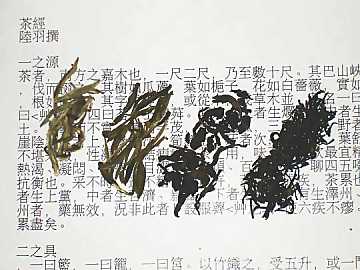
To many, making a cup of tea is the simple operation of heating water, and when it starts boiling, throw a tea bag, wait for some minutes and then removing the bag. Therefore are being added other ingredients, in particular milk, lemon juice and sugar, as it seems this is what it should be done in order to make tea, and finally the hot cup of amber and steaming tea can be drunk. To others, making tea is a refined art made of small and big details, sometimes of elements of suggestive formality, scrupulous care of cups and teapots, the rigorous choice of tea qualities and, last but not the least, superfine water, choice of right temperature and infusion times. All that in order to get out the maximum pleasure that only an impeccable infusion of tea can give to peace and tranquillity of the ones who see in tea something more than a simple beverage. To many, all that can be considered as exaggerated, even maniacal, an useless waste of time in order to show off something which is incomprehensible. After all, making tea simply means taking some tea leaves and pour on them some warm water: a simple and immediate operation.
If in its most essential definition making tea is just pouring warm water on tea leaves, the simplicity of this act hides a sublime and refined art made of important factors and fundamental conditions, a practice which is elevated in many eastern countries - first of all China, Japan and Korea - to the rank of ceremony. The preparation of tea, in its simplicity, requires the most scrupulous control of every single stage and the use of quality elements: not all the tea is the same, not all the water is the same, not all teapots are equal one to each other and so on. Sound exaggerated? Well, try to imagine the preparation of any recipe by using low quality ingredients and not being harmonic one to each other, approximate cooking techniques and times, even worse, not suited for that dish. The result which would be obtained is of course not very inviting or pleasing, something which is true for the making of everything, from food to wine, from pencils to skyscrapers. The preparation of tea is a process that in its simplicity requires the most scrupulous attention, in every aspect.
|
||||||||
|
In the preparation of tea, water plays a primary and fundamental role. If we think water is the ingredient whose quantity makes the main element of the beverage produced by the infusion of tea leaves, it is easy to understand how the quality of this crystalline liquid is fundamental. It is not by chance in China water is defined as the mother of tea. Before discussing the quality a good water should have, it is good to remember the mistakes and the types of water unsuitable for making tea. First of all, it should be avoided the water which has been already boiled as the tea will be tasteless and flat. Water should not be too alkaline because this would cause the oxidation of polyphenols contained in tea and their subsequent precipitation, with the result of making a flat and tasteless infusion. Another type of water which must be avoided is the one containing high quantities of iron, copper and other metals, as this would make a darker infusion as well as affecting the taste of tea. Distilled water, despite the fact it ensures better hygienic qualities, is not suited for the preparation of tea. Lu Yu - the most important figure in the history of tea of all times and by many considered still today as the god of tea - in its famous Cha Jing (classic of tea) writes «mountain spring water is the best, the water of rivers has an average quality, the water of wells is the least suited one». Moreover «among mountain waters, the best ones are those dripping from stalactites and the one which gathers in pools between stones and from which slowly flows». These indications are certainly useful and still valid, provided one is lucky enough to live in a mountain and near a spring of water. The first consideration suggested by Lu Yu is to avoid water which has stagnated or rested in any way: the best tea water must always and however be fresh and running. For this reason, the best water everyone has in their houses is the one flowing out from faucets, provided this water has good chemical and organoleptic qualities. For this reason, bottled mineral water does not represent the best choice, saved the case its use is mandatory because the water flowing out from faucets is of bad quality, something which frequently happens, unfortunately. How can be then recognized a good faucet water suited for the preparation of tea? Get a glass of fresh water from the faucet, smell and taste it: first of all it must not have any bad smell or taste; these would be passed to the infusion of tea therefore ruining aromas and flavors. In particular, the excessive quantity of chlorine - added to water for hygienic purposes - will affect the organoleptic qualities of any tea infusion. A simple way to remove chlorine from water is to allow the water to rest for about one day, whereas it is a mistake - in case this water should be used for the preparation of tea - to preventively boil it, as boiled water would make a tea with a flat taste. Also water hardness - that is the concentration of calcium and magnesium ions - influences both the color and taste of tea while making it bitterer, therefore it is always best to avoid the use of particularly hard water. Finally, it should be remembered the water distributed by municipal waterworks, are scrupulously controlled and processed in order to make them hygienically safer. However this processing and the problems associated to distribution, such as the passage in pipes up to home faucets, enrich water of extraneous substances - both of chemical and organic nature - which should be properly filtered. As the best water for the preparation of tea is always the running one, also for the fact it is richer in precious oxygen, and by considering not all have the luck of using fresh mountain spring water, uncontaminated and crystalline, the best solution is then to make use of the most running water we have at hand in our houses: faucet water. However, by considering the things already mentioned, this water could also be unsuited for the preparation of tea because of its bad chemical, physical and organoleptic qualities. A good solution is represented by the use of water filtering systems in order to significantly reduce chlorine, metals, hardness, solid substances of chemical and organic nature. Home water filtering systems are usually expensive, therefore a good solution is offered by the many carafes available in the market which make use of active carbon filters, generally sold at a “reasonable” price. In general terms, the water which is obtained after filtering is far better than any mineral water for the preparation of tea, also offering the advantage of being fresh and running. The fact water plays a primary role in the infusion of tea, it is something which was well known since ancient times, when in China they began the use of precious Camelia Sinensis tea for the making of the beverage. No matter how good the water can be, it is however important - and this cannot be otherwise different - to use a tea of excellent quality. However, a tea having an exceptional quality can be easily ruined by a bad quality water or boiled in a wrong way. The importance of water in the preparation of tea can be easily understood with a simple practical test, something which is worth - as always - more than one thousand words. It will be enough to make the same type of tea, belonging to the same pack and used in the same quantity, with bottled mineral water, faucet water and filtered faucet water. It is essential to pay attention on the very same conditions, therefore equal quantity of tea leaves, equal quantity of water, same type of teapot and cups, same infusion time. If you still believe the importance of water is something exaggerated, compare the three tea infusion by evaluating color, transparency, limpidity, quality of aromas and taste. In a moment the answer will be very clear.
|
||||
|
Whenever warm water is being poured on tea leaves, it is magic. Leaves begins to open up, releasing their color to water, releasing their aromas and flavors. As for the taste of tea, it should be remembered it changes according to type, area of origin, harvesting period, processing and infusion. As opposed to what it is commonly believed, the taste of white, green and semifertemed Wu Long teas (the latter also called oolong) is not bitter. In case it is perceived this taste, the causes are generally three: use of bad quality water, use of bad quality tea, water temperature too high. Excellent quality tea will never make a bitter infusion, or better to say, with an evidently bitter taste. The tendency to make a bitter infusion is a characteristic of black tea (or red, like the Chinese call it) because of the type of processing used for the leaves. For this reason, infusion time for black tea is always shorter than for the other teas, and at the end of the infusion, leaves will be removed from the beverage. Tea leaves contain more than 300 chemical components, present in variable quantities and according to type, production area, position of the leaf in the plant and processing techniques. The extraction of these substances depends on the size of tea leaves, chemical and physical qualities of water, water temperature and infusion time. The first substances to be extracted from tea leaves, after having poured warm water on them, are alkaloids - caffeine, theopyliline e theobromine - therefore a short infusion time makes a beverage rich in these substances and pretty stimulant. As the infusion time is prolonged, usually after the fourth minute and always according to the type of tea, the extraction is mainly about catechins - precious elements having antioxidant properties - as well as other polyphenolic substances. These substances are mainly contained in green and white tea, whereas black tea, because of the oxidation process required for its production, contains a lower quantity of antioxidants. An interesting effect of catechins is the property of contrasting and regulating the absorption of caffeine in the body, therefore lowering the stimulating and hypertensive effects of this alkaloid. Longer infusion times - a practice which is good to avoid for black tea - give a less stimulating beverage, while increasing, at the same time, the countless healthy effects of tea for the body.
|
|
The preparation of tea infusion - the method mainly used in the world - requires, as we have already seen, the availability of both water and tea leaves of high quality. Besides that, it is necessary to have proper tools allowing a good preparation, while avoiding, in particular, to ruin the quality of the beverage. As for the quality of tea, it should be remembered the best ones are always those produced with the sprouting buds of the plant. The leaves next to the buds make a decreasing quality tea, because they get harder and tougher and make a less aromatic and more bitter beverage. In case tea is excessively bitter this certainly is because of the low quality of leaves or bad quality water and its use. The kettle used to heat water is very important. It should be made from inert metals: in this case the best choice is always stainless steel. Cast iron kettles - common in Japan and in China - offer the advantage of keeping the water warm for a longer time, something useful in case of repetitive infusions, a very common practice in the east for the making of green and white tea. The material used for making the teapot to be used for the infusion of leaves is very important, likewise, it is very important the material used for making cups, such as in case of guywan, the famous Chinese cup with a lid used for single and personal infusions. In these cases the rule is simple and uncompromising: avoid teapot made from metal, including silver, although they look like elegant and exclusive objects, they are not suited for the infusion of tea. The best materials for the infusion of tea are porcelain and earthenware, in particular red earthenware from Yi Xing, in the province of Jiangsu in China. In particular, Yi Xing earthenware teapots - to be exclusively used for green and white teas - because of their porous nature, with time will absorb the organoleptic qualities of tea, therefore allowing a seasoning of the teapot which will make, with time, better and better infusions. The best tea cups are the ones made from very fine porcelain, with a thin border of few millimeters: a thicker border, besides being not very comfortable and unpleasing to the touch with the mouth, alters the tactile sensations of tasting. The quantity of tea to be used for the infusion varies according to the type of tea, generally a quantity of 2 or 2,5 grams (about one teaspoon) is enough for all the cases and according to personal preferences. A fundamental factor is the boiling of water and its temperature at the moment of being poured on the leaves. The fundamental rule is that water must never boil in a tumultuous way: as soon as little bubbles coming up from the kettle will be seen, it is the right time to stop heating. Now pour a small quantity of water in the teapot in order to warm it. For the preparation of black tea, the water must be immediately poured on the leaves, whereas for the other types of teas it is good to wait for the temperature to cool down. For semifermented tea will be used a temperature of 80-90° C (176-194° F), for green tea 70-85° C (158-185° F) and for white tea 65-80° C (149-176° F). It should be remembered for teas produced with buds only or with the first leaves next to the bud - that is the ones having a higher quality and finesse - will always be used the lower temperature: a trick which will avoid the delicate leaves to get cooked. When the water will have reached the proper temperature, the water used for warming the teapot will be discharged and the leaves will be added. At this point the warm water will be poured on the leaves and the teapot will be closed in order not to lose aromas. The infusion of black tea will require 4-5 minutes, after that the leaves will be removed from the infusion in order to avoid an excessively astringent and bitter taste. Despite the removal of leaves is not suggested for white, green and semifermented teas, their infusion times can go from 5-7 minutes, up to even 15 minutes for some white teas. It is generally believed it is necessary to remove the leaves from the infusion of these teas in order to avoid an excessive bitter taste, indeed, we have seen this is something depending on other factors, not on the infusion time. After having finished the consumption of the infusion, it can be poured more warm water to the same leaves: a very common practice in the east which gives a more delicate tea however delicious. And now stop, reconcile yourself with the world and with yourself, let the frenzy to get out of your life and allow yourself the tranquility and peace of a good and fragrant cup of tea.
|
AquavitaeReview of Grappa, Distillates and Brandy |
|
|
| Distillates are rated according to DiWineTaste's evaluation method. Please see score legend in the "Wines of the Month" section. |
|
|
Liquore di Mirto Selezione Speciale |
|
| Lucrezio R (Sardinia, Italy) | |
| Raw matter: Myrtle berries | |
| Price: € 18.00 - 50cl | Score: |
| This liquor shows an intense brick red color, transparent. The nose reveals intense, clean, pleasing and refined aromas of myrtle, clover and cinnamon with almost imperceptible alcohol pungency. In the mouth has intense flavors with perceptible alcohol pungency which tends to dissolve rapidly, balanced sweetness with pleasing bitter hint, intense flavor of myrtle. The finish is persistent with flavors of myrtle and cinnamon. Produced by the maceration of myrtle berries for 2 months followed by an aging in barrique for few months. Alcohol 38% | |
|
|
Filuferru Barricato Collezione Privata |
|
| Lucrezio R (Sardinia, Italy) | |
| Raw matter: Pomace of Sardinian grapes | |
| Price: € 18.00 - 50cl | Score: |
| This distillate shows a brilliant amber yellow color, transparent. The nose denotes intense, clean, pleasing and refined aromas of vanilla, licorice, hazelnut, dried fig and honey with almost imperceptible alcohol pungency. In the mouth has intense flavors with perceptible alcohol pungency which tends to dissolve rapidly, balanced sweetness, intense flavors, agreeable roundness. The finish is persistent with flavors of dried fig, hazelnut and honey. This filuferru is distilled with a discontinuous steam operated alembic still and ages in barrique. Alcohol 40%. | |
|
|
Grappa di Malvasia Monovitigno |
|
| Magnoberta (Piedmont, Italy) | |
| Raw matter: Pomace of Malvasia | |
| Price: € 17.50 - 70cl | Score: |
| This grappa is colorless, limpid and crystalline. The nose denotes intense, clean, pleasing and refined aromas of pear, apple, grape, praline, hazelnut, white rose and peach with almost imperceptible alcohol pungency. In the mouth has intense flavors with perceptible alcohol pungency which tends to dissolve rapidly, balanced sweetness, intense flavors. The finish is persistent with flavors of peach, pear and grape. This grappa is produced with discontinuous distillation at very low steam pressure. Alcohol 42%. | |
|
|
Acquavite d'Uva di Malvasia 2001 |
|
| Casa Luparia (Pidmont, Italy) | |
| Raw matter: Malvasia di Casorzo | |
| Price: € 21.00 - 50cl | Score: |
| This grape brandy is colorless, limpid and crystalline. The nose reveals intense, clean, pleasing and refined aromas of grape, white rose, pear, apple and honey with almost imperceptible alcohol pungency. In the mouth has intense flavors with perceptible alcohol pungency which tends to dissolve rapidly, balanced sweetness, intense flavors, agreeable roundness. The finish is persistent with flavors of grape and white rose. A well made distillate produced with discontinuous bainmarie distillation. Alcohol 42%. | |
Wine Parade |
|
|
| The best 15 wines according to DiWineTaste's readers. To express your best three wines send us an E-mail or fill in the form available at our WEB site. |
| Rank | Wine, Producer | |
|---|---|---|
| 1 |

| Colli Orientali del Friuli Rosazzo Bianco Terre Alte 2002, Livio Felluga (Italy) |
| 2 |

| Brunello di Montalcino 1999, Castello Banfi (Italy) |
| 3 |
| Amarone della Valpolicella Classico 2000, Zenato (Italy) |
| 4 |

| Riesling Central Otago 2004, Felton Road (New Zealand) |
| 5 |
| Wine Obsession 2001, Vignamaggio (Italy) |
| 6 |
| Trento Talento Brut Riserva Methius 1998, Dorigati (Italy) |
| 7 |
| Notarpanaro 1999, Taurino (Italy) |
| 8 |
| Chianti Classico Riserva Novecento 2000, Dievole (Italy) |
| 9 |
| Amarone della Valpolicella Classico 1998, Santa Sofia (Italy) |
| 10 |
| Nero al Tondo 2001, Ruffino (Italy) |
| 11 |
| Chianti Classico Riserva Novecento 2000, Dievole (Italy) |
| 12 |
| Don Antonio 2003, Morgante (Italy) |
| 13 |
| Aglianico del Vulture La Firma 2002, Cantine del Notaio (Italy) |
| 14 |
| Palazzo della Torre 2000, Allegrini (Italy) |
| 15 |

| Amarone della Valpolicella Classico Costasera 2001, Masi (Italy) |
up down stable new entry
| |||||||
Privacy Policy | |||||||

| Copyright © 2002-2024 Antonello Biancalana, DiWineTaste - All rights reserved |
| All rights reserved under international copyright conventions. No part of this publication and of this WEB site may be
reproduced or utilized in any form or by any means, electronic or mechanical, without permission in writing from DiWineTaste. |


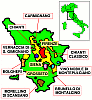
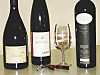
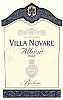
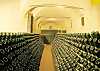
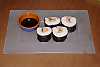
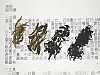
 Share this article