
Wine Culture and Information since 2002 - Volume 22
Wine Culture and Information since 2002 - Volume 22 |
 |
× |
 DiWineTaste on Instagram
  DiWineTaste Mobile for Android
DiWineTaste Mobile for iOS
Become a Registered User
Subscribe to the Mailing List
Tell a Friend About DiWineTaste
Download DiWineTaste Card
DiWineTaste Mobile for Android
DiWineTaste Mobile for iOS
Become a Registered User
Subscribe to the Mailing List
Tell a Friend About DiWineTaste
Download DiWineTaste Card
| ||||
 Temperature Glasses Accessories Temperature Glasses Accessories |
Accessories for Wine Serving |
The service of a bottle of wine may require the use of specific accessories, both
for the opening and for service. In this page can be found the most common
wine accessories.
|
Corkscrew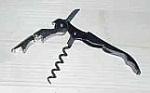 This type of corkscrew, also known as "waiter's corkscrew", in its simplicity,
represents a very efficient tool for opening a bottle. This kind of tool is
formed by a body or handle, which allows to grip it, and attached to it there
are all the other mobile parts of the corkscrew such as the blade, the spiral
and the lever. Every single element of the corkscrew plays an important role
which allows to accomplish a perfect job.
This type of corkscrew, also known as "waiter's corkscrew", in its simplicity,
represents a very efficient tool for opening a bottle. This kind of tool is
formed by a body or handle, which allows to grip it, and attached to it there
are all the other mobile parts of the corkscrew such as the blade, the spiral
and the lever. Every single element of the corkscrew plays an important role
which allows to accomplish a perfect job.
|
Sparkling wine pliers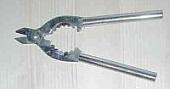 This particular tool makes it easy to extract a cork from a bottle of sparkling
wine in case it is blocked in the neck and therefore twisting and removal are
very difficult. Pliers has two toothed jaws, which can be used to have a more
solid and effective grip on the cork, as well as cutting nippers at the tip and
they will be particularly useful to remove the wire cage. This tool can be
replaced by a nutcracker.
This particular tool makes it easy to extract a cork from a bottle of sparkling
wine in case it is blocked in the neck and therefore twisting and removal are
very difficult. Pliers has two toothed jaws, which can be used to have a more
solid and effective grip on the cork, as well as cutting nippers at the tip and
they will be particularly useful to remove the wire cage. This tool can be
replaced by a nutcracker.
|
Wine Thermometer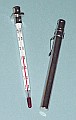 It is submerged in the glass and allow the detection of wine's temperature
within seconds.
It is submerged in the glass and allow the detection of wine's temperature
within seconds.
|
Thermal bucket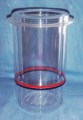 Allows to keep wine's serving temperature for a longer time.
|
Decanter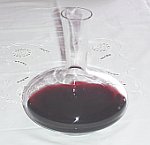 Allows a quick aeration of wine and it is useful for separating sediments in a
wine. Before starting to decant a wine, it will be good to rinse the decanter
with a small quantity of wine, the same wine to be decanted, and make sure the
wine will completely rinse the inside of the decanter. At end of this operation,
this wine will be poured off and discarded. With one hand hold the decanter
while keeping it oblique, whereas the other hand will be used to hold the
bottle while making sure bottle's neck is over the candle. Pay attention to the
distance of the bottle from the candle in order to prevent the neck to heat up
as this would damage the wine. Start pouring the wine into the decanter, it
will be poured slowly, and make sure the wine goes along the decanter's side.
As soon as turbid wines is seen through the bottle's neck, stop the operation
in order not to pour the deposit into the decanted wine.
Allows a quick aeration of wine and it is useful for separating sediments in a
wine. Before starting to decant a wine, it will be good to rinse the decanter
with a small quantity of wine, the same wine to be decanted, and make sure the
wine will completely rinse the inside of the decanter. At end of this operation,
this wine will be poured off and discarded. With one hand hold the decanter
while keeping it oblique, whereas the other hand will be used to hold the
bottle while making sure bottle's neck is over the candle. Pay attention to the
distance of the bottle from the candle in order to prevent the neck to heat up
as this would damage the wine. Start pouring the wine into the decanter, it
will be poured slowly, and make sure the wine goes along the decanter's side.
As soon as turbid wines is seen through the bottle's neck, stop the operation
in order not to pour the deposit into the decanted wine.
|
To Know More |
|
Issue 2, November 2002, Corkscrew
|
|
Issue 1, October 2002, Corkscrew
|
|
DiWineTaste Polls
|
| |||||||
| Temperature Glasses Accessories |
|||||||
Privacy Policy | |||||||

| Copyright © 2002-2024 Antonello Biancalana, DiWineTaste - All rights reserved |
| All rights reserved under international copyright conventions. No part of this publication and of this WEB site may be
reproduced or utilized in any form or by any means, electronic or mechanical, without permission in writing from DiWineTaste. |