Wine Culture and Information since 2002 - Volume 22
Wine Culture and Information since 2002 - Volume 22 |
 |
× |
 DiWineTaste on Instagram
  DiWineTaste Mobile for Android
DiWineTaste Mobile for iOS
Become a Registered User
Subscribe to the Mailing List
Tell a Friend About DiWineTaste
Download DiWineTaste Card
DiWineTaste Mobile for Android
DiWineTaste Mobile for iOS
Become a Registered User
Subscribe to the Mailing List
Tell a Friend About DiWineTaste
Download DiWineTaste Card
|
Issue 5, February 2003 |
Contents |
|
|
Appellation of Origin: is it a Warranty of Quality? |
|
The renewed interest consumers are having about wine in recent years has drastically changed the trading and production of this beverage; consumers are getting more and more exacting about quality while rightly paying little or no attention about quantity. Consumers drink less wine, and drink with a more conscious moderation, however they drink and want to drink better wine. Rightly. One of the factors that should warrant a good level of quality is represented by the so called “appellations of origin”, that is the series of norms and disciplinary which suggest producers guidelines on how to make wines having a level of quality pretty high. Does any wine belonging to a specific category of appellation of origin represent a real and sufficient warranty of quality? Quality systems are legally in force in some wine countries of the world and each one of them has the purpose of warranting, in a legal way, the quality of wines which are recognized to be in suitable conditions in order to belong to a certain category of appellation. Most of the times, producers themselves propose to institute some appellation of origin, they also take care of writing the text of the disciplinary to be submitted to the institutional offices in charge for this matter. In a certain way, producers themselves define a production style in order to warrant the quality of the wines made in specific areas. The ideas is certainly noble and worth of consideration, however what happens in reality tells a different story which is sometimes contrasting and paradoxical. Sometimes there are wines, belonging to the very same appellation of origin, which indisputably have very different quality levels, some of them can be scarcely considered as mediocre, however they all are considered, at least from a institutional and legal point of view, as worth representatives of a high quality production. To be honest, the term itself mentioned in these wine's labels, appellation of origin, does not refer to any term that could be associated to quality, in fact it just warrants a wine is coming from a specific area. There is no doubt about the importance of safeguarding the traditions and the typicality of wines and grapes coming from historical areas and traditionally suited to the cultivation of vine and to the production of wine, we all know the area where a wine and grapes come from, represent a fundamental factor in the quality of wine. In case we would analyze the texts of the production disciplinary concerning appellation of origin of the many countries which adopt this kind of quality system, we would find out precise guidelines both on the cultivation of grapes and on the production of wine, however, it is clearly evident the results, from a producer to another, are absolutely different. If we consider, for example, the parameter of yield per hectare, we clearly realize the indications provided by a disciplinary can be freely applied in many ways, as well as relying on seriousness and honesty of wine producers that, most of the times, use and apply own criteria which are absolutely legal and acceptable according to the disciplinary itself. Let's suppose a disciplinary would define, for a specific appellation, a maximum yield per hectare of 100 quintals. This kind of yield can be obtained in different ways and each of them would be absolutely legal. We can obtain this yield, for example, by having 1000 vines per hectare and having each vine to produce 10 kilograms of grapes, or we can have 10000 vines per hectare and have each vine to produce one kilogram of grapes. The result is always and however the same, that is 100 quintals per hectare, however it is also clear the quality of grapes, and therefore of wine, will be very different: the more the grape produced by a single vine, the worse the quality of grapes and its characteristics. Anyway, wines obtained from these two examples can both legally belong to the hypothetical appellation of origin which sets a maximum yield per hectare of 100 quintals. This kind of production choices influence not only the quality of wine but also the costs for making a wine. There is no doubt about this, the costs for maintaining and cultivating a one hectare vineyard having 1000 vines is certainly and absolutely less than the ones required for a one hectare vineyard having 10000 vines. These costs, added to all the other costs of each phase of the production, directly influence the final price of a wine. This is certainly not anything new: to make a high quality wine means to make costly and demanding choices, however we should make proper distinctions between the honest and reasonable price proposed for the quality of wine and the real and proper speculation. Does appellation of origin mean quality? The most appropriate answer seems to be “maybe”. Probably the most certain thing that could be warranted by any appellation of origin, provided there are suitable and proper controls done by the authorities in charge of this as well as the seriousness and honesty of producers, is the area of origin. The real and proper quality of a product is strictly dependent to the seriousness and the choices of a producer, instead of the indications and the guidelines proposed by the appellations of origin. However it should be noted the differences in quality, even the most evident and embarrassing ones, among wines belonging to the same appellation of origin, are just cause of confusion, distrust and prejudicial attitudes in consumers for those wines coming from certain areas. In case a consumer would buy for the very first time a bottle of wine belonging to a specific appellation of origin and produced with low quality standards, this would make the consumer believe every wine from that appellation is of low quality. This prejudice is, of course, detrimental for any other producer which makes wines belonging to that appellation of origin with high quality standards and believes in the wine traditions of its area. It will be pretty hard for that consumer to change his or her point of view about the quality of the wines from that area, in case he or she had a low quality wine from that very area. Sometimes happens that certain producers, historically associated to a specific area, deliberately decide to not have their wines belonging to a specific appellation of origin, and prefer having their wines belonging to a more generic appellation, even though it is legally considered of lower quality, and by doing so they free themselves of the embarrassing “load” associated to those appellation of origin whose wines are mostly considered bad because of the low quality standards applied by some producers. Most of the times the wines dissociated by some producers to the historical appellation to which they belonged for a long time, are produced with the very same grapes and in the very same area but with production criteria absolutely different and qualitatively better. Quality of wines, like we said, also depends on the area of origin and its climatic conditions, these both represent important and determinant factors, however the area of origin cannot be itself the only factor that could warrant quality. Vine can be cultivated in the best and most suitable place of the world, but if the cultivation is done approximately and speculatively and wine is produced in a generic and uncaring way, it is impossible to make any product of quality, despite the fact it was produced in an excellent area. It is rightly said that production of wine also requires the careful and intelligent work of man, also supported by the will of Mother Nature, and, above all, the conscious will to make a quality wine, no matter what is suggested by any law or disciplinary of any appellation of origin. Does appellation of origin mean quality? Maybe, but this factor itself is not enough to make a great wine. Consider and ponder the work and the results of every producer which work in any specific area, their respect for the grape and the work done in the vineyard, their passion for making wine and, last but not the least, the honesty with which they sell their products: consider all that in determining the real quality of a wine.
|
||||
MailBox |
|
In this column are published our reader's mail. If you have any comment or any
question or just want to express your opinion about wine, send your letters to
our editorial.
|
| I would like you to publish a comprehensive explanation about the origins and the current status of the “predicato” wines produced in Tuscany. Thank you and congratulations for your magazine, it is really interesting and well made. |
| Michele Serafini -- Perugia (Italy) |
| During the eighties of the past century, some Tuscan producers, in order to safeguarding the new production styles adopted in the region and that made use of barrique, decided to set production disciplinary as a way to warrant a high level of quality. These producers decided to name these “new” wines with the term “wines with predicato”, a term that was subsequently changed into “Capitolare”, both for giving them a more distinctive Italian name and to reject the accusations of some German producers which argued the term “predicato” was similar to the German term “Prädikat” and this could have been cause of confusion. There are four categories for this kind of wines: Capitolare di Biturica, because of the Latin name with what Cabernet Sauvignon was known, produced with at least 30% each of Sangiovese and Cabernet Sauvignon; Capitolare del Cordisco, name used in the middle age to refer to Sangiovese, is produced with this grape and a maximum quantity of 10% represented by other red berried grapes; Capitolare del Muschio, produced with Chardonnay and/or Pinot Blanc as well as Riesling, Riesling Italico, Pinot Gris or Müller Thurgau for a maximum quantity of 20%; Capitolare del Selvante, produced with Sauvignon Blanc as well as the same grapes and proportions allowed for the production of Capitolare del Muschio. Minimum aging for white wines is of 12 months and 18 months for red wines, moreover the label should indicate the name of the vineyard or cru where the grapes come from. |
| Last Christmas I received as a gift a bottle of Bradisismo IGT produced by Inama (Italy). As I do not know this wine at all, I would like to have some general information about it, in particular about aging expectations as well as some examples of food matching. Thank you in advance. Best regards. |
| Diego Raineri -- Rodengo Saiano, Brescia (Italy) |
| The wine you received as a gift, Inama's Bradisismo 1998, is produced with Cabernet Sauvignon, Carmenère and Merlot. The least know grapes of them is certainly Carmenère, a grape originating from the Bordeaux area and some years ago it was very spread in the Médoc area. This grape was recently reconsidered and it is getting more and more to the position it certainly deserves. Bradisismo is aged for 15 months in barrique and it is bottled unfiltered. Aging expectations are very good, provided it is kept in optimal conditions, and it could be aged in bottle for more than 10 years. This wine can be matched with robust foods such us stewed meat or braised meat, game, roasted meat and, last but not the least, hard cheese, preferably sheep or goat hard cheese. |
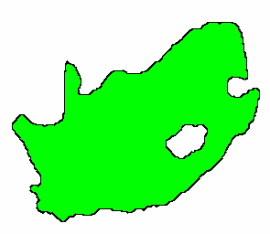
South AfricaWith an enological history of about 350 years, the country now offers a good and interesting selection of wines, from whites to reds, from sparkling to fortified wines |
|
The African continent is certainly not among the main wine producers of the world, despite of its wide surface, just few African countries produce a modest quantity of wine, however one of them is considered to be as an important wine producing country, not only in Africa, but also in the world: South Africa. With an unsuspicious historical tradition of about 350 years, in South Africa wine was made before they started making it in California and in Australia, the country is now the seventh wine producer of the world. Despite the fact the country shows a slight delay if compared to the other wine producing countries of the world, mainly because of the political events happened during the course of the last century, South Africa propose to the world interesting white and red wines and the expectations are for a rapid and important development towards quality and set good premises for the future productions. A considerable quantity of grapes cultivated in South Africa is still used for the production of concentrated must and for the production of spirits, as well as for the production of ordinary wines generally sold in 5 liter boxes. (1.3 gallons) The production of wine in South Africa is mainly run by cooperatives, however, from the middle years of the 1980, there is an increasing number of new private producers which mainly aim for the production of quality wines. The production of wine in South Africa is practically and equally divided between white and red wines and the yearly pro capita consumption is of about 9.5 liters. (2.5 gallons) The grapes cultivated in the country are mainly of French origins, except the local Pinotage, a crossing of Pinot Noir and Cinsaut used for the production of interesting wines. The fame of this grape is nowadays an indisputable South African mark and the cultivation of Pinotage was spread, even though in a very limited extent, in other countries such as California and New Zealand. The main white berried grapes cultivated in the country are Chenin blanc, here known as Steen which is also the most cultivated grape, Colombard, Chardonnay, Sauvignon Blanc, Muscat of Alexandria, Sémillon and Crouchen, here known as “South African Riesling”. Among red berried grapes, the most cultivated ones are Cabernet Sauvignon, Pinotage, Merlot, Cinsaut and Syrah, here in South Africa, as well as in Australia, this grape is known as “Shiraz”.
The most productive wine area of South Africa, which is also the one that coincides with the historical area of the country's wine origins, is Cape of Good Hope, located in the southern area of South Africa near Cape Town. The wine history of South Africa began in the middle of the 1600 and was pioneered by the one which is popularly considered as the father of the viticulture and wine making of South Africa: Jan van Riebeeck. With the intention of creating a supply station for the ships of the Dutch East India Company heading to the far east countries, this zealous 33-years-old dutch surgeon, which had no notion or knowledge about viticulture and wine making, understood crews and sailors stopping by this place would have loved to find there wine and spirits. He ordered from France, the exact place of origin is uncertain, however it is believed they were Chenin Blanc and Muscat of Alexandria roots, some vines to be planted in South Africa and, finally, after many failed attempts because of fires started by the local people in the vineyards as well as sparrows which were particularly greed of grape's berries, in 1659 he succeeded in harvesting grapes and in producing, for the first time in history, south African wine. In his diary, dating February 2nd, 1659, Jan van Riebeeck wrote «today, praise be to God, for the first time we pressed Cape's grapes and made wine». His excitement is certainly understandable, however a chronicler of those times wrote that the wine was incredibly astringent and was only good for “irritating the bowel”. Moreover, the wine that was shipped to Holland was often rejected and sent back to the sender. Despite the scarce appreciation for this wine and, according to what history tells and the very discouraging results from the first experiments, the way for the wine making in South Africa was set and there also was plenty of room for improvements. Some years later, two important events happened which gave a strong impulse and development to the wine making of South Africa. The new governor Simon van der Stel, who came to South Africa in 1679 and, disappointed by the strong acidity of local wines, decided to establish in 1685 the most prestigious winery of the whole history of South African enology: Constantia, whose fame excelled with the French wines of those times as well as with the renowned Hungarian wines of Tokaj. Another event which contributed to the improvement of the quality of South African wines was the coming, after the establishment of the Constantia winery, of about 200 refugees French protestant Huguenots, fleeing from France because of the religious prosecutions as a consequence of the revocation of Nantes edict, which brought their experience, surely providential, to the local wine making techniques. Constantia wines represented a rather singular case because it was the only wine coming from the so called “New World” which excelled, sometimes surpassing, the wines produced in Europe and for many years it was a preferred wine in the Royal courts of Europe; Napoleon himself, during his exile in the island of St. Helena, used to order Constantia wines in order to alleviate the torments of his fate. The renowned wines of Constantia were sweet and produced as red and white, the latter was highly esteemed and most looked for. White Constantia was produced with Muscat à Petit Grains and some Muscat of Alexandria was probably added as well as Pontac, a red berried grape whose origins are not certain. The fame of Constantia wines was reached mainly for the merits of the second proprietor of the winery, Hendrik Cloete, which bought and restored it in 1778. The fame of these wines started declining after the occupation of the British troops as a consequence of the Napoleonic wars as well as because of the general decline of the South African wines that began in 1861. To make things worsen and to complicate the declining condition of the South African enology, just like any other wine producing country of those times, in 1886 the terrible phylloxera devastated the country's vineyards. The effects of this parasite lasted for about 20 years and in the beginning of the 1900 local producers started planting vineyards again, mainly Cinsaut grapes, in the aim of giving a strong impulse to the enology of the country and, in fact, this led to a over production of grapes and started a serious financial crisis for the enology industry of South Africa. This financial crisis led in 1918 to the establishment of one of the many cooperatives of South Africa, the KWV, Koöperatiewe Wijnbouwers Vereeniging van Zuid Africa. (South African Co-operative Winegrowers Association) The purpose of this cooperative was to set production limits in order to avoid over productions and, as a consequence, to set minimum prices for wines. In a relatively short time, the cooperative became very strong and no wine could be produced, sold or imported in South Africa without the participation of KWV. Despite this cooperative is still active and controls about the 25% of the wine and spirit exports of South Africa, now it lost much of its power and currently is run by a group of private companies. No matter this company had the merit for having contributed to the stabilization of prices as well as regulating the wine production, the domination of KWV left little chances to the creativity and personal initiative of producers and this practically led to a delay both in quality and progress of wines, whereas in other countries these two aspects were rapidly developing in a determinant way. The changes in favor of quality of wine in South Africa began in the middle of the years of the 1980, when radical changes were introduced in the wine industry in favor of small private producers instead of what was simply the norm until then, that is cooperatives. The current production of South African enology is truly promising and the many efforts of the local producers certainly set a new way which will undoubtedly take South Africa to a prominent and prestigious position in the wine making, just like other wine producing countries of the world.
|
||||||||||||
|
The quality system in force in South Africa was introduced in 1973 and, for many aspects, it is based to the guidelines of the wine laws of France and Germany. The system is called Wine of Origin, “WO” in short, and contributed to make things clear and to regulate an indiscriminate system whose main effect was to be origin of confusion among consumers. A wine can be recognized as quality product only in case it positively pass an examination conducted by a proper commission. This commission is instituted by the office which is in charge of recognizing quality wines, the Wine & Spirit Board. Every wine which positively passes the commission's evaluation and examination is certified and can legally stick to its bottle the certification seal of quality, just like the one depicted in figure .
Wines can be certified according to their area or ward of origin, vintage and variety of grapes. A wine certified as varietal must be produced with at least 75% of the grapes named in the label and at least 75% must be of the named vintage, the remaining part can be of one or more different vintages, both older and younger than the named vintage in the label. Assembled wines which do not claim a singular variety can state in the label the composition of grapes. The system also includes the recognition of “Estate” which can be considered, with proper exceptions and differences, like the appellation “Château” or “Domaine” used for French wines. Wines that can be defined with this term must be produced within a well defined property recognized by the quality system. The definition of “Estate” is however controversial and probably too lax. For example, two vineyards belonging to the same proprietor, even though they are distant from each other many kilometers, can be used, by assembling their harvests, in order to make a wine that can be certified as “Estate”. It should be noted that both vineyards must have the very same ecological conditions and this condition must be recognized by the authorities in charge. Moreover, wines belonging to this category can also be made in a place and aged in another, provided both places belong to the same property. Lastly, it should be noted a wine can indicate in its label only one origin even though it contains wines coming from many regions. Sparkling wines produced in South Africa by means of classic method have Méthode Cap Classique as well as “Wine of Origin” stated in the label, the latter term can also appear written in local language as Wyn van Oorsprong. Chaptalization is not allowed in South Africa, as well as other forms of “enrichment”, however acidification is allowed.
|
||||||||
|
The center of wine production in South Africa is located in the so called “Cape”, in the southern part of the country, near Cape Town and Cape of Good Hope. The most important wine areas are certainly Paarl and Stellenbosch, where most of the wine production of the country is made. In South Africa are produced both white and red wines as well as fortified wines and sparkling wines. The climate of the area is favored by the vicinity of the Atlantic Ocean and Indian Ocean, a condition which allow a production of quality wines and, not surprisingly, the best wines of South Africa all come from this area. The most cultivated grape in South Africa is Chenin Blanc, here known as “Steen”, used to produce pretty ordinary wines even though it should be noted there are some exception to this and there are some small producers who make delicious wines by using this grape. Despite the fame of Chenin Blanc is declining, white berried grapes are still the most cultivated ones in South Africa, in particular some “international” species such as Chardonnay and Sauvignon Blanc, as well as other “historical” grapes of the country such as “Cape Riesling”, the name used in South Africa to refer to Crouchen, and Muscat of Alexandria, here known as Hanepoot and which is mainly used to make fortified wines, Riesling, Colombard. Among red berried grapes the most important and cultivated one is certainly Cabernet Sauvignon, followed by Cinsaut, Merlot, which is getting more and more popular, Shiraz and the local Pinotage, a crossing produced in 1925 with Pinot Noir and Cinsaut, used for the production of good quality wines as well as ordinary wines. The eldest wine production area of South Africa, Constantia, is located in the Cape of Good Hope and benefits both of a cool climate and the vicinity of Atlantic Ocean. This area got famous because of its renowned sweet wine whose production was recently resumed in this very area in the hope of repeating the prestigious and historical glories of the past. In Constantia are also produced excellent wines with Chardonnay and Sauvignon Blanc grapes, perhaps the best wines of South Africa, as well as red wines produced with Cabernet Sauvignon, Cabernet Franc and Merlot. About 45 kilometers east from Cape Town, there is another renowned wine area of the country, Stellenbosch, a prestigious town of South Africa known for its university. This town is traditionally considered among the eldest production areas of the country, besides Constantia, as well as being very important both for production and quality. The climate of this area is pretty tempered by the air streams coming from the Atlantic Ocean and the grapes which are mainly cultivated here include Cabernet Sauvignon, Merlot, Syrah and Pinotage which give excellent wines. In this area are also produced good examples of fortified wines in the style of “Porto” as well as wines produced with Chardonnay and Sauvignon Blanc grapes. North from Stellenbosch there is the other important wine area of South Africa which produces excellent quality wines: Paarl. In this area are produced, besides white and red wines, fortified wines, sparkling wines and brandy. In particular, fortified wines are produced with the same techniques used for the production of the renowned Jerez in Spain, and their quality is often comparable to it. The grapes which are mainly cultivated in this area are Chenin Blanc, Chardonnay, Sauvignon Blanc, Cabernet Sauvignon and Merlot. A rather renowned area of this region is Franschoek, the original place where the French Huguenots settled in, known for the production of interesting quality wines, in particular the ones made with Sémillon grape. Other wine areas of interest are Hermanus, south from Cape Town, where they produce wines with Pinot Noir and Chardonnay, Durbanville, west from Paarl, where they mainly produce good white wines. Other South African areas of interest include Worcester, Klein Karoo, Mossel Bay, Elgin and Walker Bay.
|
Introduction to Gustatory Evaluation of WineAfter having evaluated the aspect of wine and its aromas, it has finally come the right time to take a sip of Bacchus' nectar and to contemplate its soul and essence |
|
The quality of aromas in a wine actually represents the anticipation of what will be confirmed by the taste. The olfactory analysis, pleasing although complex phase of the evaluation of a wine, anticipates the perception of flavors of this beverage, its taste, anticipated by its aromas, certainly represent the most hedonistic aspect of the joys of wine and the examination of wine's taste is what determines the grade of pleasantness and therefore satisfaction. Moreover, the analysis of wine's taste allows the evaluation according to its most loyal ally: food. The gustatory characteristics of wine, as well as the olfactory ones, define in a determinant way the quality and pleasantness of wine, in the very moment a wine is introduced in the mouth, its grade of pleasantness is automatically determined, within few seconds every factor which makes a wine pleasing or unpleasing is evaluated, the nature of those details which disappoint or meet the taster's expectations, the confirmation of what was perceived by the nose is harmoniously corresponding and integrated to the taste and, in particular, the elegance of its balance as well as its proper structure.
|
|
Taste is a rather complex sense, what is considered as “taste” is actually the union of food's flavor sensations and its aromas: the sense of smell contribute in a determinant way to the definition of taste of any food or beverage. The sense of taste, as such, can detect a pretty limited number of stimuli, when compared to other senses, such as smell or sight. Indeed the sense of taste reveals the so called fundamentals flavors (sweet, sour, bitter and salty) as well as other sensations, known as tactile, which, also thanks to the determinant contribution of sense of smell, allow the definition of the taste as a whole. The perception of flavors in the mouth is done by means of the so called “taste buds” which are mainly located on the surface of the tongue. The most common theory about the disposition of the papillae on the tongue, says the perception of each taste is localized in specific parts of the tongue and every area is “specialized” to the perception of a specific flavor. The four fundamental flavors, sweet, sour, salty and bitter, are detected by specific types of taste buds and each of them is capable of generating a sensorial response to the brain according to the flavor it can recognize. The “classic” theory of taste perception about the way taste buds are disposed on the tongue, suggests papillae sensitive to sweet taste are located to the tip of the tongue, the ones sensitive to salty flavors are located on the front sides of the tip, the ones sensitive to sour flavors are located on the sides of the tongue, whereas taste buds sensitive to bitter flavors are located to the back. This theory, pretty known, seems to be denied by a recent and modern research about the perception of taste. It is believed that every kind of taste bud is capable to respond to each of the four fundamental tastes, even though with different intensities and sensitiveness. Moreover it is believed that perception of flavors is not exclusively limited to the tongue, but it is supposed taste buds are also located in the oro-pharynx area, that is the back area of the oral cavity, as well as in the upper tract of the esophagus. Taste buds are made of cells having a stretched shape provided of a cilia sensitive to flavors. These cells are grouped in two or more units, up to 12, and contribute to the formation of each taste bud. The cells sensitive to the perception of taste usually have a life cycle of 7-10 days, when this time has passed they degenerates and are replaced by new cells. Sensibility to flavors is a sense which is present before birth, reaches its maximum development during puberty and generally tends to diminish after 50 years of age. Many researchers have argued on the theory of taste, often proposing new theories and adding new details to what was already known. According to some researchers, fundamental tastes are not four, to the “classic” sweet, salty, sour and bitter tastes should be added tastes of alkaline, meaty and metallic. One point where everyone seems to agree is that taste is the result of the gustatory, olfactory and tactile sensorial perceptions.
|
||||
|
Although tactile sensations cannot be defined or considered as flavors, they contribute anyway to the general perception of taste and, particularly to the gustatory evaluation of a wine, they allow the determination of this beverage's balance and, lastly, the grade of pleasantness. Tactile sensations are perceived in every part of the oral cavity and in the tongue, in particular the central area. Tactile sensations that will be discussed here are thermal, pseudo-caloric, astringency, pungency and consistency or body. Thermal tactile sensation, caused by temperature, besides influencing the perception of flavors and taste, mainly represents a defensive response and its purpose is to detect dangerous conditions for the body in case a too hot or too cold beverage or food is being ingested: the typical reaction is to expel the content of the mouth before being injured. The temperature alters the perception of flavors and, in certain cases, the perception of other tactile sensations. In general terms, low temperatures accentuate the perception of salty, sour and bitter flavors, while lowering the perception of sweet flavor as well as diminishing the pseudo-caloric sensation because of alcohol and makes a wine to appear to have more body and consistency. Lastly, temperature also influences the development and action of carbon dioxide, which is responsible for pungency, a low temperature favors a slow release and pleasantness of this gas, while high temperatures favor a sudden and rapid release. The pseudo-caloric tactile sensation, or causticity, is determined in wine by the presence of alcohol. The more the quantity of alcohol, the more will be the perception of this tactile sensation which can be described as a dryness of the oral mucosa which in turn responds as a “burning” sensation in the whole oral cavity. Astringency is that tactile sensation which is detected when in the mouth is perceived a certain dryness and “roughness” in the whole oral cavity and tongue seems not to move in the mouth with its usual easiness. Moreover astringency also determines a contraction of the gum. This sensation is usually caused by tannins present in wine which have the property of combining with some proteins of saliva and coagulating it, therefore the saliva lose its typical lubricant effect. The sensation of dryness is also because of the inhibition of saliva secretion which is the response to the stimulus of astringency. Pungency is the tactile sensation caused by sparkling beverages because of the effect of carbon dioxide (CO2). This sensation is mainly detected in sparkling wines, however it should be noted this gas is also found, even though in little and negligible quantities, in still wines. The sensation of pungency, that is the effect of carbon dioxide, is also determined by temperature. The tactile sensation of body, or consistency, is that physical perception which allows the definition of the nature of the substance in the mouth, to realize whether it is a liquid, viscous or solid substance. The sensation is perceived in the whole oral cavity and allow the body to “decide” the best treatment for the substance which is in the mouth before being swallowed. In wine it is usually determined by its fluidity, that is by its consistency, and this sensation makes possible the definition, as we will see later, of the body or structure of wine.
|
|
The taste of wines, that is the result of all sensations we talked so far, are determined by many elements dissolved in the beverage. Every gustatory sensation, both flavor and tactile ones, is stimulated by specific chemical substances which make wine. These substances are mainly contained in grape, are the result of fermentation, both alcoholic and malolactic, as well as other substances added during the wine making process, such as tannins passed from cask to wine.
|
|
The gustatory sensations of sweetness and roundness are originated by sugary substances dissolved in wine: sugars contained in the grape as well as alcohol produced during the fermentation process. The main sugars contained in the grape are fructose, glucose, arabinose and xylose. This sugars are present in pretty high quantities, however dependently on the level of ripeness of grapes, and will be subsequently transformed, because of fermentation, into alcohol. According to the style of wine to be made, not all sugars are transformed into alcohol; these sugars are called “residual sugars” and mainly determine the sweet taste of passito and fortified wines. Alcohol, besides being cause of the pseudo-caloric tactile sensation, has a flavor which is fundamentally sweet. Among alcohols produced during the fermentation process, ethanol is the most important one and is produced in high quantities, its presence in a wine depends according to the style. Ethanol, besides contributing to the definition of the gustatory profile of wine, is also responsible for the definition of “roundness' as well as being a fundamental factor for the definition of balance as it actually contrasts the effects of acids and astringency. Moreover, alcohol also provides a fundamental support for primary aromas and to the development of the overall olfactory profile of a wine. Another element produced by the fermentation which is responsible for the sweet taste of a wine is glycerol. This element is present in huge quantities in wines whose grapes have been affected by “noble mold” or “Botrytis Cinerea” which also gives wine a more pronounced roundness.
|
|
The acid taste in a wine is determined by acids dissolved in the beverage and whose origin can be natural, such as acids contained in grape, and acids produced during fermentation. The total amount of acids contained in a wine constitutes the so called “total acidity”, which is made of fixed acidity and volatile acidity. Acids which contribute to the definition of fixed acidity are both of natural origin and of fermentative origin. The most important natural acids present in wine determining fixed acidity are tartaric acid, malic acid and citric acid, whereas the main acids of fermentative origin are lactic acid and succinic acid. The only acid which constitutes volatile acidity is acetic acid which is of fermentative origin. Tartaric acid, also known as grape's acid, is the most important acid of the wine in terms of quantity. When it is present in proper quantities, that is in perfect balance with the other elements, gives wine crispness and liveliness, whereas when it is too much accentuates sourness and astringency. Malic acid has a typical “unripe” and sour taste, is rather unstable and it can be easily transformed, by means of malolactic fermentation, into lactic acid which has a more round taste and it is less aggressive. Citric acid, present in little quantities in wine, gives a pleasing sour taste. This acid can be easily attacked by lactic bacteria and therefore tends to disappear with time. Lactic acid is mainly produced during the “malolactic” fermentation, that is the process started by specific bacteria which transform malic acid into lactic acid as well as producing, as a byproduct, carbon dioxide. Lactic acid contributes to diminish fixed acidity, and by taking the place of malic acid, gives wine a more round and less aggressive taste. Succinic acid, which is produced during the alcoholic fermentation, does not give wine any particular sour tastes, its main role is to determine sapidity and “vinosity” in young wines. Acetic acid, which is surely the least desired acid of them all, is produced during fermentation and is the only acid which determines volatile acidity. Acetic acid is found in any wine and in wines in healthy conditions is present in very little quantities which usually do not influence both taste and aromas. When it is present in higher quantities, it can be easily recognized because of its typical aroma of vinegar and it gives wine a distinctive astringent and sour character.
|
|
Talking about salty taste in a wine is not truly appropriate. The taste in a wine that can resemble salty flavor is produced by mineral acid's salts as well as organic acid's salts and, in general terms, are hardly perceivable in a wine because they are usually covered by alcohol and other volatile substances.
|
|
The taste which resemble bitter flavors in wine is caused by the presence of phenolic and polyphenolic compounds, which are also responsible for the tactile sensation of astringency. This double effect of the phenolic and polyphenolic elements, tannins usually found in red wine belongs to this category of elements, can be cause of confusion because it may happen that a bitter or slightly bitter taste can be considered as astringency.
|
|
Astringency, as opposed to the other sensations discussed so far, is a tactile sensation and, as such, does not have any taste and causes a physiologic reaction, in particular to the secretion and the lubrication efficiency of saliva. Tannins found in wine can be originated both from grape and wine making processes. Grape's stalks, skins and pips all contain tannins. In the production of white wines, the must is not usually left in contact with these parts and therefore it does not contain considerable quantities of tannins. Red wines contains grape's tannins, in particular the ones found in skins as a consequence of their maceration in must. Tannins in wine can also be originated by its stay in casks and the quantity of tannins passed from wood to wine depends on the number of times the cask was used as well as the type of wood used to make the cask: the newer the cask, the higher the quantity of tannins passed to the wine. The astringent effect of the tannins is not always the same, this factor depends both from their origin and from their state, that is their level of polymerization. In young wines tannins' molecules are found in pretty simple forms and have the property of combining with a protein found in saliva, mucin, and by coagulating it, causes a sensation of dryness and roughness, that is the lubricant effect of saliva is considerably diminished. Because of this, tannins which cause this sensation are defined as “aggressive”. During the course of the refining and maturing processes that happen in wine with time, tannins tend to polymerize, that is their molecules tend to group and therefore form bigger molecules, which also are more complex and heavier, and they lose the capacity of combining with saliva, that is they tend to lose their astringent effect. When tannins' molecules reach this state, a condition which is typical in mature and aged red wines, they lose their “aggressivity” and give wine a round and softer character.
|
|
Gustatory evaluation of wine is the phase which follows the olfactory analysis. After having evaluated wine's aromas, the glass will be raised to the mouth and a little sip will be taken, about 15-20 ml (0.5-0.6 oz.), that is a quantity of about two spoons, and this wine will be used to prepare the oral cavity before proceeding with the proper evaluation. Make sure the wine reaches and wets every part of the mouth and therefore it will be expelled or swallowed. This operation is useful in order to remove and “wash away” any possible residual of wine left in any previous analysis while preparing the mouth to receive the next sip of wine that will be properly evaluated. Raise the glass again to the mouth and take another sip of wine of about 10 ml (0.4 oz), that is a little more than one spoon. The quantity to be introduced in mouth is essential in order to achieve a correct and reliable gustatory evaluation: an insufficient quantity would be excessively diluted by saliva and only coarse and ordinary qualities of wine would be perceived, on the contrary, an excessive quantity of wine would make the operation of evaluation difficult. Make sure the wine will reach every part of the oral cavity and move the liquid mass to the front of the mouth. At this point some air will be inspired, through teeth and by keeping the lips almost sealed, in order to favor the volatilization of wine's aromatic elements and this will also accentuate taste and tactile sensations. Move the liquid mass with the tongue while pressing to the palate and make sure the wine homogeneously reaches every part of the oral cavity. At this point exhale air with the nose and start evaluating wine's flavors, and therefore its taste. Sweet substances, such as alcohol and sugars, will be evaluated as well as astringent and acid substances, such as tannins, acids and salts, wine's body and lastly wine's balance. After having evaluated these aspects of wine, the liquid can be either expelled or swallowed. The wine is usually expelled in case the taster is going to evaluate many wines and therefore swallowing every sample, as well as because of the effects of alcohol, would compromise his or her capacity to concentrate and diminish the sensorial capacity. Now simulate chewing movements with the empty mouth and evaluate the so called “persistence”, or length, that is the quantity of time the gustatory and aromatic sensations last in the mouth before attenuating and disappearing.
|
|
As the wine sample is in the mouth, its gustatory characteristics are immediately perceived, the correspondence of flavors with the aromas perceived to the nose as well as its strength, or intensity, of such flavors. The intensity of flavors in a wine is a factor which contributes to the determination of the wine's gustatory quality, its balance and, last but not the least, to determine the best food match. Intensity, in case it is considered by itself, is certainly not a warrant of quality: a wine having a strong intensity of flavors does not mean a quality wine. There are lots of wines whose gustatory intensity is pretty delicate, this does not mean the wine will not be much pleasing or has scarce quality. It should also be reminded that intensity depends on the kind of grape, the wine making techniques, general climate conditions of the vintage and how the wine has been kept.
|
|
Body in a wine is often considered, according to some, as an indisputable factor of quality: greater the body, higher the quality. Indeed, body, just like any other organoleptic factor in a wine, must be expressed in the proper measure and form in order to be in balance with the rest, that is it should not appear as inappropriate or disturbing in the overall gustatory profile. In other words, body, if considered by itself, cannot be regarded as a sign of quality. There are wines, mainly whites, having a very light body, however their elegance and quality is indisputably considered high by anyone. Wine's body is determined by the quantity of suspended or dissolved solid substances in the liquid, the so called “dry extract”, that is the residuals remaining after water has been completely evaporated, which is mainly made of fixed acids, sugars, phenolic compounds, mineral salts, glycerol, gums and pectins, and is mainly responsible for tactile sensations. Body is perceivable by observing wine's fluidity in the mouth, that is the easiness with what it flows in the oral cavity. To better understand this concept, let's consider the fluidity of water in mouth by comparing it with the same sensation caused by a syrup rich in sugars. Water easily flows with no difficulties, whereas syrup, because of the solid substances suspended in it, mainly sugars, seems to flow slower and seems to have a more “solid” consistency. Another example which can be useful in understanding this concept is milk: try to have a sip of skim milk flowing in the mouth, then try the same with a partially skim milk and finally whole milk. Skim milk will be perceived as more “watery” than partially skim milk, whereas whole milk will seem to be more dense and less fluid, that is, it has more body.
|
|
Persistence, or length, is the gustatory and flavor sensation which directly determine the quality of a wine. After having swallowed or expelled a wine from the mouth, the gustatory and olfactory organs will continue to perceive flavors and aromas and they will tend to disappear in a variable quantity of time. Greater the quantity of time these sensation will be perceived, greater the wine's persistence. Gustatory and olfactory sensations perceived after having expelled wine from the mouth is called Intense Aromatic Persistence, and is usually measured in seconds, counting from the moment the wine has been expelled, to the moment the sensations are not perceivable anymore. For example, a wine whose persistence is of 3 seconds is considered as “short”, up to 6 is defined as “pretty persistent”, up to 10, sometimes also 12 seconds, is defined as “persistent”, finally, more than 12 seconds, even though some consider this value to be 15 seconds, is defined as “very persistent”, a characteristic that only great wines have.
|
|
After having swallowed or expelled wine from the mouth, gustatory and olfactory sensations, like we said, continue to be perceived by the organs of sense. These sensations, which are represented by proper gustatory, olfactory and tactile stimuli, allow the determination of the wine's grade of agreeability and therefore its quality. A quality wine, and therefore pleasing, should not leave an “unbalanced” mouth, that is the sensations perceived in mouth must be balanced with the other ones and no one should actually prevail over the others, such as, for example, an evident sensation of astringency or acidity, even worse, unpleasing or faulty flavors and aromas.
|
|
Gustatory balance of a wine represents an essential and fundamental factor for the determination of its quality. A well balanced wine will surely be pleasing and overall impressions left in the mouth will surely be positive. Gustatory sensations take part to the definition of balance and are divided in two categories: sweet elements and other elements. Sweet elements are represented by any substance which fundamentally has a sweet flavor, such as sugar, alcohol and glycerol, whereas other elements will be represented by acids, mineral salts and, in case of red wines, phenolic compounds and tannins. Each category tends to contrast the other, that is to mutually balance, and the proper quantity of elements belonging to both categories is what makes a wine balanced. In order to be balanced, a wine must contain a quantity of sweet elements that can efficiently contrast and balance the other elements, that is to make a balanced gustatory profile where elements of each category do not prevail over the other. The concept of balance varies according to the type of wine which is going to be considered, white or red, both because of the factors which usually make each type agreeable, and because of the nature and quantity of sweet and other elements that make the wine.
|
|
Substances found in white wines and which determine balance are sugar, alcohol and glycerol as sweet elements, acids and mineral salts as other elements. Acidity and crispness is usually a welcome, pleasing and wanted characteristic in white wines, however, in case this sensation is excessively perceivable, therefore covering the sweet elements of wine, sugar, alcohol and glycerol, crispness becomes an unpleasing characteristic and compromise the overall quality of a wine just because it will be unbalanced. A white wine will be balanced when the presence of acids and mineral salts is in proper and pleasing quantity and the perception of sweet elements, sugar, alcohol and other elements which make the wine “round”, are perceivable as well.
|
|
Balance in red wines is somewhat more complex than white wine's balance because of the presence of another element, phenolic compounds and tannins, which play a fundamental role in the determination of red wine's balance. Phenolic compounds and tannins are considered as “other elements” and, just like any other wine, they should be perceivable without covering or prevailing over any other element which makes the wine. A red wine which is too much astringent, that is rich in phenolic compounds, will not be pleasing in case it is not properly balanced by other elements, mainly sweet elements, and a wine which is too much alcoholic will not be pleasing in case it is not properly balanced by acids or tannins. Because of the typical characteristics of red wines, each one of them contain a specific quantity of tannins, varying according to grapes and wine making techniques, and which require a proper quantity of sweet elements in order to be balanced, as well as a proper quantity of acids and mineral salts in order to balance sweet elements. As opposed to white wines, where elements which determine balance are ideally arranged in “opposed lines”, in red wines we also have a third “line”, represented by phenolic compounds which belongs to the “other elements”.
|
Wines of the Month |
|
|
Score legend Fair Pretty Good Good Very Good Excellent Fair Pretty Good Good Very Good Excellent Wine that excels in its category Wine that excels in its categoryPrices are to be considered as indicative. Prices may vary according to the country or the shop where wines are bought |
|
|
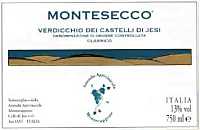
Verdicchio dei Castelli di Jesi Classico |
|
| Montecappone (Italia) | |
| Grapes: Verdicchio | |
| Price: € 7,40 | Score: |
| The wine shows a straw yellow color. The nose mainly develops fruit aromas of citrus fruit, almond, pear and peach followed by flower aromas of hawthorn and broom and pleasing hints of honey. The attack in the mouth is pleasing, however after a little while, without compromising the good quality of wine, a note of crispness tends to prevail over the rest. Good finish and good persistence with evident flavors of peach and hints of almond. This wine is aged for 6 months in steel containers and 5 months on lees followed by one month in bottle. | |
| Food Match: White meat, Pasta and risotto with fish sauce | |
|
|
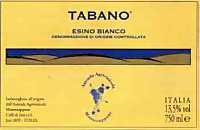
Esino Bianco Tabano 2001 |
|
| Montecappone (Italia) | |
| Grapes: Verdicchio | |
| Price: € 10,50 | Score: |
| The wine shows a beautiful golden yellow with nuances of straw yellow. The nose has intense and persistent fruit aromas of ripe banana and ripe peach as well as aromas of pear and citrus fruit. The olfactory profile is completed with hints of hawthorn, almond and honey. The attack in the mouth is intense with good a good gustatory profile: alcohol, clearly perceivable and in good quantity, is well balanced by wine's crispness and sapidity. The finish is persistent with evident and pleasing flavors of apple and honey with hints of almond. Esino Bianco Tabano is aged in steel tanks for 6 months and 5 months on lees as well as one month in bottle. | |
| Food Match: Fried fish, Broiled fish, Fish soup, Stuffed pasta | |
|
|
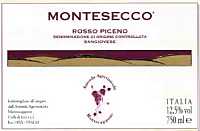
Rosso Piceno Montesecco 2001 |
|
| Montecappone (Italia) | |
| Grapes: Sangiovese (90%), Montepulciano (10%) | |
| Price: € 7,40 | Score: |
| The wine has an intense ruby red color with nuances of purplish red, pretty transparent. The nose reveals intense and pleasing aromas of black cherry, blueberry and violet. In the mouth has a good body and tannins are well balanced with alcohol, with intense and good flavor of black cherry. The finish is persistent with evident and pleasing flavors of black cherry. This wine is produced by maceration of skins for 5/6 days at a temperature controlled fermentation and is aged for 4 months in barrique and one in bottle. | |
| Food Match: Structured pastas, Sauteed meat, Roasted meat | |
|
|
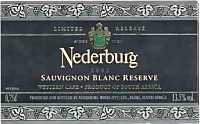
Sauvignon Blanc Reserve 2002 |
|
| Nederburg (Sud Africa) | |
| Grapes: Sauvignon Blanc | |
| Price: € 6,50 | Score: |
| The wine shows a soft straw yellow color with nuances of greenish yellow, very transparent. The nose reveals the typical aromas of the grape used for its production, very elegant and refined. There can be perceived good aromas of smoky, apricot, banana, tomato leaf, green pepper, pear, peach and elder flower. In the mouth has a good correspondence with the nose, balanced, with a firm crisp attack however agreeable. The wine has good body and the alcohol well balances the wine's crispness. The finish is persistent with evident flavors of green pepper, tomato leaf, elder flower and peach. | |
| Food Match: Fried fish, Aromatic pastas and risottos, Spicy roasted fish | |
|
|
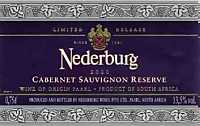
Cabernet Sauvignon Reserve 2000 |
|
| Nederburg (Sud Africa) | |
| Grapes: Cabernet Sauvignon | |
| Price: € 7,50 | Score: |
| The wine shows an intense ruby red color with nuances of garnet red, pretty transparent. The nose reveals a bouquet mainly oriented to fruit aromas. There can be perceived intense aromas of black cherry, raspberry and black currant as well as hints of violet, tobacco, licorice, vanilla and toasted aromas of wood. In the mouth is agreeable and balanced with flavors having good correspondence with the nose. The wine has good body and tannins well balanced by alcohol. The finish is persistent with pleasing flavors of black cherry and black currant. | |
| Food Match: Broiled meat and barbecue, Hard cheese, Roasted meat | |
|
|
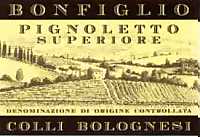
Colli Bolognesi Pignoletto Superiore 2001 |
|
| Bonfiglio (Italia) | |
| Grapes: Pignoletto | |
| Price: € 8,50 ($10,00) | Score: |
| The wine shows a straw yellow color, very transparent. The nose reveals an intense and rich series of aromas, mainly of fruit, such as citrus fruit, apple, pear and grapefruit followed by aromas of broom, hay, candy, seaweed and hints of yeast. The attack in mouth in pretty crisp, however the wine is well balanced by alcohol. Good correspondence with the nose and mouth pleasing rich of fruity aromas. The finish is persistent with pleasing and clear flavors of citrus fruit and apples. The wine is produced with temperature controlled fermentation in steel tanks. | |
| Food Match: Risotto, Pasta and soups, Fish | |
|
|
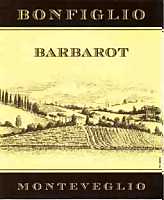
Barbarot 2001 |
|
| Bonfiglio (Italia) | |
| Grapes: Barbera (90%), Cabernet Sauvignon (10%) | |
| Price: € 9,60 ($9,00) | Score: |
| The wine shows a ruby red color, pretty transparent. The nose reveals the typical aromas of Barbera grape with good correspondence with the mouth. There can be perceived good and intense aromas of black cherry, black fruit, raspberry, blueberry, black currant and hints of violet. The attack in the mouth is pretty crisp, well balanced by alcohol and tannins. A balanced wine, intense and with good body. The finish is persistent with pleasing flavors of raspberry and blueberry. Barbarot is produced with a temperature controlled fermentation in steel tanks followed by an aging of 4 months in bottle. | |
| Food Match: Roasted meat, Hard cheese, Broiled meat and barbecue | |
|
|
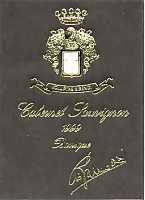
Colli Bolognesi Cabernet Sauvignon |
|
| Bonfiglio (Italia) | |
| Grapes: Cabernet Sauvignon | |
| Price: € 20,00 ($17,00) | Score: |
| This wine, a good example of Colli Bolognesi's Cabernet Sauvignon, shows a deep ruby red color with nuances of garnet red, little transparency. The nose reveals intense and clean aromas of fruit, of good personality. The perceived aromas are of black cherry, ripe cherry and plum jam with pleasing hints of chocolate, black pepper, undergrowth, vanilla and toasted aromas of wood. In the mouth has good correspondence with the nose and a tannin attack, which is well balanced by alcohol, and good body. The finish is persistent with pleasing flavors of black cherry, plum jam and vanilla. A very well made wine which can be drunk in its current state, however it will give its best with some more aging in bottle. This wine is aged in barrique for 12 months and 6 months in bottle. | |
| Food Match: Stewed meat, Braised meat, Hard cheese, Roasted meat, Game | |
TrappoliniIn Latium, few kilometers far from the Umbrian border and in wine area of Orvieto, Trappolini winery makes very good wine while fully respecting the tradition of its land and of the grapes. |
|
In the general trend of the wine industry, where the so called “international” grapes are widely used, it is not easy to find a winery which believes, with no hesitation, in the richness and potentiality of local grapes and, last but not least, getting excellent results. Trappolini winery is certainly one which belongs to this category; a production completely based on local grapes, with the only exception of a wine which is produced with Chardonnay, and the richness of the grape patrimony of their lands. Trappolini winery is located in Castiglione in Teverina, a characteristic town in the province of Viterbo, few kilometers far from the Umbrian border and, enographically speaking, located in the Orvieto wine area.
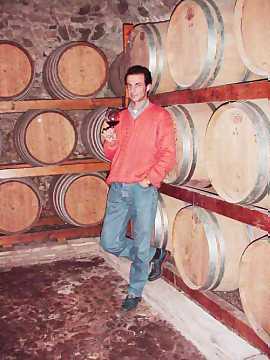
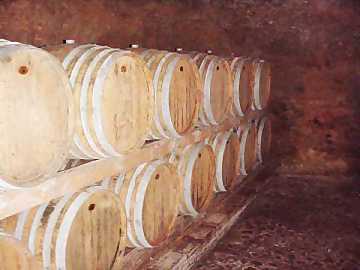
As we get to the winery we meet Mr. Roberto Trappolini, managing director of the winery, who introduced us to some historical and productive aspects of the business «the winery was established in the sixties of the past century and it was my grandfather to start the business and later my father joined him. In the beginning of our business, quality, as we consider it now, it was not a primary productive strategy of the winery, things changed with time and we changed our business from wine sellers to quality wine producers. After forty years we developed our production and commercial line and we are convinced in going to this direction while trying to improve the quality of our production, from vineyard to sales. The winery is located in the largest commune of Latium region and which is permitted to produce an Umbrian DOC wine, Orvieto, a product which allowed us to have a rapid improvement of the local enology, however, things changed with time because the main requests for the Orvieto wine was related to Orvieto Classico and being outside of the “classic” production area, we have been forced, in a sense, to get back and strongly reconsider our origins and our territory. Our land is suited for the cultivation of red berried grapes, mainly historical and typical for this area, such as Sangiovese and Aleatico, as well as white berried grapes, that we also use to make our Orvieto, and the most important one of them all is Grechetto. We obviously are interested in the red berried grapes which have historically been present in this territory, such as Sangiovese, and other that are unfortunately not considered and are disappearing as few producers make wine from them, such as Aleatico and Canaiolo. These grapes are part of our rich enological patrimony and we thought it was not good to abandon them and we believed in keep using them, particularly Aleatico which we use to make a very refined and particular sweet wine without making use of other and more famous grapes. By using this grape we produced our newest wine: Idea. Its production is made by using the same grape species and by using a rather complex process: harvest is done in two different phases, the first one of them allow us to harvest sound grapes without losing the typical aromatic character of the grape, in the second phase we press dried grapes, after a period of 5 or 6 months, and make wine from it; this second phase allows us to add body to the wine as well as sweetness. At the end of both phases we assemble the two wines and the result is a very aromatic and varietal wine which also has good body and color.» We are now going to discover the rest of the production of Trappolini winery as well as the characteristics of its wines. «Paterno, a wine exclusively produced with Sangiovese, is certainly the most important wine of our winery, and we recently supported it with out most important white wine, Brecceto, produced with Chardonnay and Grechetto grapes, which is aged for a moderately short period of time in barrique as well as in bottle. Brecceto, which was named after the place where the vineyard in which we harvest the grapes for making this wine is located, was previously produced in two different versions, one exclusively made of Grechetto grapes and the other made of Chardonnay. From 2001 on, we decided to give the Grechetto what the Chardonnay had to offer and vice versa, and therefore we decided to make only one version of Brecceto which actually is the blend of the two wines. The result is a balanced wine, where the typical impetuosity of Grechetto does not emerge while having the typical elegance of Chardonnay. The wine is aged for 12 months, part in barrique and part in bottle. Paterno certainly is our most important product which requires, and will keep on requiring, our highest attention and care in order to make sure the wine to always have the same quality. This wine is produced with Sangiovese grapes harvested in a traditional vineyard located in the border between Latium and Umbria. Even though Sangiovese has always bee considered as a non typical grape of Latium, in this region has always been successful in the production of great wines, however this grape, just like any other else, is capable of expressing proper characteristics according to the territory in which it is being cultivated. In our territory Sangiovese usually expresses itself, not for a deep concentration and structure, something which is typical in certain areas, but rather shows elegance, a characteristic which tends to improve with time. Our philosophy concerning the use of casks is rather moderate as we are convinced a good wine which was aged in barrique is the one where the “barrique aroma” is not evidently perceived. Barrique, according to our opinion, should be used to improve the wine and not to give taste to wine; barrique is for us one of the many tools we use in cellar and nothing more. Moreover, we believe that in case a consumer gets into wine and appreciates a wine which does not taste of wine, this probably means he or she is not used to drink wine or however he or she does not want to drink wine. Other wines produced by our winery include Cenereto and Sartei, the former is a red wine produced with Sangiovese and Montepulciano, the latter is a white wine produced with Trebbiano Toscano and Malvasia Bianca. These wines are intended for a different market. Not all consumers are looking for wines like Paterno, Brecceto or Idea, anyway there are many restaurants out there and there are elegant ones and ordinary ones, therefore there is the need of having expensive and elegant products as well as having cheaper but good wines. Cenereto is produced with Sangiovese and Montepulciano. The latter grape, even though it is found in our territory, is not considered to give important wines like the ones made of Sangiovese, therefore we use this grape supported by Sangiovese, in equal parts. This wine is not intended to be aged for a long time and it should be drunk as it is being released, possibly in the same year and however within the next year. Sartei is a wine produced with Malvasia Bianca and Trebbiano Toscano, two local grapes which have a fundamental importance for the enology of most of the Italian regions. Just like Cenereto, Sartei is a pleasing wine which should be drunk as it is being released and is offered at a reasonable price in order to meet the needs of the ones who want a wine to be drunk every day. Both Sartei and Cenereto are aged in steel tanks and we do not use any barrique for them. Lastly, we also produce an Orvieto wine made of Procanico, Verdello, Grechetto, Drupeggio and Canaiolo Bianco grapes, as well as Est! Est!! Est!!! of Montefiascone, produced with Trebbiano Toscano, Malvasia Bianca and Rossetto.»
Let's take a look at past productions of Trappolini winery, in particular to the wine which is well suited to aging in bottle: Paterno. Mr. Trappolini about this aspect says «the product which has the longest story in our winery is certainly Paterno, which was released for the first time in 1989, in a period when talking about red wines produced in this area, which historically have always been involved in the production of white wines, meant to swim against the stream. However our winery owned vineyards where we were cultivating red berried grapes and we ought to make the best possible use of them. Making a wine to be sold non bottled, a custom pretty common among the producers of those times, did not represent a convenient choice nor a qualitatively productive choice. Our choice was, also according to our wine consultant, to make an important red wine. We started experimenting with the grapes harvested in this vineyard in order to evaluate their potentiality and then we decided to make a red wine: Paterno. Paterno represented in this area a very prestigious and famous wine of the 1960 which was produced by our consultant's father in a local winery. Paterno was a wine that every one knew and every one was talking about and was almost considered as a “myth” of the local enology. We then decided to revive this wine and we started its production. Paterno was the name of the area where the vineyard is located and therefore the wine was named after that, lastly, thanks to the literal meaning of this word (“Paterno” is Italian for “fatherly”), we believe it is the proper tribute to our father which was the first one to change our winery production into a qualitative one, therefore dedicating this wine to him seemed to be right. The first vintage of the 1989 was not very encouraging, however we decided to go on, also thanks to the introduction of new technologies. We produced 2798 bottles from the first vintage and currently, after ten years, we produce about 30000 bottles of Paterno, however we expect to produce about 40000 bottles with the 2000 vintage. Recently we uncorked some bottles of Paterno belonging to past vintages and, with my surprise, one of the years which amazed me the most was 1989, not for the development of its quality, rather for the way the wine kept its characteristics in the course of time. Paterno is aged in Allier and Nevers barriques, that is the kind of oak, according to our opinion, that are best suited for this wine. Paterno is aged part in casks and part in used barriques, we never use new barriques for this wine, just because we do not want strong wood aromas to prevail over the real and proper characteristics of the wine. The first use of new barriques is for white wines and after that, from the second passage on, we use them for the aging of Sangiovese.» Let's take a look to market and countries where wines of Trappolini winery are sold. Talking about this aspect Mr. Trappolini says «our main market is Germany and we are also present in Switzerland, Denmark, Sweden, Brazil, Japan as well as in Italy. Our production, quantitatively not high, does not allow us to be present in every country and in every market, therefore we prefer to be present in those markets which are more right for our wines.» Trappolini winery also produces a refined grappa and Mr. Trappolini talks about its characteristics «our winery produce raw materials, that is grape pomace, which can be processed by distilleries in order to make grappa. It has been since a long time our winery had the need of creating a distilled beverage in order to satisfy and meet every gastronomical match, from wines to be matched with many foods, to spirits to be offered at the end of a meal. The choice of pomace to be distilled for the production of our grappa required a careful consideration; according to a logical point of view it would have been wise distilling the pomace of our most important product, Paterno, however we knew we had a very particular pomace, that is the one of Aleatico which we use for the production of Idea. We then decided to use this pomace in order to make an aromatic grappa which was capable of meeting the taste of everyone. We subsequently found a distiller that gave us warrants about the quality of the product and we selected Berta distilleries in Nizza Monferrato (Italy), a renowned producer of grappa.» The grappa produced with Aleatico's pomace has the same name of the wine produced with these grapes: Grappa of Idea. We tasted this grappa and it shows as crystalline and very limpid, an enchanting aroma of strawberry, walnut, hazelnut, honey, dried rose and hints of banana, very elegant and refined. In mouth reveals an excellent roundness where the flavors of strawberry and dried rose are harmoniously tied and the finish is long and pleasing. This grappa's roundness, almost velvety, is impeccably balanced by alcohol and giving it elegance, refinement and agreeability of sure value.
|
||||||||||||||||||||
|
Score legend Fair Pretty Good Good Very Good Excellent Wine that excels in its category Prices are to be considered as indicative. Prices may vary according to the country or the shop where wines are bought |
|
|
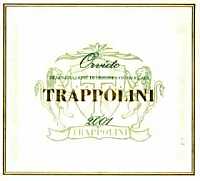
Orvieto 2001 |
|
| Trappolini | |
| Grapes: Trebbiano Toscano, Grechetto, Verdello, Drupeggio, Malvasia Bianca | |
| Price: € 4,87 | Score: |
| The wine shows a soft straw yellow color with nuances of greenish yellow, very transparent. The olfactory profile is mainly oriented to fruit aromas such as almond, apple, pear and peach and hints of acacia and broom. In the mouth has a good correspondence with the nose, it is crisp and well balanced by alcohol. The finish is pretty persistent with agreeable flavors of apple and pear. | |
| Food Match: Aperitif, Vegetables, Boiled crustaceans, Pasta and Risotto with fish | |
|
|
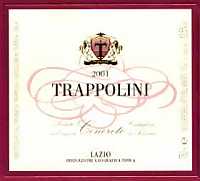
Cenereto 2001 |
|
| Trappolini | |
| Grapes: Sangiovese, Montepulciano | |
| Price: € 4,87 | Score: |
| The wine shows a ruby red color pretty transparent. The nose reveals aromas mainly oriented to fruit and a pleasing hint of fern. There can be perceived aromas of black cherry, cherry macerated in alcohol, blueberry, plum and hints of sage. In the mouth has good correspondence with the nose, good balance and body. The finish is pretty persistent with flavors of black cherry and cherry macerated in alcohol. This wine is aged in steel tanks before being bottled. | |
| Food Match: Broiled meat and barbecue, Hard cheese | |
|
|
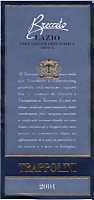
Brecceto 2001 |
|
| Trappolini | |
| Grapes: Grechetto, Chardonnay | |
| Price: € 7,89 | Score: |
| The wine has a greenish yellow color, very transparent. The olfactory evaluation reveals an elegant and properly defined olfactory profile, of good personality, with good and intense aromas of banana, apple, pear and peach and a hint of acacia. Although this wine is fermented and aged in barrique, wood aromas are very delicate and respect the personality of grapes used to make the wine. In the mouth has good body and the attack is pleasing crisp, well balanced by alcohol. The finish is persistent with agreeable flavors of pear and peach. A well made wine, very agreeable and pleasing which surely invites to repeated tastings. The grapes used to make Brecceto are separately fermented in barrique and are subsequently assembled and aged in bottle for some months. | |
| Food Match: Fish, White meat, Pasta with fish, Mushroom soups, Soft cheese | |
|
|
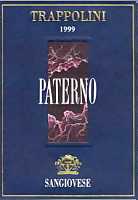
Paterno 1999 |
|
| Trappolini | |
| Grapes: Sangiovese | |
| Price: € 10,00 | Score: |
| The wine shows a beautiful brilliant ruby red color with nuances of garnet red, pretty transparent. The nose reveals a strong and interesting personality with intense, clean and elegant aromas. There can be perceived good and intense aromas of black cherry, plum jam, raspberry, blackberry, violet and tamarind with pleasing hints of cocoa, licorice, leather and vanilla. Wood aromas, although present, never prevail over the olfactory profile, are delicate and fully respecting all the other aromas. In the mouth has good body, with good correspondence to the nose and a slightly tannic attack which is balanced by alcohol, there can be perceived intense and good flavors of fruit such as the ones perceived by the nose. The finish is persistent with clean and pleasing flavors of black cherry, plum jam and blackberry. A well made wine. Paterno is aged in barrique for about two years and for 6 months in bottle. | |
| Food Match: Roasted meat, Broiled meat and barbecue, Braised meat, Game, Hard cheese | |
|
|
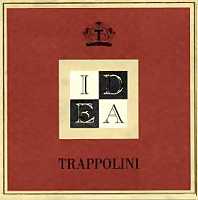
Idea 2000 |
|
| Trappolini | |
| Grapes: Aleatico | |
| Price: € 10,40 (500 ml - 16.9 oz.) | Score: |
| Excellent example of dried and sweet Aleatico. The wine has a beautiful and intense ruby red color with nuances of garnet red, little transparency. The nose denotes a wonderful personality and a good richness in elegant and refined aromas, mainly of jams and intense aromas of cherry macerated in alcohol, black cherry jam, strawberry jam, blueberry jam, raspberry, blackberry, dried rose, dried violet and hints of anise. A very clean and pleasing nose. In the mouth is round, with alcohol and sweetness well balanced by soft tannins which do not disturb at all and positively contribute to the overall balance. Denotes intense flavors and excellent correspondence to the nose. The finish is persistent with lasting and pleasing flavors of blueberry jam, strawberry jam and raspberry. A wine well made and truly agreeable which can give rich emotions even when enjoyed alone. Idea is produced with Aleatico grape: half grapes are dried and the other half is vinified as red and then both wines are assembled. | |
| Food Match: Fruit tarts, Hard and piquant cheese | |
| Trappolini - Via del Rivellino, 65 - 01024 Castiglione in Teverina (Viterbo) Tel. e Fax 0761 948381 - Winemaker: Paolo Trappolini - Established: 1963 - Production: 160000 bottles - E-Mail: trappolini@tin.it |
Cellar Journal |
|
This section is reserved to wine producers who want to publish news and information about their business, to announce new products or just for communicating to their customers information and promotions about their products and activity. Send news to be published at our e-mail address.
|
DiWineTaste's Wines Guide Grows UpAfter the striking success among our readers and wine producers, something new is being introduced to the Guide |
|
The past month we introduced a new service for our readers, DiWineTaste's Wine Guide, and, with our satisfaction, it has been appreciated as well as being a striking success, the many letters we received, both from our readers and from wine producers, have been the best reward for what we did, we are certainly looking forward to keep on improving the quality of what we offer to our readers and to wine producers. We would like to thank everyone who sent us comments and opinions about the Guide as well as their appreciation, this is an encouraging act which surely rewards our efforts and for this we thank you. After one month from its introduction, we decided to improve and to enrich the contents of our Guide. Wines to be reviewed in the “Wines of the Month” column, as well as the ones reviewed for the producer of the month, are directly shipped from producers to our office and this is the only obligation we ask them. Our publication is available and open to every wine producer, no one excluded, and every week we receive wines to be evaluated by our tasting commission and the results are published on DiWineTaste. The norm that we have is to review and publish up to three wines per producer in the “Wines of the Month” column and up to six wines per the producer who is reviewed. The choice of publishing up to three wines per producer in the “Wines of the Month” column is mainly because we want to offer sufficient opportunities to every producer as well as because of editorial needs. Producers, who are informed in advance about this norm, often send us more than three wines and therefore we publish the ones that, according to us, are worth of note or however interesting. This choice forces us not to publish the results of other wines, this is something we do not think to be right, of course, however we have to make editorial decisions, and the results of these unpublished tastings remain, like to say, in queue waiting to be published in the next months and however according to editorial needs and availability. The consent we received from producers, this is something which certainly pleases and honors us, is also confirmed by the quantity of wines they send us every week and most of them will hardly be published, just because we want to give every producer, no one excluded, the same opportunity, it will be hard for us to publish the results of those wines waiting to be published sooner or later. We decided to include these wines in the Guide, available on our site, in order to give them the opportunity to be known among our readers. In the column of our publication we will continue publishing the wines we believe to be interesting and worth of note, whereas in the Guide will be published all the wines tasted and evaluated that we received from producers, including the ones reviewed in DiWineTaste. We sincerely hope this news will contribute in improving the quality of our services and to fulfill our primary goal, to promote the wine culture and information. We remind our readers as well as producers we are available and glad to receive your comments and suggestions about what we offer and, as always, we invite you to write us your opinions at our E-Mail address.
|
||||
News |
|
In this section will be published news and information about events concerning the world of wine and food. Whoever is interested in publishing this kind of information can send us a mail at our address.
|
BottleThe container used to keep and transport the nectar of Bacchus reveals secrets and shapes which tell the traditions and the history of the people who produce wine |
|
At the end of the wine making process, the work of the producer, the skill and the talent of the wine maker, the soul and the essence of the lands where the grape comes from, are realized in the beverage of Bacchus, wine, which is sealed in a glass container and entrusted to its destiny, often it begins a journey towards distant places from the area of origin, often, as it gets to destination, is kept in a quiet room in the hope it will improve with time and become nobler. All this is realized by that object which is a trusted and loyal mate of the wine since few centuries: bottle. The problem of storing wine in a container capable of keeping its characteristics as sound as possible, as well as allowing a practical transportation for obvious commercial reasons, is a need which have always been part of the wine making process. The most modern solution, whose origin is as ancient as few centuries ago, is the bottle of glass and, despite of its apparent fragility and its reliable solidity, has proved to be a reliable container, including other essential environmental factors, ideal for the keeping and the aging of wine. The first practical examples of containers suited for the transportation of wine were amphoras, containers usually made of earthenware of stretched shape and having two handles, and they were commonly used in ancient times by Etruscans, Greeks and Romans. The huge number of amphoras found in the many European countries prove these containers were widely and extensively used for the transportation of wine, moreover, they witnesses trade of wine was a very important and relevant aspect of the economy of that time. Amphoras usually had a large body which narrowed to the top in order to form a neck with a narrow opening and two handles were also found in the neck. As the amphoras were filled with wine, they were closed with a plug, usually made of wood, cork or clay, and subsequently sealed with mortar. It seems the first ones to use corks in amphoras were Etruscans. As Amphoras were pretty porous, they usually were completely coated with resin of pine in order to seal them better. Another container which was invented and intended for the transportation of wine, and subsequently used as a cellar tool, was cask, probably invented in the area of Bordeaux, which allowed the transportation of huge quantities of wine as well as ensuring a good level of keeping, at least as long as wine was not drew from the cask, a condition which favored oxygen to enter the cask and therefore the oxidation of its content. Earthenware containers were used both for the service and the transportation of wine until the seventeenth century, when the industry of glass improved its production technologies and glass became available in large commercial quantities, mainly sold in shape of bottles. The first bottles of glass had shapes very different from the ones we currently use, they were rather short and large; this kind of shape does not suggest they considered the possibility of keeping wine in a laid bottle. The shape of the bottles of those times looked like “onions” or “bladders”, rather than having the typical shapes of modern bottles. Squat, large and short shapes with short and conical necks also suggested an impractical and difficult usage during the service of wine. The transparency of the glass of those times was not perfect and it usually had impurities and more or less intense “greenish” colors which indirectly were beneficial to the keeping of wine and sheltered it from the effect of sunlight. In the course of time, shapes of bottles radically changed, progressively losing short and large shapes and having more and more slender and narrow shapes. These new productive styles gave wine lovers the possibility to discover a fundamental factor for the keeping of wine: laying a bottle on its side allowed, not only to keep the content for a longer time, but also and above all, to improve the taste and the aromas of wine. A fundamental factor which drastically changed the trade and the economic value of wine. Keeping a bottle laid on its side allowed the cork to be moistened, therefore this prevented the cork to shrink as well as the oxidation of wine, a fundamental and well known condition for a proper keeping and aging of wine in bottle. Keeping a bottle laid on its side also allowed a better and simpler storage of bottles in cellars while greatly optimizing the use of space. Shape of bottles also evolved according to the traditions and customs of the people which made them, most of bottles, despite the fact they are widely spread all over the world, still have the name of their area of origin.
|
||||
|
Shape of modern bottles, in case we do not consider the ones traditionally used for certain wines in specific and limited areas, is tall and slender. Bottles are shaped in order to give them particular physical characteristics suited to storage and service of wine. Every bottle is made of the following parts: base, body, shoulder and neck. Base, besides having the evident function of allowing the bottles to remain in vertical position, is often modeled in rather hollow shapes, a characteristic which is not present in every kind of bottle. The reason of this “indentation” is probably because of production and historical reasons. When the bottles were built by blowing a mass of incandescent glass and without using any mould, the part which was intended to be the base assumed a round shape and this would not allowed the bottle to stay in a vertical position. This rounded part was therefore pushed inside the bottle, of course when the glass was still sufficiently warm and could be modeled, in order to make the bottle's base. This indentation, which is still present in many kinds of bottles, also has a useful function in the aging of wine, in particular for those wines which produce sediments. Because of its shape, when the bottle is kept in vertical position, wine's sediments will deposit to the base, disposing along the ring formed by the indentation, instead of being spread on the whole surface of the base in case the bottle does not have any indentation. The concentration of sediments in a such tiny area will make things easier during the operation of decanting and therefore greatly avoiding the sediments to get suspended in the wine and altering the aspect. Body, which constitutes the most extensive part of the bottle, goes from the base to the shoulder, that is the part which narrows in a more or less accentuated way in order to form the neck. The shape of a bottle's shoulders play an important role during the pouring of a wine as well as for decanting. Accentuated shoulders, such as the ones of the Bordeaux bottle (see figure ), offer an efficient barrier to any possible wine sediment produced during aging. As the wine is poured in a glass or in a carafe, sediments will be held back by shoulders while allowing a better control of the decanting process. For this reason, wines which usually tend to produce a more or less abundant sediment, are bottled in bottles having accentuated shoulders, such as the Bordeaux style, whereas white wines, which usually are not aged in bottle and therefore do not produce any sediment, or however red wines which produce a limited quantity of sediment, are bottled in bottles with sloped shoulders, sometimes in bottles having no shoulders, such as the Bourgogne style, also used for red wines, or the Flute, exclusively used for white wines. (see figure )
The neck is the narrower part of the bottles in which it is found the opening that allows the wine to be poured. Near the opening there is a protruding ring which is simply called “ring”. The presence of this ring is because of historical reasons as it was used to anchor the cork to the bottle by means of strings or metallic wires, as well as offering a better grip to sealing-wax used to seal bottles. The fundamental function of this ring can be still observed in every bottle of sparkling wine: the wire cage, which holds the cork by preventing its expulsion because of internal pressure, is tightly anchored to this robust ring of glass. The shape of bottles is mainly dependent by the traditions of the places where they have been produced and some of them are practically spread all over the world and widely used for the bottling of wine. The following list includes the bottles which are commonly used for bottling wine as well as some bottles which are commonly used for particular wines produced in specific areas.
The shapes of the above bottles are depicted in figures.
The typical volume of a regular bottle of wine is 0.750 liters (25.3 fl.oz.) and this capacity is simply defined as “one bottle”. The size and volume of bottles vary according of this capacity, assuming multiples or fraction of this measure. The many dimensions of bottle are identified with specific names instead of the measure of their capacity. Table shows the names and volumes of the many bottle sizes which are currently used for still wines and for sparkling wines. Names chosen for Champagne bottles (therefore for sparkling wine bottles) of large size are the ones of some kings of the great middle-eastern civilizations of the past. The reason of this choice was because of some Champagne merchants that, at the end of the nineteenth century, realized this wine was mainly consumed in occasion of holidays and important moments of celebration, decided to associate to large bottle sizes the names of great kings of the ancient civilizations of the middle-east in order to associate the use and the consumption of this sizes in occasion of important and significant moments. Large sizes have always been of interest among wine lovers as well as among wine collectors. However, it should be noted sparkling wines contained in bottles having a volume greater than 3 liters (6.34 pints), that is greater than the Jéroboam size, did not probably have the secondary fermentation, typical in the classic method, in that very bottle. Often bottles of large size are filled with the content of smaller bottles at the end of the sparkling wine making process.
|
||||||||||||||||
|
One of the factors which allows a good keeping of wine is sheltering from light. Color of the bottle therefore represents a very important factor which allows to prolong wine's life in the course of aging. Bottles of glass having more or less dark colors can offer a good protection against the effects of light and prevent, in a significant way, negative effects it usually has on wine. However it is believed color of bottles is in fact a consequence of the working methodologies of the past, when the production of glass got colors tending to green and sometimes to brown because of the non perfect purity of the raw materials used for the production.
The color of the bottle is also a traditional characteristic of certain areas. The flute bottle, for examples, usually has a green color in Alsace whereas in the Rhine area has a brown color. Another example is offered by the Bordeaux bottle. For the bottling of white wines is preferred a colorless type, whereas for red wines is used a bottle of green or brown color instead. Another color which is strictly connected to a particular area is the so called “dead-leaf”, a greenish-yellow color typical in many Bourgogne bottles which is also common in other parts of the world. Despite the many reasons, either traditional or productive, which determine the color of the bottles' glass, it is always preferable using those having dark colors, particularly for those wines which are destined for a period of aging in bottle. It seems to be pretty funny the habits of some producers, even though it depends by historical and traditional reasons, to use colorless bottles for white wines. This specific kind of wine needs, more than any other else, a proper protection against the effects of light and using this bottle seems to be inadequate. It should be however noted white wines are not usually suited for bottle aging and this habit is probably to be intended as an explicit suggestion from producers to drink the wine as soon as possible. Even bottle size plays a determinant role in the preservability of a wine as well as in the development of those process typical in the aging of wine. In bottles having small sizes, such as the half bottle or the quart, wine ages more rapidly and are not suited for the aging of wine. The reason for this accelerated aging depends on the greater quantity of oxygen compared to the quantity of wine contained in the bottle, therefore the process of oxidation will be faster. Conditions get better in case the capacity of the bottle is increased and therefore the quantity of oxygen will be lesser if compared to the quantity of wine. For this reason wine kept in bottles of large size ages slowly and allow a better development of the organoleptic qualities of wine. Another determinant factor for the keeping of wine in the bottles is the so called “ullage”, that is the level of the wine in a bottle. Lesser the filling level, greater the space occupied by oxygen with the consequence of accelerating the oxidative process. The level of filling can vary during the aging of a wine in a bottle because of the sudden changes of temperature which provokes expansions of the wine and forces it to be spilled out of the bottle while increasing the free space that will be occupied by oxygen. Checking the level of filling in a bottle is always a good habit every time a wine is being bought: it is also good to distrust those bottles, in particular bottles of wines which have been aged for a long time, having low filling levels.
|
||||||||||||||||||||||||||||||||||||||||||||||||||
RumThe renowned distilled beverage that evokes sunny and relaxing exotic beaches, is the result of the mastery and passion of its producers |
|
Rum is a distilled beverage, having a brownish-yellow color, more or less intense, which is obtained by the fermentation and subsequent distillation of sugar cane or molasses (a byproduct of sugar production) which is sometimes added to aromatic herbs or substances. In the years of 1920 and 1930, the years of prohibitionism in America, Havana became the mundane center of celebrities, it was frequently visited by writers, politicians and actors. One of the most illustrious visitors was Ernest Hemingway, who is usually connected to the world of Rum and spent many years at Havana, and he loved spending afternoons drinking cocktails made of rum in some bars that, according to him, were the best ones which were capable to offer the best “blended beverages”. The name Rum seems to derive from the abbreviation of “saccharum” (sugar), a name that was first used by distillers, usually monks, and was subsequently shortened, as a matter of use, by buccaneers or it may also be a word originated by the buccaneers' parlance, “rumbullion”, the tumultuous celebrations for their victories. It is also sometimes found as “Ron Rhum”. However the origin of this name is uncertain although many agree that its origin is Caribbean.
|
|
Sugar cane, which is originated in Asia, cultivated in China since four thousands years, was introduced to the Middle East by Alexander the Great, however was Christoforo Columbus who introduced it to the new world. In Puerto Rico, Cuba, Haiti and in Jamaica they started cultivating sugar cane and it was in these places settlers noticed the fermentation of the syrup, the residual of the production of sugar, could give a raw and sweet liquid. The subsequent process of distillation gave birth to the renowned alcoholic liquid which suddenly became popular: Rum was born. The first attempts to the distillation of sugar cane are probably dated back to the sixteenth century in Puerto Rico, even though there are legends which says Flemish people were the first ones to do that in Martinica island. However the largest Rum producers of the world are mainly located in the Caribbean area. The main Rum producers are: Antilles, Barbados, Cuba, Jamaica, Virgin Islands, Puerto Rico, Martinica, Mexico, Santo Domingo, Venezuela and Brazil (although here it is called cachaca and has a very different taste). Originally Rum was a secondary product of sugar cane processing, and was obtained by distillating molasses, that is the residual liquid of sugar cane production. Rum was the preferred beverage of buccaneers and pirates, called “kill devil” by English sailors, who could have half a pint of it every day, and was considered as a good remedy for pneumonia as well as an excellent anesthetic. Rum was also called “Nelson's blood” because, when he died in battle, his corpse was preserved in rum in order to take it to his home land intact.
|
|
Rum is exclusively produced by the fermentation and subsequent distillation of sugar cane juice, molasses and byproduct syrups from sugar processing. The process for the distillation of traditional Rum begins with the dilution of molasses, obtained as a byproduct of the production of sugar, and by adding fermenting yeasts. Twenty four hours later, for some producers are forty eight hours and even 5 days for others, it is produced a liquid having 5% or 6% of alcohol by volume. This liquid is heated and boiled in a steam distiller: alcohol, by evaporating, rises, whereas the residuals are left to the bottom in order to be gathered and eliminated. The rum distiller is made of 21 layered plates, as the liquid boils, alcohol evaporates and rises to the upper plates whereas the residual liquid is gathered in the lower plates and will be eliminated. At the end of this phase, the evaporated parts begin to cool down and their condensation takes place in a specific and narrower part of the distiller. Other parts of the distiller concentrate and separate the many aromatic components of alcohol: the least refined oils are gathered in lower plates, other refined oils are gathered in the middle plates, whereas “heads”, light components having an aroma of green apple, rise to the upper plates. During these phases, the experience and the mastery of distiller who needs to blend, remove or include these components, is essential in order to obtain the best product. Artists, who treasured the art of rum making, a knowledge which is the result of many hours spent in the heat of the many types of distillers, who are capable of feeling, understanding and dominating the raw materials. A difference between industrial rum and agricultural rum is the method of distillation. The former is distilled in a continuous distillation whereas the latter is distilled in batch distillation.
|
||||
|
Rum is divided in two categories: industrial rum and agricultural rum. Industrial rum is produced by the distillation of molasses, whereas agricultural rum is exclusively produced by pure sugar cane juice and it is called “vesou”. When rum is distilled, just like any other distilled product, is colorless and it will be colored by the process of aging in cask or by adding caramel. As the rum is distilled it usually has a very high content of alcohol and it will be added to distilled water in order to lower the alcohol by volume to 40%. The most popular rums are the ones obtained by syrups and molasses produced during the processing of the sugar cane, that is industrial rum. This kind of rum is considered as having a lower quality, whereas the ones obtained by the fermentation and distillation of sugar cane, that is agricultural rum, are certainly difficult to find although are considered to be of high quality, often compared to the best brandies of Europe. The fermentation of sugar cane juice allow the production of a distilled liquid having very complex organoleptic qualities, with aromas of fruit and flowers, and the subsequent aging in cask will also add balsamic aromas of wood. Agricultural rum, as opposed to industrial rum, is suited for aging thanks to its particular structure and aromatic complexity, as a matter of fact the “Appellation of Origin” is only reserved to agricultural rums. In general terms, white rum or light rum are usually aged for one year before being released to the market, are distilled in continuous distillation, are delicate with hints and dry aroma of molasses. Because of their characteristics they are usually used for the preparation of cocktails and long drinks. Aged rums have more complex organoleptic qualities and are best enjoyed when drunk plain as well as when blended. For the aging of rum are not usually used new casks, used casks are preferred, particularly the ones used for the aging of bourbon and American whiskey, just because the tannins of the used wood are considered to be more elegant, light and delicate and are best suited for the structure of rum, without covering or prevailing over the personality and delicacy of agricultural rum. Aging rum in cask will originate aromas of ripe fruit, caramel, vanilla, tobacco and the typical balsamic aromas of American oak. There is no disciplinary regulating the aging of rum. According to the aging time, there are commercial rums aged from one to three years, followed by rums aged for five to seven years and labeled as “dorado” or “anejo”. The warm climate of Caribbean islands influence the aging of rum, acting as a catalyst and accelerating this process by two of three times. An aging of ten years for rum can be compared to an aging of more than twenty years for a Scotch whisky, which is produced and aged in cooler climates. Dark rums, which are sometimes added to caramel in order to intensifying color and increasing density, are very aromatic and are not particularly suited for cocktails and should be used as a secondary ingredient only. Cuban rum, categorized as “Carta Blanca” and “Carta de Oro”, is usually heavily refined, is a high quality product, light, pale color and dry, is mainly used in cocktails and is different from the one produced in Jamaica, which is suited for a long aging (at least five years) it is dark, full bodied and pungent, excellent when drunk plain. Rum produced in Martinica, as well as some produced in Jamaica, Haiti and Gujana, are usually full bodied, dark and robust, can be aged up to twelve years and even more. A meditation beverage and, thanks to its organoleptic characteristics, can be compared to the best brandies. Rum produced in Venezuela is very strong and is usually “diluted” with water before aging. From agricultural rum can be obtained the so called “white grappa”, a full bodied colorless distilled liquid that can be aged for more than three years in oak casks. From industrial rum can be obtained “young rum”, colored with caramel and sugar, is a light distilled liquid, pale and neutral, “old rum”, aged in cask for more than three years, “rum gran aroma”, used for blending, and “rum doppio aroma”, used for cooking and pastry. Among commercial rums there are spiced rums which are added to spices or herbs such as cinnamon or anise. It should be worth knowing that in Western Indies and in the archipelago of Java are produced many kinds of distilled beverages obtained with the very same methods used for the production of rum but using different raw materials, such as coconut, rice and other ingredients.
|
|
Rum is preferably tasted at temperatures from 12° to 14° C (53° - 57° F), and preferably served in a “balloon” crystal glass, or alternatively in sherry “copitas”, whereas the official glass to be used for the tasting of rum is the so called “ISO tasting glass”. Sometimes plain water is added in order to promote the development of “hidden” aromas. Rum is usually drunk plain, in cocktails and in long drinks. It is a pity to see few appreciate the elegance of a glass of rum, drunk in tiny sips; it seems this distilled beverage is mainly appreciated added to fruit juices, syrups and in blended beverages, preferably having a sort of “exotic” taste, as well as in fruit salads and it is a frequent ingredient of many cocktails.
|
Wine Parade |
|
|
| The best 15 wines according to DiWineTaste's readers. To express your best three wines send us an E-mail or fill in the form available at our WEB site. |
| Rank | Wine, Producer | |
|---|---|---|
| 1 |

| Masseto 1998, Tenuta dell'Ornellaia |
| 2 |
| Semillon Sauvignon 2001, Cape Mentelle |
| 3 |

| Chardonnay 2000, Planeta |
| 4 |

| Muffato della Sala 1999, Castello della Sala |
| 5 |
| Château Pontet-Canet Pauillac 2000 |
| 6 |
| Château Lynch-Bages Pauillac 2000 |
| 7 |
| Rioja Reserva “Pagos Viejos” 1997, Bodega Artadi - Cosecheros Alavares |
| 8 |
| Capo di Stato 1998, Conte Loredan Gasparin |
| 9 |
| Teroldego Rotaliano Granato 1998, Foradori |
| 10 |
| Château Laroque Saint-Émilion Grand Cru Classè 1998 |
| 11 |
| Gevrey Chambertin DB Boillot 1998 |
| 12 |
| Brunello di Montalcino Riserva 1995, Fattoria dei Barbi |
| 13 |

| Zinfandel Barrel Select Mendocino County 1999 - Fetzer Vineyards |
| 14 |
| Trentino Müller Thurgau “Pendici del Baldo” 2001 - Mori Colli Zugna |
| 15 |
| Cabernet Sauvignon Reserve Maipo Valley 1999, Carmen |
up down stable new entry
Classified |
|
|
| In this column we will publish your classifieds. Send your classified, with a length up to 255 characters, to our staff |
| |||||||
Privacy Policy | |||||||

| Copyright © 2002-2024 Antonello Biancalana, DiWineTaste - All rights reserved |
| All rights reserved under international copyright conventions. No part of this publication and of this WEB site may be
reproduced or utilized in any form or by any means, electronic or mechanical, without permission in writing from DiWineTaste. |



 Share this article